


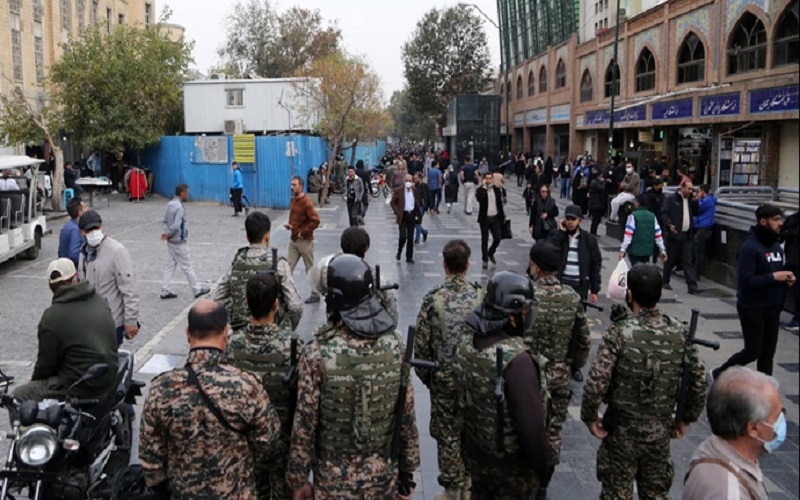

Despite claiming 90 million Iranians support the regime, reality and public dissent expose a decades-old propaganda machine that uses “the people” as a shield for repression and foreign adventurism.
In the aftermath of Iran’s recent military confrontation, one of the dominant narratives echoed by regime officials and media is that of “maximum popular support” for the Iranian regime in the face of external threats.
This line of messaging, long embedded in the regime’s propaganda playbook, was amplified again when parliamentary speaker Mohammad Bagher Ghalibaf declared, “The hard core of the regime is made up of 90 million Iranians.”
His quote was prominently featured in the July 14 editorial of Ham-Mihan, a pro-regime newspaper, and repeated the following day in support of President Masoud Pezeshkian against political rivals.
Before examining the contradictions revealed by regime-affiliated media itself, it’s essential to highlight a long-standing and cynical tactic in the Iranian regime’s political discourse: the systematic appropriation of the term “the people.”
For over four decades—from Khomeini to Khamenei—officials and loyalists have consistently used “the people” as a rhetorical shield for their unpopular domestic policies, international isolation, and military adventurism. Through state media, they claim:
- “Sanctions are against the people of Iran.”
- “The people support Iran’s nuclear program.”
- “Iranians demand punishment for enemies of the regime.”
- “There is a national consensus against improper hijab.”
- “The entire Iranian population stands with the Islamic Republic against foreign aggression.”
But the truth tells a very different story:
- Sanctions were imposed by Western nations in response to covert nuclear activities and ballistic missile development—not because of the Iranian people, whom the regime disingenuously uses as human shields in its rhetoric.
- The morality police, infamous for violent repression, are broadly despised by the majority of Iranians. Yet regime media portrays this repressive force as being backed by “the people.”
- Patriotism, love of the homeland, and defense against foreign invasion are real and widespread—but have nothing to do with loyalty to the current regime. The same people who would defend their land have chanted countless times in the streets: “Our enemy is right here, they lie when they say it’s America.”
- On religious manipulation and economic plunder, the public has shouted: “They chant for Imam Hussein, but their job is theft and corruption.”
- On foreign adventurism: Iranians have repeatedly rejected the regime’s imperialist strategies, with the famous slogan: “No to Gaza, No to Lebanon—My life only for Iran.”
- On environmental destruction and economic mismanagement: The regime has dried up rivers, ruined Lake Urmia, depleted groundwater, caused widespread land subsidence, and plunged millions into poverty—all for the sake of preserving its rule.
The people’s response to this has been: “We fight, we struggle—we will take Iran back.”
Even on the question of political alternatives, the regime continues to assert there is “no viable opposition,” especially targeting the People’s Mojahedin Organization of Iran (PMOI/MEK). But Maryam Rajavi, the president-elect of the National Council Resistance of Iran (NCRI), publicly challenged Khamenei: “If the regime is so confident about its popularity, it should allow peaceful demonstrations and free elections under United Nations supervision, so the people’s will can reign.”
The Iranian public has made it clear: they do not support foreign aggression or occupation, but neither do they accept the internal occupation of the Velayat-e Faqih regime. These dual positions reflect a national will—opposed both to war and to dictatorship. Crucially, many Iranians believe that the regime’s provocative policies invite foreign attacks.
Even regime-affiliated newspapers cannot deny the truth. In an article on July 15, Etemad newspaper admitted that Ghalibaf’s claim of “90 million supporters” was absurd, recalling that just one year ago, Pezeshkian was elected during a presidential race marked by historically low voter turnout, a fact that “sounded a serious alarm for the political system.”
The people have spoken—again and again—in the streets, at the ballot box through boycotts, and in their slogans. No amount of regime propaganda can mask the growing disconnect between rulers and ruled. The myth of a united 90-million-strong support base is not only false; it’s a last-ditch narrative for a regime facing deepening isolation—both at home and abroad.