



Why Europe’s long-overdue decision marks a strategic rupture for the Iranian regime—and exposes the bankruptcy of authoritarian alternatives disguised as “solutions”
For decades, the terrorist designation of Iran’s Islamic Revolutionary Guard Corps (IRGC) by the European Union remained stalled in endless debates, legal evasions, and the doctrine of “strategic patience.” Today, that delay has ended. The EU’s terror listing of the IRGC is not merely a symbolic gesture; it is a strategic blow to the core of Iran’s religious fascism and a decisive marker on the road to regime change.
The central question, however, is not what happened—but why now. Why did a decision postponed for nearly three decades finally materialize at this historical juncture? The answer lies not in diplomatic corridors, but in the blood spilled during Iran’s January 2026 uprising and in the accumulated force of a resistance that refused to disappear.
The Collapse of Europe’s Appeasement Paradigm
European policy toward Iran had long been trapped in a cycle of appeasement—balancing trade, nuclear negotiations, and vague hopes of “moderation.” Yet realities on the ground proved uncompromising. Thirty years of sustained resistance, coupled with the visible courage of a new generation confronting the regime in the streets, pushed the international conscience past the point of denial.
The terror listing of the IRGC is, in essence, the political crystallization of this shift. It reflects the moment when global actors could no longer reconcile dialogue with a regime whose primary instrument of governance is organized violence.
January 2026: When Blood Redefined the Global Narrative
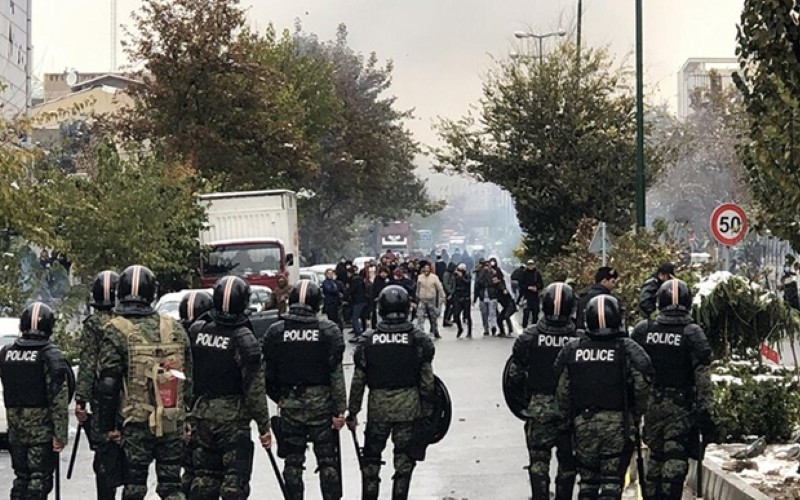
At a deeper level, this decision is inseparable from the January 2026 uprising. The regime’s violent response—executed primarily through the IRGC—exposed beyond doubt the function of this force as the backbone of repression, terror, and regional destabilization. The martyrs of that uprising shook the fragile architecture of Ali Khamenei’s rule and punctured the myth of regime stability.
What was once dismissed as “internal unrest” became internationally legible as a liberation struggle.
The Moral Vindication of Resistance
This shift also marks a long-overdue recognition of a struggle that endured years of isolation, defamation, and political marginalization. Today, the IRGC is formally acknowledged as a central organ of terror. By extension, the right of a subjugated people to defend themselves—including through organized resistance—has gained international legitimacy.
This is a victory of the logic of resistance over the logic of surrender.
The Exposure of Authoritarian Alternatives
One of the most revealing consequences of the IRGC’s terror listing is the exposure of political currents that sought to recycle repression under new branding. Figures like the son of the Iran’s deposed Shah, Reza Pahlavi, who portrayed revolutionary forces as “part of the problem” while framing the IRGC and Basij as “part of the solution” now face an undeniable contradiction.
Pahlavi and his political project that openly relied on security forces, Revolutionary Guards, and Basij militias—while marketing imaginary defections from within the IRGC—has been reduced to ashes. Once the IRGC is designated a terrorist organization, any attempt to present it as a democratic asset collapses under its own weight.
What, then, becomes of those alleged “50,000 defectors”? Can an internationally blacklisted terror apparatus still be marketed as a vehicle for democratic transition? The answer is self-evident.
A Strategic Blow to the Regime’s Core
The IRGC has always been the regime’s existential shield. The regime’s supreme leader Ali Khamenei himself has repeatedly admitted: without the IRGC, the system would not survive. That shield is now cracked. Internationally, the IRGC has become a pariah; domestically, it faces an eruptive society. This dual pressure accelerates internal fragmentation and makes defections not only possible, but inevitable.
Armed Resistance and International Legitimacy
The terror designation also settles a critical legal and moral question. When a regime’s primary instrument of rule is formally classified as terrorist, resistance against that instrument is no longer ambiguous—it constitutes legitimate self-defense. In this context, the role of organized resistance units and liberation forces gains unprecedented international clarity.
No Room for Recycled Tyranny
History is unforgiving toward opportunists and dictators alike. Iran is turning a page, and on that page there is no space for institutions of repression—whether under clerical rule or recycled in nostalgic uniforms. The EU’s terror listing of the IRGC is the sound of religious fascism’s bones cracking, echoing through Iran’s streets.
The path to freedom now runs through the fire of resistance units and the authority of an organized liberation force. With his principal power arm isolated and delegitimized, Khamenei would do well to prepare for the fate of his predecessor, the Shah. The Iranian people will accept nothing less than the complete dismantling of the repression apparatus and the establishment of a democratic republic.
Anything short of that is no longer politically viable—nor historically possible.