


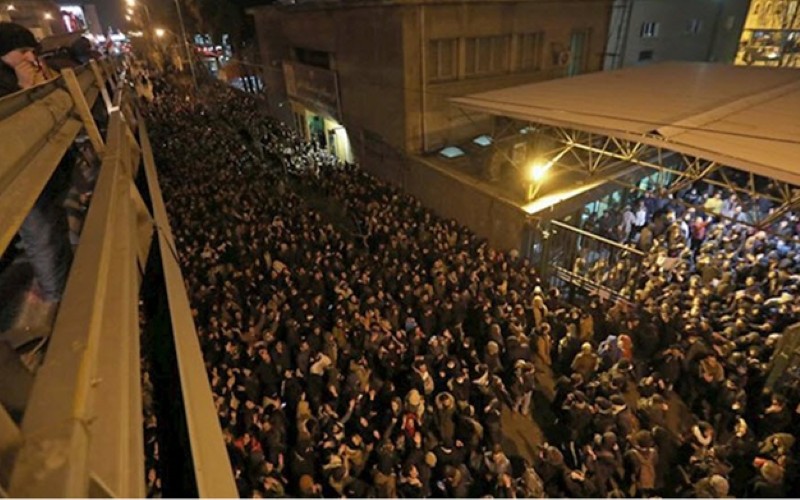

Beneath enforced silence and economic paralysis, a country waits for the next rupture
Anger in Iran is no longer latent; it is visible, shared, and generational. From young people to the elderly, the language of the streets has converged around a single demand: the overthrow of the ruling regime. This is not the rhetoric of fringe groups or isolated activists—it is the dominant mood of a society pushed beyond endurance.
Following a bloody nationwide uprising against a deeply corrupt power structure, Iran has entered a state of suspension. It is a society simultaneously mourning its dead, fearing for its prisoners, suffocating under runaway inflation, and witnessing the effective shutdown of its economy. This suspension is neither calm nor stability. It is a pause before the next eruption.
A “Silent Shutdown” of the Economy
Iran’s economy has entered what can only be described as a silent shutdown. The indicators are unambiguous. Point-to-point inflation in January 2026 reached 60 percent—an unprecedented level in at least fourteen years. Food inflation, especially in rural areas, has effectively dismantled food security. A 51 percent spike in cooking oil prices in a single month and inflation exceeding 80 percent for bread and grains are no longer abstract statistics; they are markers of livelihood collapse.
What deepens the crisis is the simultaneity of price explosions with the paralysis of financial mechanisms. Government bond auctions have failed outright. Even state-aligned banks have refused to participate. This is not a technical hiccup—it is a vote of no confidence from within the regime’s own financial pillars. A system that relies on debt to cover budget deficits, only to find no buyers for that debt, has entered a phase of irreversible erosion.
Governance by Closure, Not Crisis Management
Confronted with this convergence of crises, the regime’s response has not been governance but shutdown. Schools closed. Offices closed. Markets effectively frozen. Power appears incapable of decision-making, familiar with only one button: “close.” This is not precaution—it is desperation. A refusal to confront reality by erasing its visible symptoms.
Internet blackouts complete this paralysis. One of the last remaining lifelines of society—the digital economy—has been choked. This is not merely political repression; it is the direct destruction of growth capacity, employment, and trust. A system that must sever its society’s connection to the world in order to survive is implicitly admitting that its survival is incompatible with normal life.
The Bazaar Turns Away
Nowhere is this suspension more tangible than in Tehran’s Grand Bazaar. Shops remain open, but trade does not flow. Merchants unlock their doors not for profit, but for survival. Revenues that once covered millions of tomans daily now fail to pay rent. Distress sales, liquidation of gold, and the selling of personal goods signal the classic collapse of the middle class.
This is not merely an economic phenomenon—it is profoundly political. The bazaar, historically one of the regime’s pillars of stability, has joined the ranks of the disillusioned. When merchants say, “This no longer feels like a market,” they are rejecting the economic legitimacy of the ruling order. When shopkeepers, workers, couriers, and street vendors share a single feeling—waiting for “what comes next”—society has entered a pre-uprising phase.
Repression Deepens, Resistance Internalizes
Meanwhile, the human cost of repression has reached staggering proportions: thousands killed, tens of thousands detained, children among the dead, pressure on medical staff, forced confessions. These are not just numbers; they are the collective memory of a nation. Repression has not extinguished dissent—it has pushed it beneath the surface, where it grows more radical and more enduring.
The regime’s obsession with cutting internet access and controlling communication has only widened the chasm between state and society. For a generation whose lives and livelihoods are inseparable from connectivity, this is not a temporary measure—it is a declaration of war on their future. Discontent adapts, but it does not disappear. History has proven this repeatedly.
The Silence Before the Storm
Iran today stands at a point where neither a return to the past nor the continuation of the present is possible without escalating costs. A shuttered economy, a suspended market, a grieving and enraged society, and a ruling structure armed with nothing but repression—this combination leads not to stability, but to rupture.
Just as bread lines in the final years of the Soviet Union signaled the collapse of an entire order, today’s queues in Iran—queues for bread, justice, prison visits, and survival—mark the end of the legitimacy of a system built on absolute clerical rule. Society may appear momentarily silent, locked in waiting. But this is not resignation. It is the silence before the storm.
Uprising is no longer a distant possibility. It is the next stage of a historical deadlock that has exhausted all other paths.