


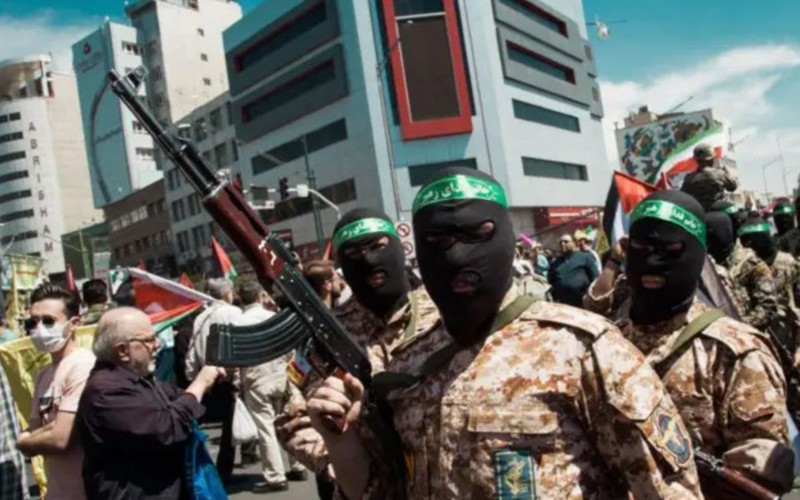

For the National Council of Resistance of Iran (NCRI) and its President-elect, Mrs. Maryam Rajavi, the push to designate the Islamic Revolutionary Guard Corps (IRGC) as a terrorist entity has never been a stand-alone demand. Across decades, the call is consistently framed as part of a wider policy: end impunity, cut off the regime’s repressive machinery, and ultimately dismantle the IRGC and related security organs that underpin domestic repression and external militancy.
1981 — “Dissolution” of the IRGC placed on the agenda
In a January 2023 address in Brussels, Mrs. Rajavi states that “the dissolution of this evil force” (the IRGC) was already among the “most urgent issues” the NCRI announced in its program in 1981. This is presented as the Resistance’s own longstanding position (a historical claim made in her speech).
2006 — The Ten-Point Plan links freedoms with dismantling the regime’s coercive organs
Rajavi has repeatedly described the Resistance’s Ten-Point Plan as a political roadmap first presented in 2006.
Crucially, the plan’s second point explicitly calls for the “dissolution and disbanding” of the IRGC and a wide set of coercive bodies, including the Qods Force, Basij, plainclothes groups, the Ministry of Intelligence, and “all suppressive patrols and institutions” across society.
This is the clearest, programmatic statement tying a future democratic order to the dismantling of the regime’s security architecture, not merely reforming it.
22 February 2010 — NCRI urges the EU Council to put the IRGC on the terrorist list
In an NCRI statement dated 22 February 2010, the Resistance urges EU foreign ministers to place the IRGC and its affiliated institutions/companies on the terrorist list (and to escalate pressure accordingly).
27 July 2019 — Rajavi calls for proscription “in its entirety” under UK terrorism law
At a London rally (reported by the NCRI site), Rajavi is quoted in a tweet calling for the IRGC and the regime to be “proscribed in their entirety” under the UK Terrorism Act—an unambiguous demand for terrorist designation/proscription.
12 April 2021 — “Designate the entire IRGC,” plus expulsions and legal action
After the EU imposed restrictive measures on certain security figures, Rajavi welcomed the step but reiterated the need to designate the entire IRGC (and the Intelligence Ministry), and called for prosecuting, expelling, and stripping status from regime operatives in Europe.
This is also one of the clearest examples where the designation demand is paired with operational dismantling measures: expulsions, prosecutions, and removal of networks tied to the IRGC/Qods Force.
December 2022 — Calls to place the IRGC and Intelligence Ministry on terrorist lists, close embassies, expel operatives
In a statement amid executions and repression, Rajavi calls for practical measures including shutting down regime embassies and placing the IRGC and MOIS on terrorist lists, alongside expelling their mercenaries.
19 January 2023 — “Disbanding and designating” the IRGC described as a prerequisite against terrorism
Rajavi issues a statement arguing that the “long overdue disbanding and designating of the IRGC” is an urgent demand and a prerequisite in confronting terrorism, explicitly linking designation with disbanding (not just sanctioning).
25 January 2023 — Brussels: reiteration of the 1981 claim + Ten-Point Plan + EU blacklisting demand
In her Brussels conference address, Rajavi:
- reiterates that the NCRI has “repeatedly emphasized” the need for terrorist designation,
- cites her earlier calls (including the claim about the NCRI’s 1981 program),
- links the demand directly to the Ten-Point Plan’s dissolution/disbanding provisions,
- and calls on the EU to blacklist the IRGC.
12 February 2023 — Reuters and VOA document Rajavi’s public call for EU designation
At a large rally near Paris, Reuters and Voice of America both quote Rajavi calling on the EU to designate the IRGC, including the line: “The IRGC must be added to the list of designated terrorist organisations by the European Union.”
These are among the strongest independent corroborations that her call for EU designation was made publicly and contemporaneously.
15 September 2023 — Brussels speech frames designation as part of a firm international policy
In a Brussels conference speech, Rajavi references international statements and initiatives emphasizing the need for designating the IRGC as a terrorist entity, alongside accountability for regime leaders.
22 November 2023 — Strasbourg: Rajavi urges action, including terrorist listing of IRGC
At a Strasbourg conference with lawmakers, Rajavi again calls for a firm policy and urges steps that include placing the IRGC on terrorist lists (framed as necessary to confront repression and terrorism).
24 September 2024 — UN-week rally message: accountability + terrorist listing demands
In a message to demonstrators protesting at the UN during the Iranian president’s presence, Rajavi pushes for international accountability mechanisms and policy action against regime crimes; the message sits in the same policy framework where she calls for concrete international measures against the regime’s coercive organs.
29 June 2025 — Strasbourg: NCRI event calls on the EU to designate the IRGC
An NCRI report on a Strasbourg gathering with MEPs and dignitaries describes policy recommendations including an urgent call for the EU to designate the IRGC as a terrorist organization, alongside broader pressure and accountability.
31 July 2025 — “From the outset”: designation paired with dismantlement
In a major political statement, Rajavi explicitly frames the approach as long-standing and structural: designation is presented alongside the need to dismantle the regime’s security and repressive forces, treating the IRGC as the spine of repression and regional destabilization.
25 September 2025 — German MPs conference: designation + dismantling the regime’s repressive apparatus
At an online conference with German MPs, Rajavi’s remarks again tie international pressure—including terrorist listing—to a policy of confronting and ultimately removing the regime’s coercive machinery.
25 November 2025 — Netherlands conference: call to place the IRGC on the terrorist list
Rajavi calls on Dutch parliamentarians to press their government to place the IRGC on the terrorist list, linking it to a wider policy shift on executions and repression.
10 December 2025 — European Parliament (Human Rights Day): explicit listing demand
In a Human Rights Day speech at the European Parliament, Rajavi lists concrete steps and explicitly includes: “place the IRGC and the regime’s Ministry of Intelligence on the terrorist list.”
The throughline: designation as a tool—dismantlement as the end state
Across this record, the NCRI/Rajavi position is consistent in structure:
- Name the IRGC as the core instrument of repression and external violence (not a normal military body).
- Demand terrorist designation/blacklisting as an immediate policy step (especially from European institutions and states).
- Pair designation with operational rollback: expulsion of operatives, closure of enabling infrastructure, prosecutions, and—programmatically—dissolution/disbanding of the IRGC, Basij, Qods Force, and other suppressive bodies.