


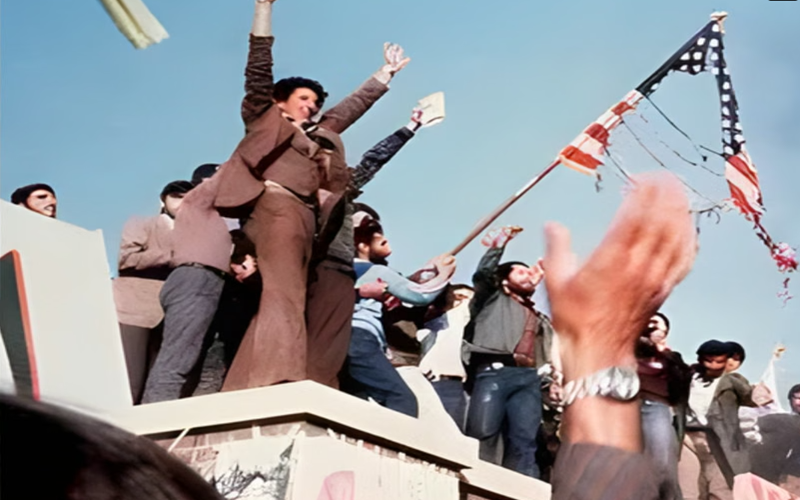

Confessions by former IRGC commanders and a senior judicial official expose how Khomeini’s regime orchestrated the hostage crisis and exploited it to eliminate democratic opposition, particularly the MEK.
The 1979 takeover of the US Embassy in Tehran was not simply a spontaneous protest by radical students, as the regime has long attempted to portray it. Statements by former Islamic Revolutionary Guard Corps (IRGC) commanders, together with admissions by senior officials of Khomeini’s government, reveal the extent of prior planning, the IRGC’s direct involvement, and the political objectives behind the operation.
More than four decades later, these accounts shed light on how Khomeini exploited the hostage crisis to consolidate his power, dismantle the provisional government, marginalize political rivals, and suppress democratic forces, particularly the People’s Mojahedin Organization of Iran (PMOI/MEK).
Former IRGC commander reveals advance planning of the embassy takeover
On November 4, 2018, then-IRGC commander Mohammad Ali Jafari described the preparations for the November 4, 1979, takeover of the US Embassy in Tehran. His remarks contradicted the official narrative that the occupation had emerged spontaneously from a student demonstration.
Jafari explained that the operation had been planned under strict secrecy. A limited number of students and university officials had been informed that the demonstration would culminate in an attack on the US Embassy.
According to his account, organizers deliberately created an atmosphere in which the takeover would appear to be a spontaneous decision by the demonstrators. Once the crowd reached the area in front of the university, slogans and coordinated actions were used to generate the impression that the decision to occupy the embassy had emerged naturally from within the gathering.
Jafari also acknowledged the political importance Khomeini’s regime attached to the operation. He argued that without the embassy takeover, the revolution might not have survived its first decade, let alone reached its fortieth anniversary.
Khomeini himself had described the hostage-taking as a revolution greater than the 1979 anti-monarchical revolution that toppled the Shah. This characterization reflected the operation’s importance in transforming the balance of power inside Iran.
How the hostage crisis was used to eliminate democratic opposition
From the beginning, the PMOI/MEK warned that the embassy hostage crisis was being exploited as a political instrument to establish a monopoly of power and eliminate democratic forces.
In its contemporary publications, the organization argued that the hostages had become a pretext for the ruling faction to seize key positions in the state and push political rivals out of the political arena.
The MEK pointed out that the ruling faction’s increasingly extreme slogans, including demands for the prosecution and execution of the hostages, served domestic political purposes rather than any constructive foreign-policy objective. Maintaining the crisis over an extended period provided the authorities with an instrument to discredit opponents and consolidate their control.
The political consequences were later acknowledged by senior figures within the regime itself.
On November 4, 1985, during a broadcast marking the anniversary of the embassy takeover, then-chief judicial authority Mousavi Ardabili openly described its domestic political impact. He said the operation had led to the fall of the provisional government, the political isolation of liberals, and the confusion and marginalization of leftist groups and the MEK.
He also repeated Khomeini’s characterization of the takeover as a revolution greater than the first revolution.
These remarks amount to an acknowledgment that the hostage crisis was instrumental in eliminating political competitors and reshaping the country’s political structure in favor of Khomeini’s faction.
Historical accounts document the targeting of the MEK
Historian Ervand Abrahamian, in The Iranian Mojahedin (pages 208–209), also documented the MEK’s criticism of the hostage crisis and its use to impose Khomeini’s doctrine of Velayat-e Faqih (absolute clerical rule).
According to Abrahamian, the MEK published accounts examining the connections between the hostage-taking students and the Islamic Republican Party, the assistance provided by Revolutionary Guards to those entering the embassy, and the removal of individuals who opposed the party’s political line.
The organization also highlighted how Mohammad Beheshti exploited the crisis to undermine Prime Minister Mehdi Bazargan and how cleric Mohammad Mousavi Khoeiniha, appointed by Khomeini as an adviser to the students, supervised the removal of documents concerning meetings between Iranian clerics and American officials during the revolution.
These accounts reinforced the MEK’s central argument: the hostage crisis was not merely an international confrontation but also a domestic instrument for eliminating political pluralism and imposing clerical authoritarianism.
Former IRGC logistics chief confirms direct assistance to hostage-takers
Another revealing account came on August 16, 2023, when former IRGC logistics chief Mohsen Rafiqdoust described his own involvement in preparing for the embassy takeover.
Rafiqdoust acknowledged that he had been informed of the operation in advance and that, in his capacity as the IRGC’s logistics official, he provided the students with equipment and other necessary resources.
He explained that he had attended a briefing alongside Mohsen Rezaei, who was then involved in the IRGC’s intelligence apparatus, and several individuals associated with the student group. During that meeting, participants were told that the US Embassy would be seized two days later and that the IRGC should assist the operation.
Rafiqdoust said:
“I was informed before the takeover of the US Embassy. As the IRGC’s logistics official, I helped the students with their operation and provided them with the necessary equipment.”
He added that he had been specifically instructed during the briefing to assist the students.
Rafiqdoust was careful to say that he did not know whether Khomeini had been informed beforehand. However, he acknowledged that Khomeini immediately recognized the political opportunity presented by the takeover and made effective use of it.
He also recalled that Khomeini subsequently sent a message instructing those occupying the embassy to hold on to it firmly. Rafiqdoust said he had heard this message attributed directly to Khomeini.
His account further acknowledged that some of the students involved later regretted their participation, including Abbas Abdi.
A calculated operation to consolidate clerical rule
The accounts of Jafari, Rafiqdoust, and Mousavi Ardabili expose different dimensions of the November 4, 1979, embassy takeover: advance planning, logistical support from the IRGC, and the deliberate exploitation of the resulting crisis to restructure political power.
The operation provided Khomeini with an opportunity to eliminate the provisional government, marginalize political rivals, and intensify the suppression of democratic forces. The MEK, which had warned from the outset about the hostage crisis’s domestic political purpose, became one of its principal targets.
The 444-day hostage crisis therefore cannot be understood solely as a confrontation between Tehran and Washington. The regime’s own former commanders and officials have acknowledged how it became a powerful instrument for consolidating authoritarian rule inside Iran.
The historical record also underscores a central point: the hostage-taking was not simply an anti-American gesture. It helped Khomeini’s regime eliminate political pluralism and establish the foundations of its clerical dictatorship.