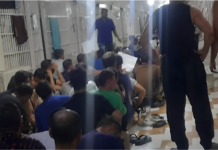
Around 1,500 death row prisoners continue their mass hunger strike, demanding an end to executions as reports warn of worsening medical conditions and continued official inaction.
The mass hunger strike by approximately 1,500 death row prisoners in Iran’s Qezel Hesar Prison has entered its twelfth consecutive day, with growing concerns over the prisoners’ deteriorating health and continued refusal by prison authorities to address their demands.
According to reports received from inside the prison, the protest began in response to the Iranian regime’s accelerating use of the death penalty and the continued transfer of prisoners for execution. The striking inmates are demanding an immediate halt to executions, respect for the fundamental right to life, and a fair review of their cases.
🆘🆘URGENT: Day 12 of the hunger strike at Ghezel Hesar prison, Iran.
1,500 death-row prisoners are being denied medical care. Several are now in critical condition.
International bodies and every relevant institution must act before it is too late.
Stand with them.… pic.twitter.com/XxcHXoT1FY
— Shabnam Madadzadeh (@ShMadadzadeh) July 24, 2026
New Video Shows Prisoners Defying Pressure
A newly released video from Unit 2 of Qezel Hesar Prison shows a group of prisoners gathered in a prison corridor holding handwritten signs reading “No to Executions.” The footage demonstrates that, despite nearly two weeks without food, many participants remain committed to continuing their protest until their demands are met.
The hunger strike, which began in Unit 2 and has involved around 1,500 prisoners sentenced to death, has become one of the largest coordinated prison protests against executions in recent years.
The prisoners have declared that they will continue their hunger strike until the regime suspends executions and responds to their demands.
Prisoners’ Physical Condition Rapidly Worsens
As the strike enters its twelfth day, reports indicate that the health of many participants has significantly deteriorated.
Sources inside the prison say prolonged fasting has caused severe weakness, dangerously low blood pressure, rapid weight loss, exhaustion, and physical collapse among numerous prisoners. Several participants are reportedly no longer able to move without assistance after nearly two weeks without food.
One prisoner described the situation inside the prison, saying that many participants are suffering from extreme physical weakness after twelve days on hunger strike, yet no meaningful medical intervention has been provided.
According to the reports, prison authorities and medical staff have failed to carry out effective medical examinations or dispatch treatment teams despite the worsening condition of the prisoners.
Growing Concerns Over Official Inaction
Prisoners say that despite the increasingly critical health situation, officials have taken no meaningful steps either to provide medical care or to respond to the protesters’ demands.
They warn that continued neglect could lead to irreversible consequences as more prisoners become physically incapable of enduring the prolonged strike.
Human rights sources have also expressed increasing concern over the situation, warning that the lack of medical attention places the lives of many participants at serious risk.
Protest Against Iran’s Escalating Executions
According to the prisoners, the hunger strike was launched in response to the Iranian regime’s continued executions and the transfer of several inmates to solitary confinement in preparation for carrying out death sentences.
During the early days of the protest, images circulated showing several prisoners who had sewn their lips shut as an act of protest against the regime’s execution policy—images that drew widespread attention on social media and among human rights advocates.
Reports also indicate that communication restrictions inside Qezel Hesar Prison have intensified, making it increasingly difficult for information to leave the facility.
Despite these obstacles, the prisoners continue to insist that their protest seeks an end to executions, protection of the fundamental right to life, and fair judicial proceedings for those facing capital punishment.
As the hunger strike continues into its second week, families of the prisoners and human rights activists are urging immediate intervention, warning that continued official indifference could have fatal consequences for many of the striking inmates.