


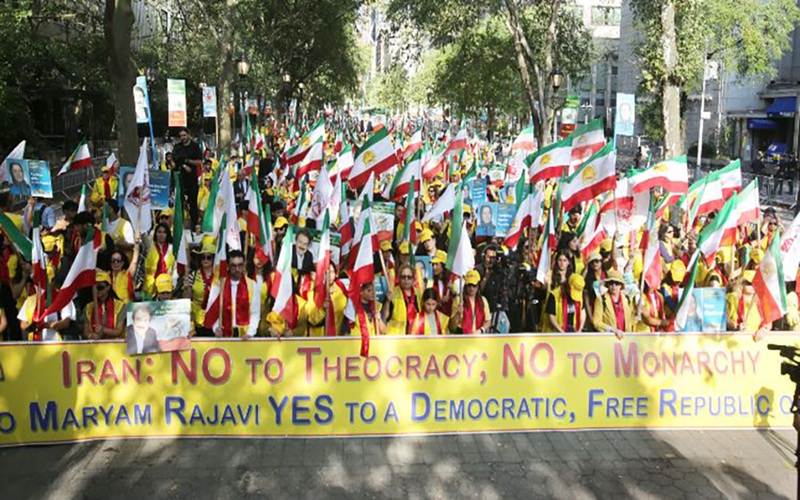

As the Iranian regime prepares to appear at the UN General Assembly, opponents will gather in New York to challenge its claim to speak for the Iranian people and highlight the country’s organized democratic resistance.
As representatives of Iran’s regime prepare to take their place at the United Nations General Assembly in New York on September 22 and 23, Iranian opponents are preparing to gather outside the UN headquarters with a fundamentally different message: the regime does not represent the Iranian people.
The annual demonstration in New York has become a recurring point of confrontation between the regime’s diplomatic presence and Iranian dissidents seeking to bring the voices of those inside Iran to the international community.
This year, the demonstration carries particular significance. The organizers are not simply protesting the presence of a government delegation. They are challenging the idea that a regime responsible for decades of executions, imprisonment, repression, and violence can present itself at the United Nations as the legitimate voice of Iran.
Who Speaks for Iran?
For decades, the Iranian regime has used international forums to portray itself as the representative of the Iranian people while suppressing dissent at home.
Its critics argue that this creates a fundamental contradiction: while regime officials appear before international institutions claiming to defend Iran’s interests, political prisoners remain behind bars, executions continue, families of victims demand justice, and citizens face repression for challenging government policies.
The New York demonstration is intended to bring that contradiction into view.
The message from Iranian opponents is that the people whose voices cannot reach the UN themselves must not disappear from the international discussion about Iran. Political prisoners who issue statements from inside prisons, families who continue campaigning despite pressure, young people who risk arrest by protesting, and Resistance Units operating inside Iran are presented as part of the reality that the regime’s official delegation cannot speak for.
The demonstration therefore seeks to make a simple political point: when the Iranian regime speaks at the UN, the Iranian people should not be assumed to be speaking through it.
Bringing the Voice of Iran’s Resistance to the UN
Iranian dissidents in the United States argue that the demonstration provides an opportunity to amplify voices that cannot physically stand before the UN.
That includes prisoners who have continued protesting from inside Iranian prisons, including through hunger strikes and public statements, as well as families of those killed or imprisoned by the regime.
The organizers also point to the activities of the Resistance Units inside Iran, portraying them as evidence that opposition to the regime has not disappeared despite years of repression.
This is central to the political significance attached to the New York gathering. Rather than presenting opposition to the regime as a phenomenon confined to the Iranian diaspora, the demonstration seeks to connect those abroad with the continuing resistance inside Iran.
Its organizers are also demanding that the international community recognize the Iranian people’s right to resist repression and support a democratic alternative to the current regime.
A Protest With a Long History
The New York demonstration is not a new response to the current political situation.
According to accounts from participants who have been involved in the Iranian opposition community in the United States, similar demonstrations have taken place for many years alongside the annual UN General Assembly.
The themes have changed according to the circumstances facing Iran.
In one year, the focus may have been executions. In another, massacres, terrorism, political prisoners, or the regime’s regional activities. Yet the underlying message has remained consistent: the international community should not treat the Iranian regime’s presence at the UN as equivalent to the voice of the Iranian people.
That continuity is itself significant.
Iran has witnessed successive waves of protest and repression, while different governments and presidents have come and gone. Yet the organized opposition outside the country has continued to return to the same international stage to challenge the regime’s narrative.
For Iranian dissidents, the persistence of these demonstrations reflects the persistence of the underlying conflict inside Iran.
From the 1981 Resistance to Today
The political movement represented at the New York demonstration also places today’s confrontation within a much longer history.
The organized resistance traces its current struggle against the clerical dictatorship to June 20, 1981, when the conflict between the opposition and the emerging theocratic state entered a decisive phase.
Since then, the regime has sought to eliminate organized opposition through arrests, executions, imprisonment, and other forms of repression.
Yet the opposition argues that the objective of the resistance has remained unchanged: establishing a free and democratic Iran.
This historical continuity is important because it places today’s international demonstrations within a broader political struggle rather than treating them as isolated diaspora protests.
The message is also explicitly framed around rejecting both forms of dictatorship represented by Iran’s modern political history. The opposition’s slogan, “No to Shah, No to Mullahs,” rejects a return to the former monarchy as well as continuation of the current theocratic system.
The proposed alternative is a democratic republic.
Challenging the Regime’s International Legitimacy
One of the most explicit demands associated with the New York demonstration is the removal of the Iranian regime from the United Nations and the temporary transfer of Iran’s voting rights to the National Council of Resistance of Iran (NCRI), described by its supporters as the country’s democratic alternative.
The demand reflects a broader argument: international institutions should distinguish between the people of Iran and the government that claims to represent them.
Iranian opposition activists point to the repeated condemnation of the regime by UN bodies as evidence, in their view, of the contradiction between its international status and its domestic record.
Their presence outside the UN is intended to ensure that the regime’s delegation does not have the international stage entirely to itself.
The Other Iran
The central message of the September demonstrations can ultimately be reduced to a question of representation.
There is the Iran presented by the regime’s diplomats: a state speaking in the name of its people and claiming to defend national interests.
And there is the Iran represented by those who continue to oppose executions, political repression, forced conformity, and dictatorship; by prisoners who continue their resistance behind bars; by families who refuse to remain silent; and by activists who continue their activities despite the risks.
The New York demonstration seeks to ensure that the second Iran is heard.
As the regime’s delegation enters the United Nations, Iranian dissidents will once again gather outside its doors to argue that the people of Iran should not be represented solely by those who rule over them.
For the demonstrators, this is not merely a protest against one speech or one annual diplomatic appearance. It is a declaration that the struggle over who speaks for Iran remains unresolved—and that the demand for a free, democratic republic continues to have an organized voice both inside and outside the country.