


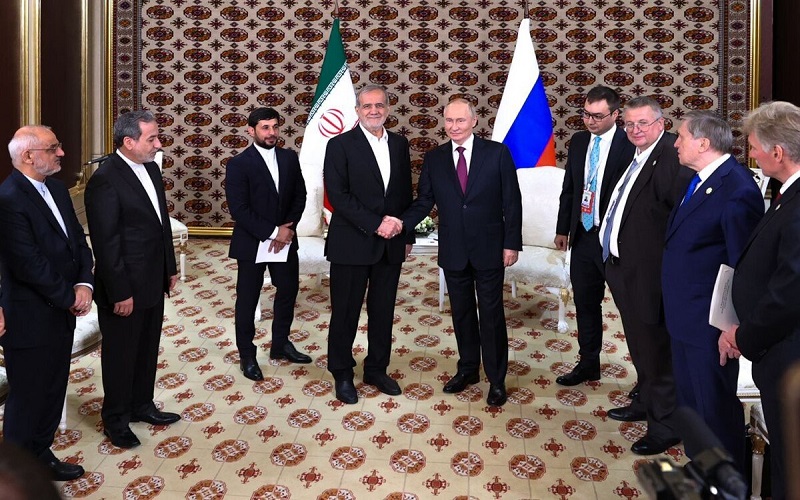

In a strategic maneuver to bypass international sanctions, Iran’s regime and Russia have reportedly linked their respective national bank card systems, Shetab and Mir, as announced by Iran’s state-run Islamic Republic of Iran News Network (IRINN) on Monday. This development is intended to allow Iranians to use their bank cards in Russia and permit Russian nationals to access financial services in Iran.
While an official start date for this initiative has not been provided, the collaboration marks a significant step in Iran’s efforts to insulate its economy from Western financial pressures.
Iran’s banking sector has been crippled since 2018, when the United States, under then-President Donald Trump, pushed for Iran’s exclusion from the global financial messaging system SWIFT.
This isolation severely restricted Iran’s ability to conduct international transactions, as SWIFT is the primary channel for global banking. With these restrictions in place, Iran has struggled to participate in global markets and finance its activities abroad.
In the years since, Tehran has sought to establish alternative financial pathways, particularly with Russia, which has faced similar isolation following its 2022 invasion of Ukraine. This alignment has motivated both countries to deepen their economic ties, with Iranian officials viewing this integration with Russia’s Mir network as an essential tool to circumvent sanctions.
Expanding Financial Ties with Regional Allies
The linking of Iran’s Shetab with Russia’s Mir network is just the beginning of Tehran’s broader vision for circumventing sanctions.
According to IRINN, the regime is actively working to expand its financial connections to other nations in the region, including Iraq, Afghanistan, and Turkey. This expansion aligns with Iran’s strategy to enhance its influence in neighboring countries, aiming to create a resilient network that supports both trade and finance despite Western restrictions.
By expanding these networks, Iran’s regime is attempting to stabilize its economy and demonstrate independence from Western-dominated financial systems. Tehran’s goal is to build a network of financial allies that can collectively withstand international sanctions, thereby reducing Iran’s reliance on global institutions.
Deepening Military Ties with Russia
In addition to economic cooperation, Iran’s regime has strengthened its military relationship with Russia, a development that has drawn increasing concern from the United States and its allies.
Although Russia is considered a military power, it reportedly lags behind Western nations in certain technologies, particularly drones, which Iran has supplied for use in the ongoing conflict in Ukraine. Tehran’s willingness to support Russia militarily marks a notable shift in its foreign policy, aligning itself more openly with Moscow.
The U.S. has repeatedly raised concerns about this evolving partnership. In December 2022, U.S. National Security Council Spokesman John Kirby warned that the military collaboration between Russia and Iran represented “an unprecedented level of military and technical support,” adding that it posed a direct threat to regional stability in the Middle East. Kirby cited intelligence indicating that Russia and Iran’s military cooperation could soon extend into areas like weapons development and even air defense.
Further intensifying their collaboration, Iran and Russia agreed in early 2023 to construct a drone manufacturing facility within Russian territory, a project aimed at enhancing Moscow’s drone production and battlefield capabilities.
Potential Ballistic Missile Transfers Escalate Tensions
The alliance between Iran’s regime and Russia has become a focal point of U.S. security concerns, particularly with the recent revelation that Iran might provide ballistic missiles to Russia. In September 2024, the Biden administration raised alarm over reports suggesting that Tehran intends to supply Moscow with these missiles, which could signify a substantial escalation in Iran’s support for Russia’s war in Ukraine.
Sean Savett, a U.S. National Security Council spokesman, stated, “Any transfer of Iranian ballistic missiles to Russia would represent a dramatic escalation,” describing it as a critical threat to both European security and the broader geopolitical landscape.
“This partnership threatens European security and illustrates how Iran’s destabilizing influence reaches beyond the Middle East and around the world,” Savett added. The expanding military cooperation between the Iranian regime and Russia demonstrates Tehran’s readiness to bolster Moscow’s military capabilities, even as it risks further isolation from the West.
Broader Implications of Iran-Russia Collaboration
Iran’s regime has long sought to counterbalance Western pressure by forging alliances with countries similarly isolated by international sanctions. This partnership with Russia exemplifies Tehran’s strategy to create new financial and military networks that reduce its dependency on Western systems and bolster its influence in both the Middle East and Eurasia.
As Tehran solidifies its ties with Moscow, the regime’s broader ambitions and defiance of Western sanctions are increasingly evident. This collaboration has significant implications for global security, financial systems, and the geopolitical landscape, as Iran and Russia continue to challenge the status quo.
With ongoing sanctions, Tehran’s actions underscore its commitment to finding ways around these restrictions, fostering a resilient alliance that could have wide-reaching consequences in the years ahead.