


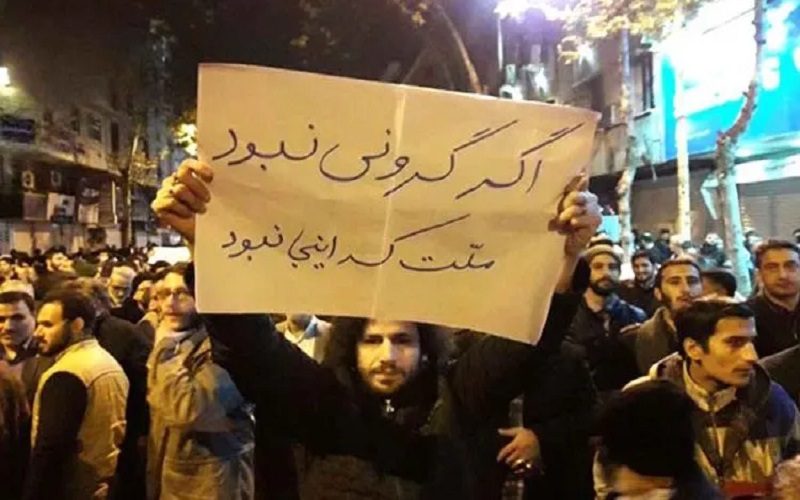

A revolution driven by the desperation of Iran’s starving population has become a nightmare for the regime, with growing public dissatisfaction and skyrocketing prices posing an existential threat. Regime officials and state-controlled media now openly acknowledge the crisis, underscoring the regime’s precarious position.
Khamenei’s Struggle Against Mounting Crises
Supreme Leader Ali Khamenei faces an array of challenges, from economic deterioration to regional failures, leaving the regime trapped between crises. State-run media have likened the situation to a dying entity gasping for its last breaths.
On November 26, the state-run daily Jomhouri Eslami published a stark warning under the title “Be Afraid of the Revolution of the Starving Army.” Highlighting the widening class gap and intensifying economic crisis, the article stated:
“The poor are getting poorer, and the rich are getting richer, with unprecedented aristocracy taking over society. This aristocracy will have dangerous social consequences for a population unable to secure their livelihood.”
The article ominously warned:
“The smallest consequence of such a situation is the accumulation of suppressed grievances among the poor, which will one day erupt like a volcano. The hungry army will rise against the perpetrators of this injustice. Aren’t you afraid of this revolution?”
Protests and Strikes: The Rise of Popular Dissatisfaction
Iran’s economic collapse has triggered widespread protests across various sectors. Strikes by oil, gas, and petrochemical workers, alongside ongoing demonstrations by retired teachers and other retirees, reflect growing frustration. Their demands include unpaid retirement bonuses and a minimum salary of 30 million tomans to counter inflation. Nurses, too, have joined the protests, demanding better wages and working conditions.
The Etemad newspaper described the situation as being “on the brink of the abyss,” stating:
“Different forms of dissatisfaction are becoming more visible every day. When the president speaks from the edge of the abyss, every Iranian has the right to be afraid.”
Similarly, the state-run ILNA news agency criticized the government’s economic policies, labeling the surge in prices a “price liberalization bomb.” It wrote:
“Electricity and energy bills, meat, eggs, and even the dollar and housing have become more expensive at an unprecedented rate. The government, which sees itself on the edge of the abyss, appears to have no solution but to intensify pressure on people’s livelihoods.”
Clerics Raise Alarm Over Economic Instability
Prominent regime clerics have also voiced their concerns. Ahmad Khatami, speaking during Tehran’s Friday Prayer, warned:
“High prices threaten the existence of the system. This system must persist, and high prices will deal it a severe blow.”
Ahmad Alamolhoda, a hardline cleric in Mashhad, echoed this fear, describing the situation as “irrational high prices” and cautioning that it might be a “conspiracy to exhaust people.”
Even Khamenei himself acknowledged the mounting unrest, urging the “strengthening of the Basij” militia to suppress public dissent—a sign that the regime’s fears of popular dissatisfaction are at their peak.
Economic Collapse: A Self-Made Crisis
In a bid to stave off complete economic collapse, the regime has retreated from some foreign ambitions, hoping to alleviate sanctions. However, limited progress in this area has deepened domestic problems. The national currency’s sharp decline and depleted government funds have exacerbated the crisis.
The Speaker of Parliament, Mohammad Bagher Ghalibaf, admitted that the state of the country’s administration is critical, pointing to failures across multiple sectors. Similarly, Mahmoud Najafi Arab, head of Tehran’s Chamber of Commerce, revealed that:
“Over the past decade, an average of 27,000 Iranians have emigrated annually to Europe, the United States, and Canada.”
A Volatile Future
The regime’s inability to address these crises—economic stagnation, public dissent, and international isolation—has left it teetering on the brink. As dissatisfaction grows and protests escalate, the question remains: how much longer can the regime suppress the voice of its people?
This volatile mix of economic collapse, political desperation, and public anger paints a grim picture for the future of Iran under its current leadership. Whether the “revolution of the starving” materializes or not, the regime’s survival hangs by a thread.