
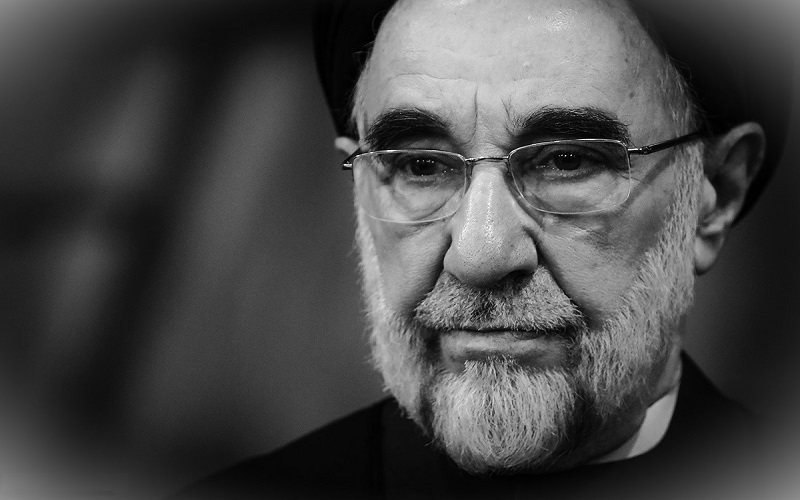

Recent revelations about backdoor efforts by Iran’s so-called reformists to safeguard the Velayat-e-Faqih system have once again exposed the deceptive and corrupt nature of this political faction. One of the most significant disclosures comes from the state-run website “Alef,” affiliated with Ahmad Tavakoli, which published a confidential letter from former Iranian regime president Mohammad Khatami to the U.S. government in early 2003.
Khatami’s Secret Offer to Washington
Sent amid the U.S. invasion of Iraq, Khatami’s letter outlined his willingness to fulfill all of Washington’s demands. These included halting support for the so-called resistance axis and ensuring transparency regarding Iran’s nuclear program. In return, Khatami sought the lifting of U.S. sanctions and an end to American efforts to overthrow the Iranian regime, particularly its support for the People’s Mojahedin Organization of Iran (PMOI/MEK).
The Real Threat to the Regime
This raises a crucial question: Why was the regime so eager to appease the United States at that moment? What existential threat compelled such a significant proposal?
The answer lies in the clerical regime’s true adversary. Contrary to its official rhetoric, Iran’s primary enemy is neither the U.S. nor Europe, but rather the PMOI. Since the 1979 revolution, the PMOI has been at the forefront of the opposition against the emerging religious dictatorship, firmly positioning itself as the nucleus of an organized resistance and democratic alternative advocating for the regime’s overthrow.
A Common Enemy Across All Factions
Every faction within the regime, including both principlists and so-called reformists, identifies the PMOI as their greatest threat. In the regime’s political lexicon, the distinction between “insiders” and “outsiders” is defined by their stance on the PMOI. Those who criticize the government—no matter how harshly—are still considered insiders, as long as they maintain the PMOI and the idea of regime overthrow as their red line.
Even the regime’s covert agents abroad may criticize Supreme Leader Ali Khamenei, but any mention of PMOI activities remains strictly prohibited. This is because, for the ruling clerics, the PMOI is synonymous with the existential threat of regime change. All factions within the regime consistently label the PMOI and its supporters as “hypocrites,” “enemies,” and “rebels,” demonstrating their unified stance against the opposition.
A History of Suppression and Massacres
This hostility is most evident in the regime’s treatment of political prisoners. The 1988 massacre of thousands of political prisoners is a prime example: their only “crime” was identifying themselves as PMOI members or supporters. These individuals were sentenced to death in sham trials lasting only minutes, with no due process. On this issue, reformists and principlists have always been in complete agreement.
International Efforts to Undermine the PMOI
Beyond domestic suppression, the regime’s efforts to demonize the PMOI extend to the international stage. Through state-controlled media and lobbying networks abroad, Tehran seeks to depict the PMOI as an isolated and widely despised organization with no real support. This narrative is not only promoted within Iran but also actively pushed in negotiations with Western governments, where Iranian officials routinely demand restrictions on PMOI activities as a precondition for dialogue.
The Significance of Khatami’s Letter
The revelation of Khatami’s secret letter to the U.S. underscores a crucial reality: Iran’s so-called reformists are no different from the hardliners when it comes to preserving the Velayat-e-Faqih system. They are equally willing to make extensive concessions to protect the ruling theocracy. At the same time, this disclosure reinforces the notion that the regime’s principal enemy is not the U.S. or Europe, but rather a relentless force actively working to dismantle it—the PMOI.
Even in its most sensitive negotiations, the regime has demonstrated its readiness to compromise on major geopolitical issues, yet it remains unwavering in its suppression and demonization of the PMOI. This persistent hostility reveals the clerical leadership’s profound and enduring fear of the organization that continues to challenge its rule.