


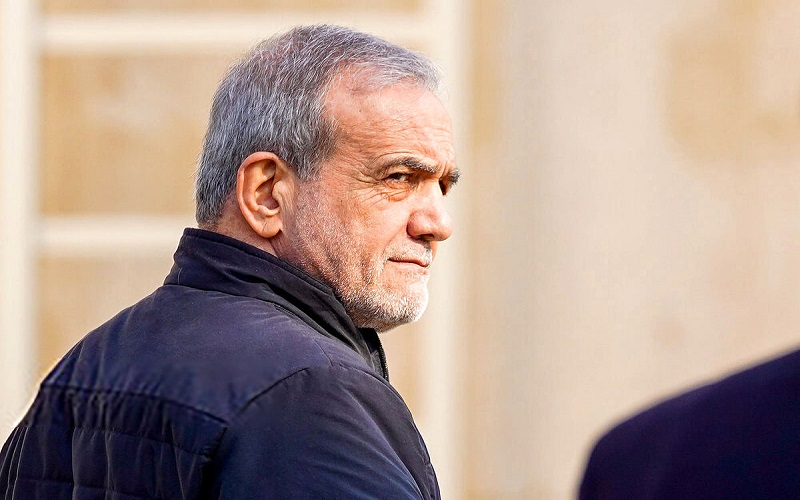

Masoud Pezeshkian, the president of Iran’s regime, recently delivered remarks that, on the surface, seem to advocate for dialogue and unity. However, rather than demonstrating strength or cohesion, his statements expose the regime’s deep internal fractures and growing instability.
Instead of fostering engagement, Pezeshkian’s words reveal the disintegration of a dictatorship in its final phase—a stage where regimes collapse under mounting pressure from both within and without. His comments, aired on the state-run Khabar TV channel on March 17, 2025, provide a glimpse into the growing fractures within the regime.
A Regime in Crisis
In his speech, Pezeshkian decried the absence of a culture of genuine dialogue, the prevalence of irrational criticism, and the tendency to engage in disputes rather than constructive discussion. He stated, “We have not learned to sit down and listen to each other… This is how we criticize each other, and we curse each other.” Though seemingly directed at the entire system, these words reflect the regime’s internal turmoil. In authoritarian states—especially those nearing collapse—ideological cohesion erodes, and internal divisions become irreparable.
Rather than working together, regime factions and officials engage in relentless disputes, undermining one another. Pezeshkian’s plea for unity inadvertently exposes the deepening rifts among the ruling elite. These disputes are no longer grounded in political or ideological differences but in outright hostility and denial—hallmarks of a failing dictatorship.
A Desperate Attempt to Appear Reasonable
Pezeshkian’s statement, “If something is right, we should accept it; if it is wrong, we should reject it—but we must not turn disagreements into conflicts.” is an effort to project an image of rational leadership. However, this attempt rings hollow given the regime’s history of repression, censorship, and coercion.
Dictatorships nearing their end often resort to such tactics, pretending to engage in dialogue while continuing their authoritarian rule. Yet, these efforts fail to convince the public. The Iranian people, having endured years of suppression, no longer believe such empty gestures.
His remarks not only expose the regime’s failure to persuade the public but also highlight its inability to maintain internal unity. This growing discord among regime officials highlights a deeper crisis—one that even those in power can no longer ignore.
Admission of Failure
Pezeshkian further acknowledged the regime’s failures by stating, “The whole point of the argument is to implement justice in our country, but we are lagging behind in that.” This is an explicit admission that the regime has failed to uphold one of its core promises—justice.
For a government that has long justified its rule through claims of social and economic justice, this statement underscores its inability to deliver on its own declared objectives. Whether intentional or not, this admission reveals a profound crisis in the regime’s effectiveness and self-confidence.
As authoritarian regimes near their end, they face a paradox: they cannot conceal their failures, yet admitting them only hastens their downfall. For a long-oppressed population, such confessions confirm the regime’s eroding credibility.
The Breakdown of Trust
In the closing segment of his speech, Pezeshkian accused certain regime officials of hypocrisy, stating they should abandon their false pretenses, as there is no real difference among them. While delivered in a seemingly lighthearted manner, his remarks expose the moral and social decay among the ruling elite.
This attempt at humor reveals a more serious reality: the collapse of trust and internal solidarity within the regime. Such fractures often hasten the downfall of authoritarian systems, as internal conflicts escalate beyond control.
A Cry from Within a Dying Regime
Pezeshkian’s words are not mere rhetorical missteps; they are a desperate cry from within a regime on the verge of collapse. History has shown that dictatorships in their final phase follow a predictable pattern: internal cohesion disintegrates, legitimacy evaporates, inefficiency becomes undeniable, and maintaining appearances replaces genuine crisis management.
The Iranian regime is no exception. Pezeshkian’s statements, rather than projecting strength or reform, inadvertently confirm what many already suspect—the system is failing, and its downfall is only a matter of time.