


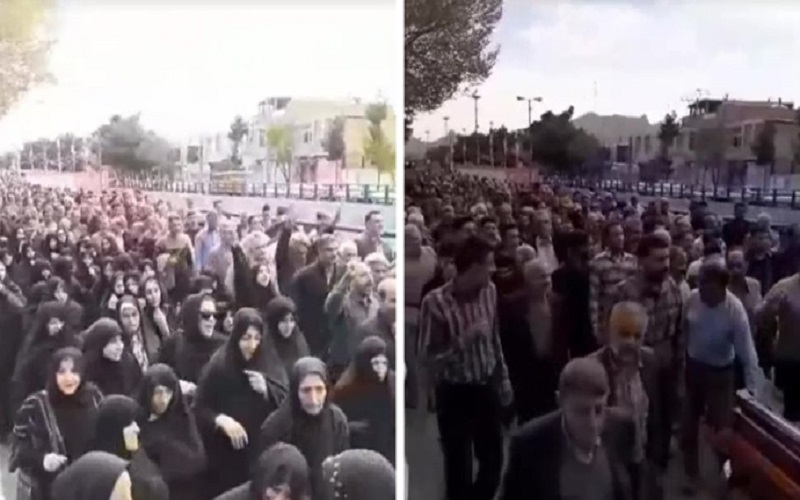

Farmers in Isfahan have launched a fresh wave of protests, reigniting their long-standing struggle over water rights from the Zayandeh Rud River. On Friday, April 4, large groups of farmers rallied once again, voicing anger over the Iranian regime’s ongoing failure to fulfill promises related to water allocations. Demonstrations stretched from the eastern to western parts of Isfahan, with farmers taking to the streets with their tractors and a unified message: this time, they will not return home without a resolution.
The protesters accuse authorities of years of neglect and deception. In several videos circulating on social media, farmers expressed their frustration over repeated broken promises. One farmer, speaking emotionally, declared, “We didn’t celebrate Eid or Ramadan—without water, our lives are destroyed. They’ve been stealing our water under false pretenses. Enough is enough.”
Another added, “We’ve been beaten, imprisoned, and still have nothing to show for it. This time, we will not leave until our water rights are guaranteed—permanently.”
Brutal Crackdown by Security Forces
Reports from the scene indicate that what began as a peaceful protest quickly turned violent when security forces and special guards intervened. Tear gas was deployed to disperse the crowd, and demonstrators were reportedly beaten. Videos from villages like Shatoor show regime forces firing tear gas at farmers protesting the continued dryness of the Zayandeh Rud.
Local sources report that the protests intensified after it became clear that the promised water release from March 28 had not occurred, leaving farmlands in both the eastern and western regions of Isfahan parched.
Adding to the tension, videos posted online show the burning of pumping stations in Varzaneh, used to transfer water to Yazd province—highlighting growing anger at the regime’s policy of water diversion.

A Decade-Long Struggle
This is not a new movement. Isfahan’s farmers have been staging protests since 2011, when worsening water shortages began to threaten their livelihoods. That year, farmers occupied the dry bed of the Zayandeh Rud River for three weeks before their sit-in was violently dismantled by plainclothes forces who burned their tents and attacked the demonstrators.
At the heart of the crisis is the near-collapse of the Zayandeh Rud River system. The river’s 200,000-hectare catchment area has been devastated by upstream overexploitation, unregulated industrial activity, large-scale water transfers, mismanagement, and declining rainfall. Today, the river runs dry for much of the year, and the limited water released during agricultural seasons falls far short of the farmers’ needs.
Protesters consistently point to systemic mismanagement by the regime as the root cause. “Our farmlands are dead. We are facing starvation,” many have stated in recent years. Despite their desperate pleas, the government’s response has largely consisted of repression and hollow reassurances.

Voices of Solidarity and Resistance
Mrs. Maryam Rajavi, President-elect of the National Council of Resistance of Iran (NCRI), voiced her support for the farmers via social media, hailing their determination and denouncing the regime’s exploitation:
“Hail to the courageous and deprived farmers of Isfahan, who, with their cries of ‘Zayandeh Rud water is our inalienable right,’ continue their protests daily, defying the regime’s empty promises. Today, angry farmers from Khurasgan and Ziar sent a powerful warning to the mullahs’ regime with chants like: ‘If the river doesn’t flow, Isfahan will rise!’ One of the main causes of this crisis is the diversion of water to Revolutionary Guards’ military industries and institutions. The only solution is resistance and rebellion against this oppressive regime.”
Water Crisis and Environmental Injustice
Experts and environmental activists view Iran’s water crisis as not just a result of mismanagement but as a form of environmental injustice—often called environmental racism. Water is routinely diverted from marginalized regions and ethnic communities to serve the needs of elite-controlled, heavily industrialized central provinces. This has impoverished rural regions, exacerbated environmental degradation, and created massive socio-economic disparities.
Approximately 28 million of Iran’s 85 million people live in water-stressed areas, a situation many describe as “water bankruptcy.” Regions that serve as “donor basins” for water transfer projects suffer severe consequences: drought, soil erosion, dust storms, health crises, migration, and unemployment. Soil erosion is now widespread, leaving many parts of Iran both desertified and flood-prone.
Official statistics indicate that at least 14 provinces—including Alborz, East Azerbaijan, Isfahan, Kerman, Khorasan Razavi, and Yazd—are experiencing land subsidence. Environmental damage in these areas has led to intensified dust storms and surging rates of respiratory illness, cancer, and economic loss.
Dam Projects and Misguided Development
The roots of this ecological disaster also lie in the rapid expansion of dam construction since the 1990s. Hundreds of dams and thousands of kilometers of tunnels and canals have been built without adequate environmental assessments or long-term sustainability planning. Many dams are in poor condition, raising concerns about water safety and infrastructure collapse.
Nepotism and political favoritism have further distorted water management decisions. Many high-ranking officials have prioritized transferring water to their own provinces or to industries in which they hold a stake—regardless of environmental consequences or public need.
A Growing Storm
The plight of Isfahan’s farmers reflects the broader reality of Iran’s deepening environmental and governance crises. As water becomes scarcer and public trust in government wanes, the regime’s reliance on repression over reform is only fueling public outrage.
For the farmers of Isfahan, water is not just a natural resource—it is a right, a lifeline, and the foundation of their identity. As one protester declared, “We will get our rights with our blood and our lives, even if it costs us everything.”