


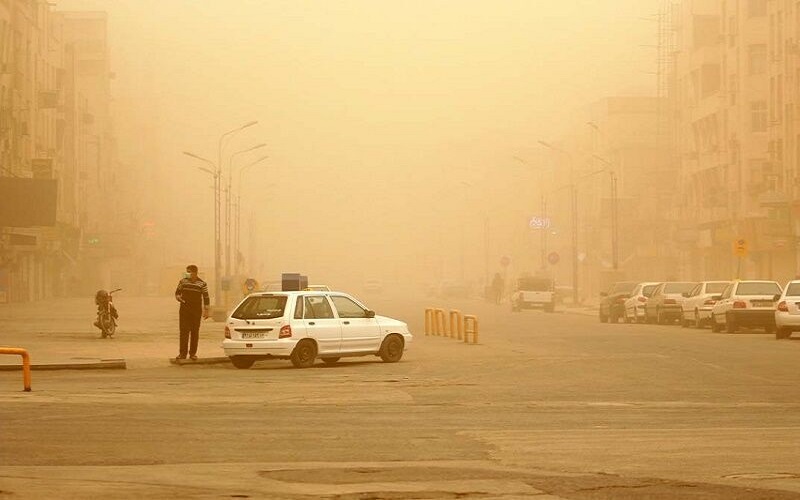

On April 16, 2025, a severe dust storm swept across western Iran, paralyzing life in several provinces. Khuzestan, Kermanshah, Lorestan, Bushehr, Ilam, and Zanjan have been either partially or fully shut down due to unprecedented levels of air pollution. In some areas, pollution levels have surged to over 500 on the Air Quality Index (AQI)—a level so extreme it exceeds measurable limits—and suspended particles have reached up to 67 times the permissible threshold.
A Health Emergency Across Provinces
In Kermanshah, authorities reported AQI levels surpassing 500, rendering the pollution unquantifiable. As a result, the entire province was ordered to shut down, excluding essential health and emergency services.
Khuzestan faced similar chaos. Schools and universities were closed, public offices shifted to remote work, and pollution levels spiked dramatically. In Lorestan, school closures were announced late, sparking public protests in Kuhdasht and Poldokhtar. Official outlets described the situation as “completely dangerous.”
Bushehr, Ilam, and Zanjan also experienced shutdowns. While in Bushehr and Ilam, schools, universities, and offices were entirely closed, Zanjan limited closures to afternoon school shifts in the city, where the storm’s intensity was comparatively milder.
Health officials in Khuzestan have warned that the storm poses a serious risk to at least 800 individuals, especially those with respiratory or heart conditions. Reports from other provinces are still pending.
The Rising Toll of Fine Dust
Fine dust particles—particularly PM2.5—have plagued Iran’s western regions since the early 2000s, with Khuzestan being the hardest hit. These microscopic particles penetrate deep into the lungs and bloodstream, causing a surge in asthma, bronchitis, and cardiovascular diseases.
Some dust particles also carry toxic heavy metals at concentrations up to ten times the safe limit. As the storm intensified in Khuzestan, residents rushed to buy protective masks, which quickly sold out by noon on April 16.
Economic Impact: Another Blow to Struggling Provinces
The shutdowns caused by the dust storm have added to the economic woes of the affected regions—comparable to previous closures due to electricity and gas shortages. Agriculture and industry have also suffered indirect losses, though current figures have yet to be released.
In 2018, Khuzestan’s farmers faced damages estimated at 140 trillion tomans due to similar dust events, with nearly half of their production lost. Today, some experts estimate daily economic losses from dust storms in western cities to be between 12 to 15 trillion tomans.
A Regional Crisis, Worsened by Local Mismanagement
The source of over half of Iran’s fine dust is external—mainly from Iraq’s deserts, especially areas affected by drought and desertification around the Tigris and Euphrates rivers. Seasonal spring winds carry this dust into Iran’s western provinces, turning annual weather patterns into health crises.
Eastern Syria and northern Saudi Arabia also contribute to the crisis, exacerbated by dam construction, drought, and excessive exploitation of underground water resources.
Yet, Iran’s internal environmental mismanagement has magnified the problem. Vast swaths of land—350,000 hectares in Khuzestan alone—have been turned into dust bowls due to unsustainable practices. The Sistan Plain, the Hamun Wetland, the dried Zayandeh Rud river, and the Lut Desert are now major sources of internal dust. Nearly half of Iran’s wetlands have deteriorated into dust-producing zones.
A Regime of Neglect
Since the early 2000s, the Iranian regime has consistently failed to cooperate with neighboring countries like Iraq, Syria, and Türkiye to address the transboundary dust crisis. This failure has turned environmental challenges into full-blown catastrophes in Iran’s western provinces.
The environmental degradation across Iran is not merely the result of natural forces—it is a direct consequence of state neglect, corruption, and short-sightedness. The regime’s obsession with power and wealth accumulation has come at the cost of Iran’s natural heritage.
Lake Urmia, once a shimmering icon of natural beauty, has become a barren salt flat. The Caspian Sea and the Persian Gulf are now choked with industrial and domestic waste, threatening marine life and human health alike. The fresh breezes that once descended from Damavand now carry deadly pollutants into Tehran and the surrounding plains. Once-vibrant landscapes are now littered with garbage and industrial runoff.
A Preventable Disaster
What makes this crisis especially tragic is that it was entirely foreseeable. These environmental disasters are not random; they are the inevitable result of a system built on inefficiency, corruption, and disregard for the public good.
Iran’s environmental collapse is not just a policy failure—it is a crime against its people and future generations. The Islamic Republic has drained the nation’s resources to enrich a select few, leaving the land, water, and air poisoned in their wake.
Instead of nourishing farms and villages, dam projects have lined the pockets of regime insiders. Instead of protecting life, the regime has prioritized its own survival, sacrificing Iran’s environment in the process.