


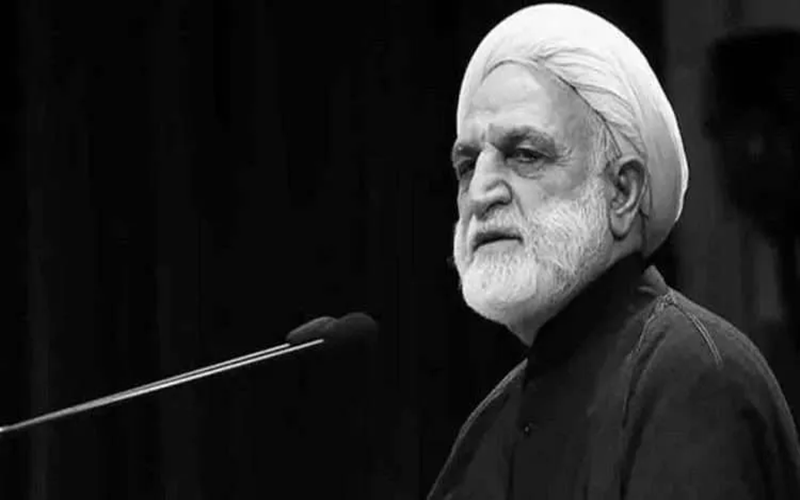

As Tehran intensifies political executions, the judiciary chief’s rhetoric and actions expose a deliberate strategy of fear, repression, and revenge against Iran’s younger generation.
The Iranian regime’s machinery of repression has once again revealed its brutal efficiency.
On Thursday, April 30, Gholamhossein Mohseni Eje’i, head of Iran’s judiciary, openly reaffirmed the regime’s commitment to executions and political repression. Mocking U.S. President Donald Trump’s warning over the continuation of executions in Iran, Ejei declared: “You have no right to tell us not to execute.”
His remarks were not mere political posturing.
In the same meeting, Ejei explicitly called for the continuation and acceleration of punishments against detainees, insisting that the regime would pay no attention to what he described as “arrogant powers.”
Only hours later, the consequences of that policy became tragically clear.
News broke of the execution of Sasan Azadvar, a 21-year-old karate champion from Isfahan. According to the judiciary’s own media outlet, he was convicted on charges including “intent to confront the regime” and “damaging a police vehicle.”
Even under the regime’s own stated accusations, Azadvar was not executed for committing an actual violent crime. He was put to death for alleged intent — a chilling demonstration of how Iran’s judicial system has abandoned even the most basic legal standards.
A New Wave of Political Executions
For years, Iran’s judiciary has relied on vague and politically weaponized accusations to eliminate dissidents and protesters.
Charges such as “enmity against God,” “collaboration with hostile entities,” or “intent to act against national security” have repeatedly served as legal cover for politically motivated executions.
What distinguishes the current wave is its speed and scale.
In recent months, both death sentences and executions have risen sharply. Human rights observers increasingly compare the current judiciary under Mohseni Eje’i to the infamous revolutionary tribunals of the early Islamic Republic.
Many now describe Eje’i as the modern continuation of the judicial methods associated with Sadegh Khalkhali — marked by rushed trials, absent due process, and predetermined death sentences.
The numbers are deeply alarming.
UN High Commissioner for Human Rights Volker Türk announced on Wednesday that since the beginning of Iran’s military confrontation with the United States and Israel, the regime has officially acknowledged at least 21 executions.
With the execution of Sasan Azadvar, that figure rises to 22 political prisoners executed in just two months.
The most disturbing detail is the age of the victims.
Most were under 25 years old. Among them was 18-year-old Amirhossein Hatami.
Meanwhile, several other detainees arrested during Iran’s recent bloody crackdown have already received death sentences, placing their lives in immediate danger.
Executions as Political Revenge
The mass issuance and rapid implementation of death sentences suggest a clear strategy.
This is not merely about deterring protest.
It is about revenge.
The regime seeks to punish a generation that has repeatedly challenged its authority and demonstrated unprecedented resistance.
Executions have become instruments of collective intimidation, designed to send a message to Iranian society: dissent will not simply be punished — it will be annihilated.
At the center of this campaign stands Mohseni Eje’i.
His role is no accident.
He began his career in the Mullahs’ regime within interrogation chambers and intelligence-linked judicial structures. Today, he presides over the country’s highest judicial authority.
His rise reflects the regime’s priorities: loyalty to repression outweighs any concept of legal justice.
The Language of Dehumanization
The messaging associated with Mohseni Eje’i reveals the ideological foundation of this repression.
Posts attributed to him on X repeatedly describe political detainees as “enemy foot soldiers,” “collaborators,” and “traitorous elements.”
This language is not incidental.
Throughout authoritarian history, dehumanizing terminology has consistently preceded intensified state violence. It prepares public justification for severe punishment and physical elimination.
Eje’i has also repeatedly demanded judicial acceleration.
In one published statement, he argued that cases involving alleged collaborators should not follow normal legal procedures and suggested investigators should conduct interrogations directly inside prisons to speed up indictment preparation.
In another message, he emphasized that punishment rulings for “enemy elements” — especially those involving asset confiscation and death sentences — must be issued more rapidly.
Such statements expose the reality of Iran’s judiciary.
This is not a justice system.
It is an administrative apparatus for political liquidation.
A Career Defined by Repression
Mohseni Ejei’s current conduct is entirely consistent with his record.
His career has been marked by:
- politically motivated prosecutions
- suppression of civil society movements
- mass closure of independent media outlets
- intimidation of journalists and activists
- fabrication of security-related cases
- protection of corrupt regime insiders
He embodies the Iranian regime’s longstanding subordination of justice to security doctrine.
If there is a single figure who reflects the judiciary’s transformation into an extension of state repression, it is Mohseni Ejei.
The International Community’s Failure
The regime’s conduct is horrifying, but it also raises another urgent question:
Why has the international response remained so weak?
Statements of concern from international institutions and human rights organizations continue to accumulate. Yet these declarations rarely carry meaningful consequences. While condemnations are issued, executions continue. While reports are published, young Iranians are hanged.
The absence of enforceable international pressure has effectively allowed Tehran’s execution machine to operate with near-total impunity.
For Iran’s regime, silence is interpreted as permission.
Unless the international community moves beyond symbolic condemnation toward concrete accountability measures, the cycle of repression will continue — and more young Iranians will pay with their lives.