


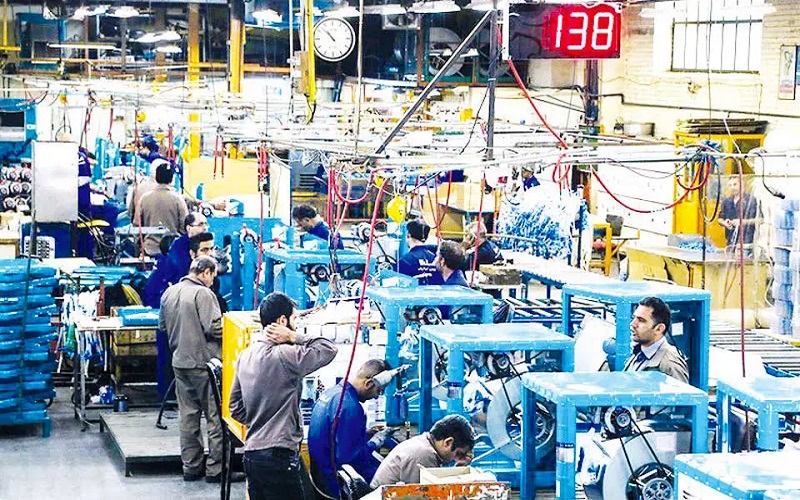

A recent report by Iran’s Parliamentary Research Center on the performance of industrial companies listed on the Tehran Stock Exchange paints a stark picture of stagnation and decline in the country’s industrial sector. Echoing this assessment, the Purchasing Managers’ Index (PMI) also indicates a continued slowdown across Iran’s manufacturing landscape.
Contrary to expectations, the industrial sector not only failed to grow in 2024—it actually contracted compared to 2023. The output of companies listed on the Tehran Stock Exchange fell below last year’s levels, signaling a deepening crisis in the country’s industrial base.
A Confluence of Economic Pressures
Several interrelated factors have contributed to the downturn. Chief among them is a severe recession in both domestic and international demand, which has significantly weakened the sales outlook for Iranian manufacturers. Volatile currency fluctuations have compounded the problem, introducing further instability into an already fragile production environment. Additionally, imbalances in the supply of energy and raw materials have disrupted operations, forcing many industrial units to scale back or halt production altogether.
Data shows that since the winter of 2023, both the industrial production index and the sales growth index have turned negative. This downward trend accelerated in 2024, driven in part by a sharp depreciation of the Iranian rial. The resulting spike in input costs has made it increasingly difficult for companies to access raw materials, exacerbating existing challenges in sourcing foreign exchange. The overall impact has been a significant reduction in the country’s industrial production capacity.
Energy Shortages and Financial Constraints
Energy shortages have been another major contributor to the slowdown. Widespread power outages, gas supply interruptions, and forced plant closures during the colder months brought production lines to a standstill in numerous factories. Simultaneously, a persistent liquidity crunch has left many firms without the working capital necessary to maintain operations, invest in equipment, or pay wages.
Declining consumer demand at home—driven by falling real incomes and diminished purchasing power—has further eroded sales. Exports have also plummeted, leaving many manufacturers without access to vital foreign markets. As a result, Iranian industry, heavily reliant on both domestic consumption and international trade, is under dual pressure from within and without.
Alarming Indicators Across the Board
In the three months ending in Esfand 1403 (March 2025), the moving average of the production index dropped by 4.5%, while the sales index declined by 2.2%. Although the year-on-year production index saw only a 1% decrease, the sales index grew a mere 0.2%—hardly a sign of recovery. These marginal shifts suggest that the sector remains locked in a prolonged recession.
In February 2025 alone, the production and sales indices decreased by 0.8% and 4.2% year-over-year, respectively. While there were month-on-month gains of 3.4% in production and 5.4% in sales compared to January, these are insufficient to offset the overall downward trend.
The Parliamentary Research Center’s sectoral analysis for February 2025 revealed particularly steep declines in “wood and paper,” “non-metallic minerals,” and “food and beverages (excluding sugar).” In total, eight industrial sub-sectors experienced sales declines compared to the same month in 2024, including “tiles and ceramics,” “base metals,” and “pharmaceuticals.” These sectors also saw some of the most pronounced drops in production.
Stagflation Grips the Sector
Despite the recession, the price index for listed companies on the Tehran Stock Exchange surged by 26.3% in February 2025 relative to the same month the previous year. This troubling combination of declining output and rising prices reflects a classic case of stagflation—a condition where economic stagnation coexists with inflation, eroding both productivity and consumer welfare.
Misguided Priorities and Systemic Corruption
The crisis engulfing Iran’s industrial sector is not merely a result of cyclical economic forces—it is deeply rooted in structural mismanagement and corruption. Decades of policy missteps, misallocation of resources, and security-driven governance have drained the country’s industrial potential. Instead of channeling public funds into revitalizing infrastructure, upgrading technology, or supporting innovation, the government has poured billions into unproductive military and nuclear ventures.
The nuclear program, in particular, offers no economic return, no employment opportunities, and no technological spillover—only the looming threat of war and further international isolation. At the same time, vast sums are diverted to fund proxy groups such as Hezbollah, leaving Iranian industries starved of investment and working capital.
This comes at a steep cost. Iranian workers, unemployed engineers, and shuttered factories bear the burden of these misplaced priorities. When the state directs its financial resources toward military expenditures and regional interventions, it inevitably crowds out investment in productive economic sectors.
Adding insult to injury, structural corruption has further crippled the industrial economy. A network of politically connected officials and elites have captured state resources, monopolized banking facilities, and undermined competition. This corrupt ecosystem has destroyed incentives for entrepreneurship, triggered capital flight, and eroded investor confidence.
A National Betrayal
What is unfolding in Iran today is not merely an industrial crisis—it is a national betrayal. The destruction of Iran’s manufacturing base is not an unfortunate byproduct of external sanctions or market volatility, but the predictable consequence of entrenched incompetence, corruption, and authoritarian policy-making.
Unless the foundations of this system are fundamentally reformed, the downward spiral will continue—culminating not just in economic collapse, but in the total erosion of public trust and national capability. The choice ahead is stark: either dismantle the corrupt structures suffocating Iran’s economy, or face the complete disintegration of what remains of its once-vibrant industrial sector.