


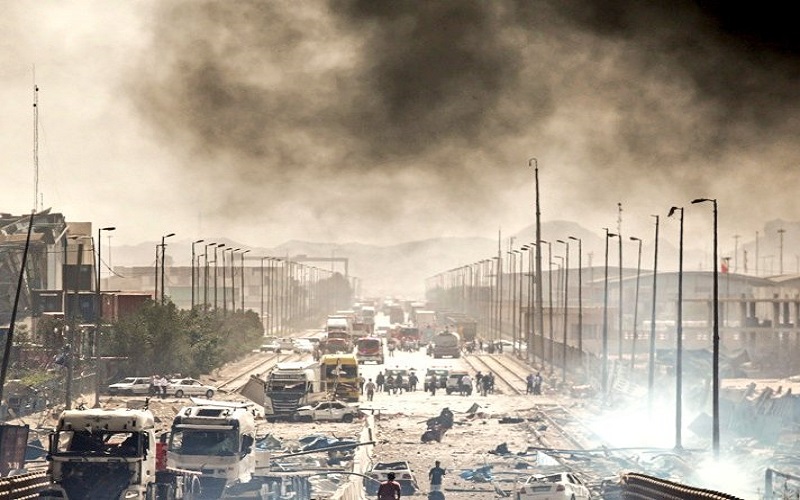

The deadly explosion at Iran’s Bandar Abbas port has once again exposed the lethal consequences of systemic mismanagement, corruption, and military secrecy under the Iranian regime. The blast, which claimed at least 70 lives and injured over 1,300 people, was not a mere accident—it was the predictable result of a regime that routinely prioritizes clandestine military ambitions over public safety.
A Preventable Catastrophe
The explosion occurred in the Shahid Rajaee Port’s private terminal—an area with restricted access and reportedly under the control of entities linked to Iran’s military apparatus. According to Saeed Jafari, CEO of the Sina Port and Maritime Services Development Company, the tragedy was triggered by misdeclared cargo: hazardous materials, including what experts believe may have been solid missile fuel, were listed as ordinary goods and stored without proper precautions.
Multiple investigations, including by The Washington Post, Associated Press, and The New York Times, have confirmed that the blast had a force equivalent to 50 tons of TNT—a devastating magnitude that places the incident among the most destructive non-nuclear industrial explosions in recent history.
Explosion Comparisons: A 50-Ton TNT Catastrophe
To grasp the scale of the Bandar Abbas disaster:
-
A 50-ton TNT explosion far exceeds the power of most conventional weapons. For instance, the U.S. military’s MOAB (Massive Ordnance Air Blast)—often described as the most powerful non-nuclear bomb—has a yield of about 11 tons.
-
The Beirut port explosion of 2020, which killed over 200 people, had an estimated yield of 1,000 to 1,500 tons of TNT. While larger in scale, the Bandar Abbas blast still ranks as an extraordinary event, especially given its avoidable nature.
-
Experts noted that the shockwave and crater left behind in Bandar Abbas were consistent with the effects of a small-scale nuclear explosion—underscoring the gravity of what unfolded.
This kind of destruction is not typical of peacetime accidents. It points instead to a broader pattern of recklessness and disregard for basic safety protocols—especially when the regime’s covert weapons-related activities are involved.
Regime Secrecy and Militarization of Civilian Infrastructure
What makes this tragedy particularly damning is the likely involvement of military-linked materials and the regime’s routine use of civilian infrastructure for covert weapons activities. Iran’s ports, airports, and even commercial airlines have long been exploited by the Islamic Revolutionary Guard Corps (IRGC) and affiliated organizations to smuggle weapons, missile components, and explosives—often at the expense of safety regulations and international norms.
This deliberate militarization of civilian spaces not only violates global standards but puts Iranian civilians in the crosshairs of the regime’s dangerous ambitions.
A Legacy of Disregard
Iran’s authoritarian system has long operated in a vacuum of accountability, where military elites and regime-connected contractors act with near-total impunity. The Bandar Abbas explosion is just the latest outcome of a state structure that rewards secrecy, not transparency; obedience, not competence.
Already, state media have downplayed the scale of the blast, while local authorities shift blame to administrative oversights or junior staff. But no amount of finger-pointing can obscure the fact that high-level negligence—and likely, military involvement—is at the heart of this disaster.
The Human Cost
Once again, it is ordinary Iranians who suffer the consequences. Dock workers, port staff, and nearby civilians were exposed to an explosive force that should never have been present in a commercial hub. Many of the injured will face lifelong consequences, while families grieve the sudden and violent loss of loved ones.
In a functioning state, such an event would prompt full investigations, resignations, and prosecutions. But in the Islamic Republic, where silence and denial are policy, justice remains elusive.
Conclusion: Accountability or Catastrophe
The Bandar Abbas explosion was not an unpredictable accident—it was the direct result of the regime’s institutionalized secrecy, military opportunism, and disregard for civilian lives. A 50-ton TNT-equivalent blast, caused by misdeclared and likely weapons-grade materials, is not just a national tragedy—it is an indictment of an entire system.
As long as Iran’s rulers continue to weaponize civilian spaces and shield themselves from oversight, such disasters will not only continue—they will worsen. Real accountability is not just necessary for justice; it is essential for survival.