
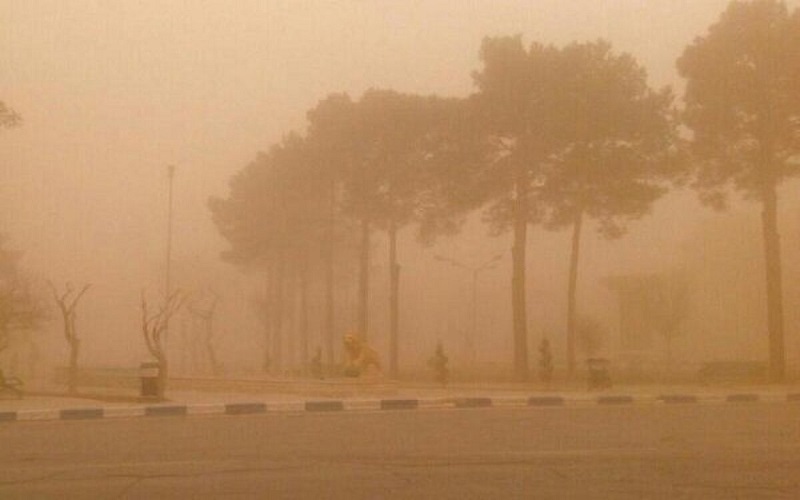

In recent weeks, widespread dust storms have once again engulfed large parts of Iran, reaching even the central provinces of Qom, Alborz, and Tehran. What was once a recurring problem confined to border regions is now unfolding as a full-scale national crisis. The dust storms have forced the closure of schools and offices in several provinces—including Khuzestan, Ilam, Hamedan, Kerman, and Kermanshah—highlighting the scale and severity of the disaster.
Unlike previous years, this time the crisis is not limited to peripheral areas. Fine dust storms have advanced deep into the heart of the country, signaling a dangerous shift. What was previously seen as a localized environmental issue is now a threat to the entire nation. And yet, regime officials continue to respond with vague promises of long-term solutions, while the immediate crisis escalates.
Mounting Health and Environmental Consequences
The toll on public health has been devastating. According to the deputy head of medicine at Ahvaz Jundishapur University of Medical Sciences, more than 2,000 individuals sought medical treatment within 72 hours due to respiratory and cardiovascular complications triggered by air pollution. In Ilam, the air quality deteriorated to such an extent that flights were canceled and government offices shut down.
Elsewhere, the impact has been equally severe. Schools and universities in Kurdistan, Lorestan, and Bushehr provinces were closed as dust concentrations exceeded safe limits. In Sardasht, environmental officials reported that the level of fine particles in the air was over eight times the permissible standard, plunging the region into a “black status” of air pollution. The crisis has reached the capital, with multiple provinces—including Zanjan, West Azerbaijan, and East Azerbaijan—also forced to suspend school operations.
Official Inaction and Ineffective Responses
Despite the growing danger to public health and the environment, Iranian regime authorities have offered little in the way of effective intervention. Government media continues to publish repetitive headlines acknowledging the crisis, but actual responses remain largely symbolic.
The government blames external sources—namely Iraq and Saudi Arabia—for the dust clouds. Fatemeh Mohajerani, the government spokeswoman, stated that “a significant portion of the dust originates outside Iran.” She also mentioned initiatives such as environmental diplomacy, sapling planting, watershed management, and aquifer control as part of the government’s strategy.
Yet these responses are viewed by many as superficial and uncoordinated. The most concrete action mentioned by officials has been the activation of the “Dust Countermeasures Secretariat” within the Environmental Protection Organization—a measure that seems grossly inadequate given the scale of the problem.
Root Causes: Mismanagement and Environmental Degradation
Experts argue that the fine dust crisis is not merely a natural disaster, but a man-made catastrophe, driven by years of environmental mismanagement, unsustainable development, and the regime’s disregard for ecological realities.
A recent report in Payam-e Ma newspaper points to rushed, project-oriented development without proper environmental assessments. This has led to deforestation, destruction of pastures, aggressive dam construction, and the depletion of wetlands and groundwater aquifers. As these protective natural buffers have vanished, vast swathes of land have become dust traps.
Dust particles, once held in place by vegetation, are now easily swept up by the wind, entering people’s lungs and endangering the health of millions. The Karun River, Zayandeh Rud, Hawizeh Marshes, and other once-thriving ecosystems have all become major dust hotspots—victims of over-damming and unregulated exploitation, such as oil extraction projects in sensitive areas like the Hawizeh Marshes.
Oil Extraction and the Death of Wetlands
In the Hawizeh Marshes, environmental degradation has been accelerated by the expansion of oil fields such as Yaran, Azadegan, and Sohrab. These projects, often launched without environmental assessments and with the backing of security institutions, have ravaged local habitats. As soil moisture decreases, dust emissions increase, further choking Khuzestan and neighboring provinces.
Despite repeated warnings from environmental experts and activists, authorities have failed to take meaningful action to reverse the damage or protect remaining wetlands. The result is a steady march toward ecological collapse.
A Public Health Emergency
The long-term consequences of the dust crisis are staggering. Former Health Minister Mohammad Reza Zafarghandi once warned that air pollution claims 50,000 lives in Iran each year. Fine particulate matter—especially PM2.5 (particles less than 2.5 microns in diameter)—can penetrate deep into the lungs and bloodstream, leading to a host of health issues.
These include chronic respiratory conditions such as asthma and bronchitis, as well as more severe outcomes like lung cancer, cardiovascular disease, heart attacks, and strokes. In effect, the air itself has become a silent killer.
Conclusion: A Crisis of Governance
Iran’s dust storm disaster is not just an environmental issue—it is a governance crisis. The regime’s inability or unwillingness to confront root causes, combined with years of ineffective planning and neglect, has turned a manageable problem into a national emergency. Without immediate and science-based intervention—backed by genuine political will—millions will remain exposed to toxic air, and the natural environment will continue to degrade.
This is no longer a future problem. It is a present catastrophe demanding urgent, systemic change.