


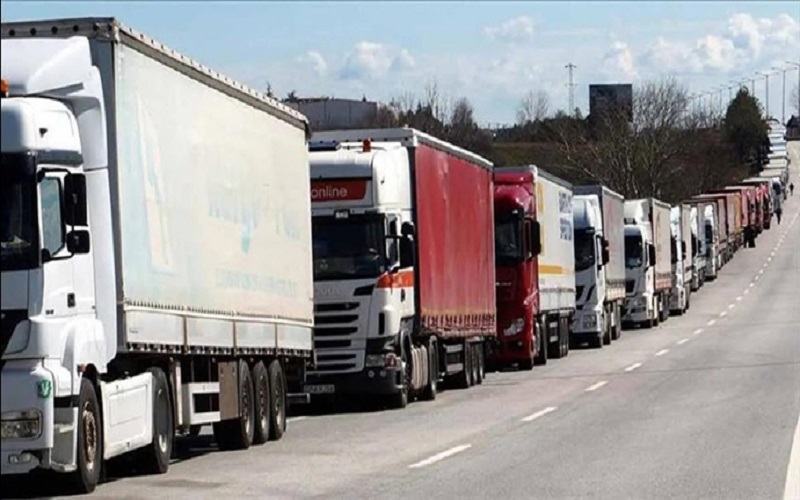

Thousands of truck and heavy vehicle drivers across Iran have entered the fourth consecutive day of a nationwide strike, bringing major sections of the country’s transportation network to a halt. The protest—sparked by long-standing grievances over poor working conditions, unpaid dues, and lack of union support—has rapidly evolved into one of the most significant labor actions in recent years.
As the strike intensifies and drivers from all provinces park their vehicles in protest, one question looms large: Where is the country’s Minister of Roads and Urban Development?
Now in its fourth day, the nationwide strike by truck and heavy vehicle drivers has brought a significant portion of Iran’s road transportation network to a standstill. From the northern provinces to the southern ports, and from the eastern borders to the western cities, drivers have parked their trucks and refused to load cargo—a unified act of defiance against systemic neglect, unbearable working conditions, and unmet demands.
At a time when the presence of the Roads Minister among the protesting drivers would have symbolized leadership, solidarity, or at least a willingness to listen, the reality has been quite the opposite. In the midst of this critical crisis, the regime’s Minister of Roads is not on the ground in Iran—but in Iraq. Her focus? Inspecting the Khanaqin-Baghdad road and planning a trip to Basra to review Arbaeen pilgrimage traffic conditions.
This foreign trip, at such a sensitive time, has sparked outrage among drivers and citizens alike. The frustration deepens knowing that funds which could be allocated to fixing Iran’s deteriorating roads, improving transportation infrastructure, or addressing backlogged union payments are instead being diverted to development projects in Iraq. Many believe these projects serve little more than to fuel the regime’s regional propaganda campaigns—particularly its annual Arbaeen march.
Why, many ask, is Iran’s Roads Minister attending to Iraqi roads while Iranian drivers are forced into a desperate strike just to be heard? The message is unmistakable: the grievances of Iran’s truckers are simply not a priority for the government.
This strike is widely seen as the most significant union action since the major truckers’ protest in 2018. Videos and reports from across Iran show widespread participation, with drivers in multiple provinces halting their work to demand justice and dignity.
But the unrest doesn’t end with truckers. CNG station operators have also joined the wave of protests, citing years of unpaid government claims, rising operational losses, and the state’s failure to adjust employee wages. Their participation adds fuel to what is fast becoming a broader movement of union discontent.
These developments are part of a broader trend. Over the past year, Iran has seen continuous protests from teachers, retirees, workers, farmers, pharmacists, contractors, and more—united by a common thread: the regime’s chronic failure to meet its financial and social obligations.
In response, the regime routinely claims it lacks the necessary budget. But Iranians know better. Billions of tomans are spent annually on foreign adventures—supporting groups like Hezbollah in Lebanon, financing Bashar al-Assad’s regime in Syria, and funding regional proxy networks. Meanwhile, Iranian workers, including truck drivers, are left struggling to survive.
Many now believe that Iran’s economic crisis stems not from a lack of resources, but from rampant misallocation and systemic corruption. Funds that should be used for health care, education, transportation, and social welfare are instead funneled into ideological projects abroad or siphoned off through corrupt networks.
Just recently, the Supreme Audit Court of Iran revealed that the Ministry of Roads alone was responsible for 2 trillion tomans in financial irregularities in a single case—raising the question: How can the regime claim it cannot pay drivers when such massive sums vanish into mismanagement and graft?
Given this backdrop, it’s no wonder truck drivers—who spend days and nights hauling goods across vast distances—are refusing to work. Their grievances are not only ignored; they are actively suppressed.
In Sanandaj, regime forces attacked protesting drivers with pepper spray. In Khuzestan, the provincial Roads and Transportation Department issued warnings that striking drivers would lose their loading rights and be removed from the transportation fleet.
Still, the resistance grows. In cities like Kermanshah, Zahedan, and Ahar, placards and flyers bearing the slogan “Neither Shah, Nor Mullah” reflect broader political disillusionment.
Solidarity has also come from other sectors. The Syndicate of Workers of the Tehran and Suburbs Bus Company issued a statement supporting the strike:
“Strikes and protests are the legal right of drivers and all workers. We support your strike and just demands.”
Alarmed by the growing scope of the strike, Mohammad Bagher Qalibaf, Speaker of the regime’s Parliament, made a hollow call on May 25 for “immediate and effective attention” to drivers’ issues. In a similar tone, the Deputy Minister of Roads promised vague reforms, while the IRGC-affiliated Tasnim News Agency tried to pacify the protest with promises of fuel quotas and insurance discounts.
But these are words without action—too little, too late.
Iran’s striking drivers are not just demanding fair pay. They are demanding recognition. They are demanding dignity. Their movement has become the voice of a larger community that feels forgotten and exploited—a community asking: “We are still here. Why don’t you see us? Why don’t you hear us?”
Until these questions are answered—not with propaganda, but with tangible change—the wheels of resistance will keep turning.