
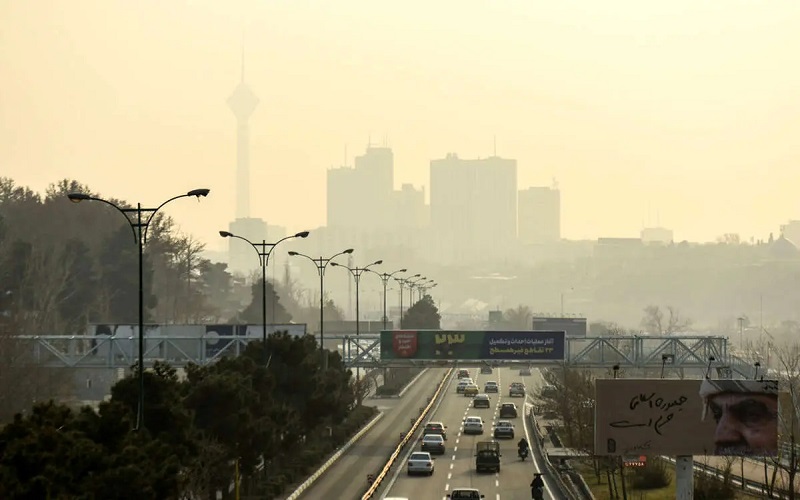

Chronic Air Crisis Deepens Across Iran Amid Inaction and Mismanagement
Tehran’s skies were once again shrouded in thick dust and polluted air on Wednesday, July 9, marking yet another day in a worsening environmental crisis that has transformed air pollution from a seasonal nuisance into a year-round threat. According to air quality indicators, the capital’s atmosphere reached the “unhealthy” orange level for sensitive groups—an increasingly common designation not just in Tehran, but in cities across Iran including Ahvaz, Mashhad, Karaj, Zahedan, Kashan, and Kerman.
Despite the widespread scope of the crisis, the Iranian regime’s response has largely been limited to vague advisories, such as encouraging people to remain indoors and wear masks. Some officials have even suggested that these conditions could persist through the fall, underlining a stark reality: air pollution in Iran is no longer confined to colder months but has become a persistent and dangerous feature of daily life.
Dust from Within and Beyond
Environmental experts trace the origin of this airborne menace to both domestic and transboundary sources. In the eastern provinces—such as South Khorasan, Razavi Khorasan, and Sistan and Baluchestan—dust storms are fueled by deserts in Afghanistan and local arid zones. Meanwhile, western provinces like Kurdistan, Ilam, Lorestan, and Khuzestan suffer from dust blowing in from Syria and Iraq’s barren lands.
In central provinces, including Alborz and Tehran, the dust is overwhelmingly domestic. Behzad Rayegani, head of the National Headquarters for Policy-Making and Coordination of Dust Management at Iran’s Environmental Protection Organization, confirms that all dust sources in Tehran stem from within the region.
For example, in Karaj, the dust largely originates from the plains downstream of Buyin-Zahra and upstream of Eshtehard and Nazarabad—once the Salehiyeh Wetland, now dried up due to repeated droughts. In Tehran, the picture is even more complex. Pollution sources include sand and gravel mining operations in the south, industrial sand separation facilities, and vast stretches of uncultivated agricultural land rendered barren by drought, now transformed into dust hotspots.
Natural deserts surrounding the city, stripped of vegetation due to prolonged dryness, have further contributed to this toxic atmosphere.
Finger-Pointing and Policy Paralysis
Reza Shahbazi, deputy head of geology at the Geology and Mineral Exploration Organization, recently identified the dried-up Salehiyeh Wetland in southwest Tehran as the capital’s most significant dust source. He cited drought, regional winds, and increased activity at internal dust centers as key contributors.
However, Sedigheh Torabi, Deputy Director of Human Environment at the Environmental Protection Organization, disputes this, pointing instead to the broader trend of declining rainfall and sustained droughts over recent years as the main culprits.
Regardless of the debate, the health implications are undeniable. The regime’s own officials have begun to tie the duration of the crisis to unpredictable weather patterns, essentially deferring responsibility to rain and wind. Torabi bluntly stated that the situation would persist “until it rains,” and the Meteorological Organization has confirmed that the fifth consecutive year of drought is worsening in both scope and intensity.
A Public Health Emergency
This air quality crisis is no longer theoretical—it’s a public health emergency. Health authorities report a surge in emergency calls related to respiratory distress. Within just 48 hours, calls to emergency centers in dust-affected provinces jumped by 15 percent, with Tehran logging the highest number of medical missions.
Air pollution is now the second leading cause of death in Iran, with over 30,000 deaths annually linked to it, according to the Ministry of Health. In 2024 alone, the cost of treating pollution-related illnesses exceeded $23 billion—an amount nearly equal to the regime’s entire annual oil revenues.
Yet while lives are lost and billions are drained from the economy, decision-makers continue to rely on ineffective “emergency meetings,” temporary advisories, and hopeful rhetoric about “regional cooperation.”
Regulatory Inertia and Budget Shortfalls
Government institutions, including the Environmental Protection Organization, have issued dust-control guidelines such as stricter regulations on mining operations. However, enforcement remains weak. According to Rayegani, the Ministry of Industry, Mines and Trade (MIMT) has failed to provide comprehensive or effective progress reports on implementing these measures.
Short-term interventions, like soil stabilization or the construction of windbreaks, are dismissed as unfeasible due to vast affected areas and insufficient funding. In some provinces, one-third of the landmass is impacted by extreme drought, a scale beyond the reach of current government budgets.
Even long-term planning is hampered by bureaucratic delays and lack of transparency. Although authorities claim to be working on identifying and controlling high-risk dust zones across provinces, there’s little to suggest any tangible progress.
“People Should Get Used to the Dust”
Perhaps the most damning indication of institutional resignation came from Fatemeh Karimi, a manager at the Tehran Air Quality Control Company, who stated, “People should get used to the dust. It will continue in the country for years to come.” Rather than offering hope or policy innovation, this remark encapsulates a growing trend among officials: normalize the crisis instead of solving it.
Environmental experts strongly disagree with this passive approach. Prominent environmentalist Mohammad Darwish recently told Farhikhtegan newspaper that climate change and global warming are driving the crisis and must be addressed through comprehensive restoration of Iran’s water ecosystems. He called on the government to enforce the Fourth Development Plan, which prioritizes the allocation of water to wetlands after drinking needs and before agriculture and industry.
Darwish emphasized that wetlands like Gavkhuni, Hor-al-Azim, Shadegan, Bakhtegan, Parishan, Jazmurian, and Lake Urmia have been systematically drained to feed industrial and agricultural ambitions. “Their water rights are approved but not honored,” he said, “because their water has been diverted to more politically favored sectors.”
A Crisis Demanding Real Change
The dust choking Iran’s skies is not an anomaly—it’s the new normal. But that normal is deadly. The institutional failure to act decisively—relying on seasonal rainfall, superficial meetings, and hopeful statements—reveals a dangerous gap between public expectations and government capability.
If Iranian authorities do not shift from symbolic gestures to concrete, well-funded, and transparent strategies, the country’s environmental degradation will continue to claim lives, cripple the healthcare system, and destroy ecosystems.
In a region already vulnerable to climate extremes, this crisis demands not adaptation to disaster, but immediate and sustained action.