


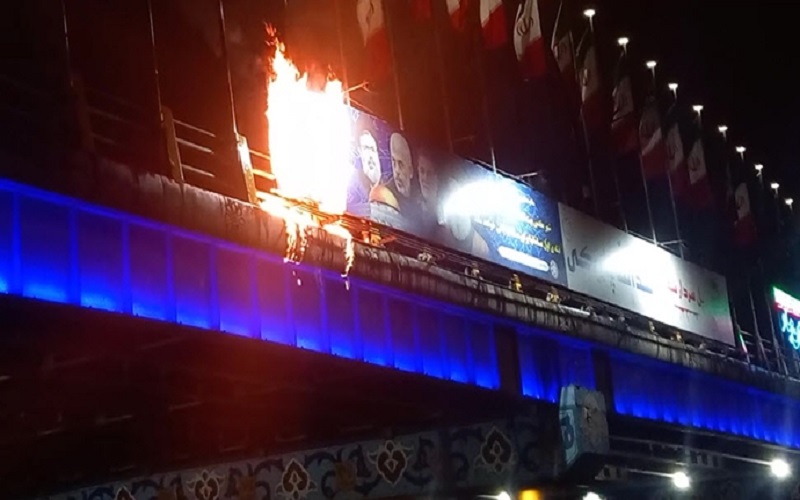

Since the temporary ceasefire between Iran and the United States and Israel was established on June 24, Iran’s political landscape has entered a new and pivotal phase. Developments both inside the country and on the international stage over the past three weeks suggest that the defining feature of this new phase is the growing visibility of a political alternative to the rule of the Supreme Leader. This emerging reality now dominates the Iranian political scene.
Regime Response: Repression and Demonization
In response to this shift, the Iranian regime has launched two parallel initiatives in an attempt to contain the growing momentum for change:
-
Escalated Domestic Repression: Under the pretext of wartime urgency, the regime has intensified crackdowns inside the country. This includes arbitrary redefinitions of espionage laws, an increase in executions, and widespread intimidation tactics. The goal is to create a climate of fear to suppress dissent and prolong the regime’s grip on power.
-
Targeted Smear Campaigns: Simultaneously, the regime is ramping up its demonization efforts against the organized opposition. Chief among its targets is the National Council of Resistance of Iran (NCRI) and its main constituent group, the People’s Mojahedin Organization of Iran (PMOI/MEK). These groups represent the most structured and capable alternative to the current theocratic rule.
Cracks Within the Regime
Notably, the idea of succession and replacement is now openly discussed within regime circles. Supreme Leader Ali Khamenei’s position appears increasingly weakened, with signs of fragmentation within the power structure. Some factions inside the establishment have begun to view him as an obstacle to reform and change. The intensifying rivalries between the regime’s economic and political elites are further evidence of this internal crisis and the urgency of planning for a post-Khamenei era.
Momentum Toward an Alternative
All domestic and international indicators in the post-war environment point toward the need for a concrete political alternative to the clerical regime. The Iranian leadership is fully aware of this trajectory. The state propaganda apparatus, in coordination with the Ministry of Intelligence, has launched a full-scale disinformation campaign to discredit the PMOI—precisely because it is the only organized force that presents a real alternative to the existing system.
At the same time, the NCRI’s “Third Option”—rejecting both war and appeasement—has gained traction as the most viable national and independent path forward. This approach is centered on the rejection of Velayat-e Faqih (absolute clerical rule) and offers a vision of a democratic, secular republic.
A Defining Struggle
To understand Iran’s political dynamics, one must recognize the central axis of conflict. For the past 46 years, the principal battle has been between the ruling theocracy and the PMOI. This struggle has intensified since the nationwide uprising of 2022. While multiple political disputes play out at the base and upper levels of Iran’s political pyramid, the defining conflict at its peak remains that between the regime and the PMOI.
A Call to Action
Given the current domestic volatility and growing international pressure, the question of a political alternative is no longer a theoretical debate—it is the most urgent issue facing Iran’s future. The moment demands action. It is now the historical responsibility of the Iranian people—along with political, social, and cultural leaders—to seize this critical juncture and shape a new future for the nation.