



In the Iranian regime, executions have become a grim and near-daily occurrence, woven so deeply into the country’s political and judicial landscape that the word “Iran” has become almost synonymous with “execution” in the global human rights discourse. The Iranian regime’s record, both domestically and internationally, continues to deteriorate with each new report of state-sanctioned killings, prompting growing outrage and scrutiny from human rights organizations and foreign governments alike.
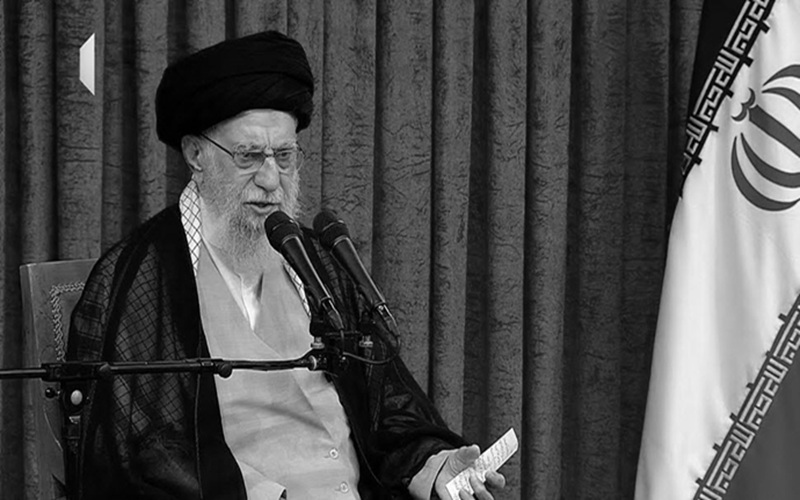
Yet the reality behind Iran regime’s machinery of death is more complex than a mere accumulation of judicial rulings. Beneath the surface of each execution lies a rigid power structure that leads directly to the office of Iran regime’s Supreme Leader, currently Ali Khamenei — the man who holds the ultimate authority not only in political and religious matters, but also in matters of life and death.
Execution by Permission: The Concept of Estezan
In the Iranian regime judicial system, the issuance and implementation of death sentences is not merely a judicial decision. A rarely discussed but critical step in the process is the requirement of estezan — a unique legal-religious mechanism that requires final permission for carrying out executions, especially in qisas (retribution-in-kind) or ta’zir (discretionary) punishments.
Estezan, a term rooted in Shiite jurisprudence, literally means “seeking permission,” and in practice, it is the process of obtaining the Supreme Leader’s blessing to spill blood. While not all executions go through this formality, particularly in drug-related cases, for many categories of capital punishment — especially those with political or high-profile implications — estezan is mandatory.
Though Khamenei rarely signs the documents himself, he typically delegates this authority to the head of the judiciary, who is directly appointed by him. That delegation does not absolve the Supreme Leader of responsibility — it merely operationalizes his will through a loyal hierarchy.
The Chain of Command: From Khamenei to the Execution Chamber
According to the Iranian regime’s governing doctrine, Velayat-e Faqih (the Guardianship of the Islamic Jurist), all legal and executive powers in the country emanate from the Supreme Leader. That includes the judiciary, whose senior officials — including the Chief Justice and often his deputies — are selected directly by the Leader himself.
Under former regime president Ebrahim Raisi, known for his involvement in the 1988 prison massacre, a new precedent was set: Raisi requested — and received — permission from Khamenei to further delegate the signing of estezan forms to his first deputy, Gholamhossein Mohseni-Eje’i, who now heads the judiciary. This development underscored the deeply bureaucratized but still centralized nature of the execution process: the Supreme Leader may not review every file personally, but no execution of political or sensitive nature occurs without his sanctioned chain of command.
This bureaucratic structure does not shield Khamenei from accountability. On the contrary, it demonstrates the deliberate architecture of state repression, where layers of delegation are merely instruments of a singular authority. In effect, every death sentence carried out in Iran — particularly those involving political prisoners, juvenile offenders, or dissenters — can be traced back to a single signature of permission, directly or indirectly: that of the Supreme Leader.
Systemic Guilt: Moral and Legal Responsibility
When international human rights defenders speak of the “Iranian judiciary” as the executioner, they risk obscuring the true source of authority. The judiciary is not an independent branch but rather an extension of the Supreme Leader’s political apparatus. Every head of the judiciary since the 1979 revolution has been personally appointed by the Supreme Leader. Every ruling is a reflection of his power — and in many cases, his will.
In such a system, where no significant decision is made without Khamenei’s consent or strategic direction, the defense of “plausible deniability” collapses. The claim that the Supreme Leader might be unaware of or uninvolved in the process of executions becomes untenable.
This is particularly relevant when considering the extensive number of executions of political prisoners, minority activists, and even teenagers who were under 18 at the time of their alleged crimes. The very structure of estezan ensures that these cases receive high-level attention. Each time, a choice is made at the top — and each time, a life is extinguished with the Supreme Leader’s blessing.
A Political Instrument of Fear
Capital punishment in Iran is not merely punitive; it is a political tool designed to instill fear, suppress dissent, and project the regime’s control. The surge in executions, particularly following waves of anti-government protests, is no coincidence. Rather, it reflects a deliberate strategy of intimidation, orchestrated from the highest levels of power.
When protesters chant slogans such as “Death to the dictator,” they are not simply referring to abstract tyranny. They are addressing the architect of the system that makes mass execution a normalized state practice.
Blood on the Supreme Leader’s Hands
In the Iranian regime, the question of who is responsible for executions cannot be answered by pointing solely at judges, prosecutors, or interrogators. The core of the matter lies at the apex of the regime — with Ali Khamenei himself. His signature, his appointments, his delegated powers, and his doctrine of absolute authority all culminate in one undeniable truth: he is the principal figure behind every state-sanctioned execution in Iran.
The estezan process — far from being a legal formality — is a damning record of complicity. Each signed approval is a silent decree of death. Each execution a reminder that, in Iran, justice is subordinate to the will of one man.
And until this reality is acknowledged and addressed by the international community, the cycle of bloodshed is doomed to continue.