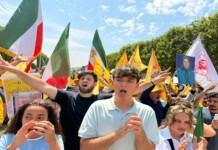
Eje’i claims “no political prisoners” exist, as Khamenei’s regime destroys graves of thousands executed in the 1980s to wipe out evidence of genocide and crimes against humanity.
On August 10, 2025, Iranian Judiciary Chief Gholam-Hossein Mohseni Eje’i publicly denied the existence of political prisoners in the country, framing the issue as a matter of “definition” and claiming no credible list had ever been provided to him.
Speaking through the judiciary’s official media outlet, Eje’i asserted that “sometimes all security detainees are called political prisoners” and that there is “no uniform definition” of the term. He said that after the recent 12-day war — his term for the conflict with Israel — various figures, including some inside the government, urged him to release political prisoners as a gesture of national unity.
According to Eje’i, he responded by asking those making the request to submit a list of names for review. “Until today, none of them have provided any names,” he claimed, adding that some reportedly told him they were “prevented” from doing so.
This narrative was reinforced by Mohammad-Hossein Hazraty, head of the government’s Information Council, who said he asked journalists and intellectuals for a list of political prisoners. “They could only name three,” Hazraty claimed, adding that he personally added two more to reach a total of five.
Contradicting Facts and International Records
The coordinated statements by the judiciary and government appear aimed at minimizing public perception of political repression and undermining reports by international human rights organizations. Groups such as Amnesty International have documented hundreds of political prisoners in Iran, including journalists, women’s rights advocates, religious minorities, labor leaders, and participants in nationwide protests since September 2022.
By denying the category altogether and reframing detainees as “security criminals,” the Iranian regime avoids accountability under international law, while attempting to delegitimize domestic and international criticism.
Destruction of Evidence from Past Crimes
Eje’i’s denial comes as the clerical regime is engaged in another act of historical erasure — the destruction of Section 41 of Behesht Zahra Cemetery in Tehran, where thousands of members of the People’s Mojahedin Organization of Iran (PMOI/MEK) executed in the 1980s are buried. Acting on orders from Supreme Leader Ali Khamenei, the regime has deployed heavy machinery to demolish and level the site, while agents of the Ministry of Intelligence stand guard to prevent public access.
For four decades, this section has been under strict surveillance, with periodic desecration of graves by regime agents. Now, the authorities seek to erase it entirely, destroying critical evidence of the mass executions that independent investigators and human rights bodies have recognized as crimes against humanity and genocide.
In his July 2024 report, Professor Javaid Rehman, then UN Special Rapporteur on human rights in Iran, stated that the 1980s executions constituted “crimes against humanity as well as genocide” and urged UN member states to apply universal jurisdiction to investigate, issue arrest warrants, and prosecute those responsible. He noted that many perpetrators remain in positions of power today.
The Iranian Resistance warns that under international law, the destruction of such graves constitutes the continuation of genocide and crimes against humanity. It calls on the United Nations and international bodies to take urgent action to stop the demolition and to bring those responsible to justice.
A Regime of Denial and Concealment
The juxtaposition of Eje’i’s denial of political prisoners with the regime’s active destruction of evidence from past atrocities highlights a consistent pattern: the Iranian authorities not only refuse to acknowledge their ongoing repression but also seek to erase the historical record of their crimes. This dual strategy — denying the present while obliterating the past — underscores the urgent need for international scrutiny and accountability.