


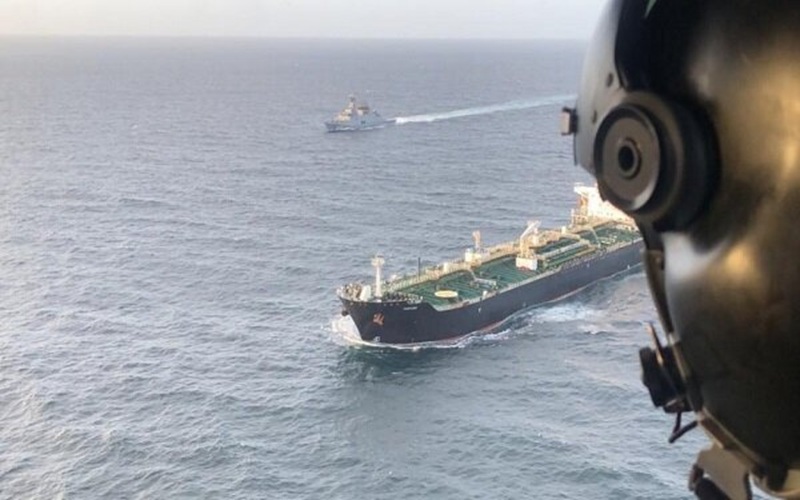

While Tehran denies having millions of barrels stranded at sea, new evidence exposes the regime’s reliance on ghost fleets and shadowy networks to smuggle sanctioned oil to China.
Mohsen Paknejad, the Iranian regime’s oil minister, dismissed reports on Wednesday that 120 million barrels of Iranian oil were floating unsold in East Asian waters. “They were joking, don’t take it seriously,” he told reporters. Paknejad insisted that “all these barrels have been planned and not a single barrel of Iranian oil will go to sea without a customer.”
His denial comes as international reports indicate a decline in purchases of “discounted Iranian oil” by small Chinese refineries, traditionally among Tehran’s most reliable customers.
Financial Times Exposes Sanctions-Evasion Network
On the same day as Paknejad’s remarks, the Financial Times published an extensive investigation detailing how Iran uses a sophisticated web of brokers, shell companies, and “ghost fleet” tankers to bypass international sanctions and funnel crude oil primarily to China.
The report highlights the case of Saeed Alikhani, who in 2019 visited a lawyer’s office in Zug, Switzerland, claiming to represent a Panamanian firm named Ocean Glory Giant. Alikhani sought to arrange marine insurance for oil tankers as collateral in deals with Chinese buyers. To legitimize the contracts, he presented bills of lading for Malaysian and Iraqi crude.
Over the next six months, the Swiss lawyer arranged contracts for at least nine tankers. However, analysis of shipping data by the Financial Times and the research group C4ADS revealed that these vessels were instead transporting billions of dollars in oil from Iran, Venezuela, and later Russia. Each tanker was registered to a different holding company managed by Chinese nationals, obscuring the ultimate ownership and beneficiaries.
According to the investigation, many of these vessels belong to the so-called “ghost fleet,” a network of tankers operating under false flags, frequently engaging in ship-to-ship transfers to disguise the origin of sanctioned oil. At least 20 of these ships have already been blacklisted by the United States.
China’s Role as a Lifeline for Regime Oil
China, the world’s largest oil importer, has long been Iran’s main customer for sanctioned crude. In 2023, it imported around 1.5 million barrels per day from Iran and about 2 million barrels per day from Russia—together accounting for nearly one-third of its total imports. Most of Iran’s oil sales to China are routed through independent “teapot” refineries.
The Financial Times report indicates that the Iranian regime relies heavily on intermediaries like Alikhani, shell companies, and murky insurance arrangements to conceal the origin of its shipments and secure payments.
Decades of Sanctions Pressure
Iran’s oil trade, its principal source of foreign exchange, has been under various sanctions since 1979, following the U.S. embassy hostage crisis. Restrictions tightened in 2012 when the European Union imposed sanctions in response to Tehran’s nuclear program. In 2018, the U.S. withdrew from the nuclear deal, and a year later, Washington ended waivers that had allowed countries like China to continue purchasing Iranian oil.
Since then, Tehran has increasingly turned to opaque networks of brokers and the “ghost fleet” to sustain its exports, despite mounting international scrutiny.
Regime’s Denial vs. Reality
While the Iranian regime’s oil minister claims there is no unsold oil at sea, mounting evidence suggests otherwise. The revelations underscore how Tehran continues to rely on illicit trade networks and deceptive practices to circumvent sanctions, maintain its oil revenue lifeline, and fund its broader political and military ambitions.