


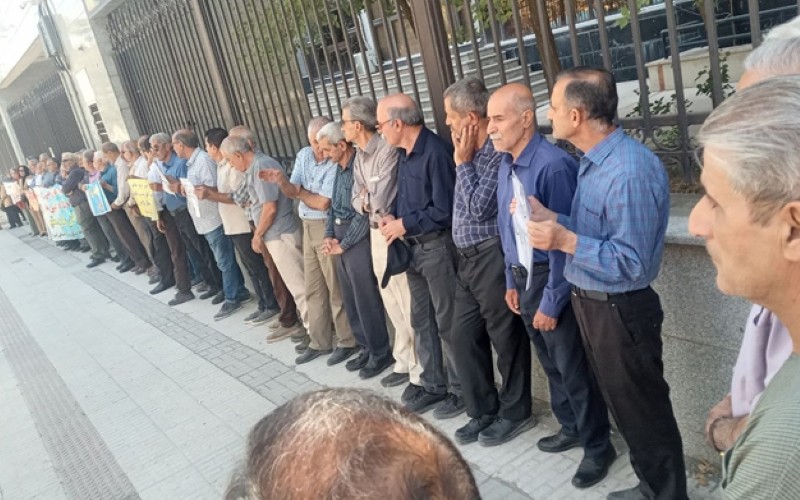

With 313 protests recorded in August 2025, workers, retirees, students, farmers, and other social groups escalate demonstrations amid worsening economic stagnation and systemic failures.
Mounting Crisis and Public Anger
As Iran’s regime faces widening fractures and systemic failure, public protests across the country have surged. More than a year into the presidency of Masoud Pezeshkian, it is increasingly evident that the regime has no solution to the country’s worsening crises.
The recent 12-day war delivered heavy blows to the regime’s already fragile economy, deepening stagnation and triggering new rounds of demonstrations. In August 2025 alone, at least 313 protest movements were recorded in cities across the country, reflecting broad-based unrest and the regime’s preparation for what appears to be an inevitable final confrontation with its people.
The Scope of Protests
The protests spanned virtually every sector of society:
- Workers: 119 cases
- Retirees: 39 cases
- Doctors and healthcare workers: 16 cases
- Truck drivers: 11 cases
- Farmers: 10 cases
- Shopkeepers and bazaar merchants: 6 cases
- Students: 5 cases
- Teachers: 2 cases
- Bakers: 2 cases
- Nurses, livestock breeders, engineers: 1 case each
- Other social groups: 100 cases
This distribution demonstrates not only the economic collapse but also widespread frustration across both traditional and professional classes.
Workers at the Forefront
Workers once again led the protest wave. Their demands included unpaid wages and benefits, lack of job security, unlawful tax deductions, and the failure to implement legal entitlements such as job-related allowances under Article 10.
Protests spanned key industries:
- Oil, Gas, and Petrochemicals: Workers across major refineries, offshore platforms, and petrochemical complexes—including Mahshahr, Asaluyeh, Kangan, Lavan Island, Kharg, and South Pars—staged strikes over unpaid wages, contract dismissals, and the government’s mismanagement of retirement funds.
- Steel, Aluminum, and Mining: Demonstrations erupted at the Pars Steel plant in Gilan, the Aluminum Company of Arak, coal and copper mines in Semnan and Sistan-Baluchestan, and at Isfahan’s steel and coke plants.
- Municipalities and Other Industries: Protests spread to municipal workers in Sanandaj, Shadgan, Tabriz, Zanjan, and other cities, as well as to industrial zones in Shiraz, Esfahan, and Arak.
These actions highlight the deep crisis gripping Iran’s vital energy and industrial sectors, traditionally considered pillars of regime stability.
Retirees and Professionals
Retirees from the steel, telecommunications, and education sectors staged demonstrations over unpaid pensions, lack of wage equalization, and state control over the Social Security Organization. Their repeated protests underline growing despair among a group once seen as politically passive.
Doctors and radiology staff in more than a dozen provinces protested against job insecurity, unsafe working conditions, and bureaucratic neglect. Nurses in Chabahar went on strike over ten months of unpaid salaries.
Farmers, Truckers, and Bazaar Merchants
The agricultural sector faced sharp discontent. Farmers in Zabol, Isfahan, and Khuzestan protested water shortages, fuel restrictions for tractors, and destructive irrigation policies. Truck drivers in Tehran and Khuzestan staged protests against diesel quotas and delays in customs clearance.
Bazaar merchants—traditionally viewed as a stabilizing force for the regime—also joined protests in cities like Sanandaj, Tehran, and Saveh, angered by rolling blackouts, economic stagnation, and government crackdowns.
Students and Teachers
University students in Tehran, Shiraz, and Yasouj staged demonstrations over skyrocketing tuition fees, inadequate stipends, and deteriorating dormitory conditions. Teachers and preschool educators held protests in Tehran and Saqqez against precarious employment contracts and in solidarity with detained activists.
Widespread Social Discontent
Beyond organized labor and professional groups, broader society expressed discontent through diverse protests:
- Families of prisoners in Kermanshah protested sudden shutdowns of prison workshops.
- Residents in Lorestan, Kurdistan, and Sistan-Baluchestan protested water shortages, electricity cuts, and skyrocketing bills.
- Housing applicants in multiple provinces staged sit-ins against corruption and unfinished projects.
- Environmental activists in Sanandaj, Kamyaran, and Dehgolan gathered to honor environmentalists killed in recent regime crackdowns.
- War victims in Tehran demanded compensation after the 12-day war.
The wide-ranging nature of these protests underscores how grievances now cut across class, geography, and identity lines.
Conclusion: Regime at an Impasse
The August protests highlight a regime in absolute deadlock. The inability of the Pezeshkian administration to address even basic economic and social demands reflects the structural paralysis of the system.
As the number and breadth of protests grow, the regime faces a society that increasingly sees demonstrations as the only means to demand justice. With the leadership preparing for what it calls a “final confrontation,” Iran appears to be entering a new stage of escalating popular unrest and political crisis.