


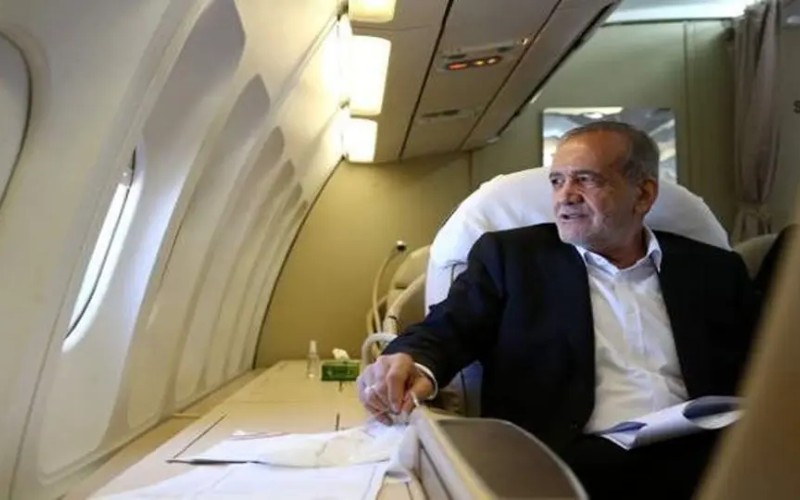

Iranian regime presidents have long treated the UN General Assembly as a platform for posturing rather than problem-solving, leaving ordinary Iranians with nothing but higher costs and empty promises.
Each September, when world leaders gather in New York for the United Nations General Assembly, Iran regime’s president arrives with a large entourage. Officially, these trips are billed as diplomatic opportunities. In reality, they have come to symbolize an expensive annual ritual that produces little benefit for the Iranian people.
Instead of advancing the country’s foreign relations or addressing its domestic struggles, these visits are often reduced to rehearsed speeches, ceremonial banquets, and meetings with lobby groups. The hefty costs only deepen the perception that the UN stage is less about diplomacy and more about theater.
From Khatami’s “Dialogue” to Ahmadinejad’s Confrontation
Iran regime’s presidents have tried different tones at the UN, but the outcomes have been remarkably similar. In the late 1990s, Mohammad Khatami attempted to cast himself as a reformist voice through his “Dialogue of Civilizations.” The UN even designated 2001 as the official year of that initiative. Yet the idea quickly collapsed in the aftermath of the September 11 attacks, highlighting the disconnect between lofty slogans and political realities.
Mahmoud Ahmadinejad went in the opposite direction. For eight consecutive years, his speeches combined Holocaust denial with apocalyptic predictions of Western decline and repeated attacks on Israel. These performances triggered walkouts by diplomats across the world, leaving Iran further isolated.
Rouhani’s Smiles, Raisi’s Symbols, Pezeshkian’s Debut
Hassan Rouhani arrived promising “constructive engagement.” His most notable achievement was a brief phone call with U.S. President Barack Obama, which became part of the narrative around the nuclear negotiations. Beyond that, Rouhani’s trips were dominated by polite smiles and photo opportunities, while sanctions and domestic crises worsened.
Ebrahim Raisi, who attended only twice, left little impression except for displaying a picture of Qassem Soleimani during one of his speeches. Masoud Pezeshkian, the newest entrant, repeated the familiar rhetoric by calling on Israel to disarm. The statement neither gained traction abroad nor escaped criticism from hardliners at home.
A Pattern Without Change
Across decades, the themes have barely shifted: defending proxy militias, condemning foreign nations for confronting the regime, portraying themselves as a victim, and demanding relief from sanctions. None of these speeches have offered practical steps for resolving Iran’s economic collapse or social unrest.
The result is a cycle of costly performances that highlight contradictions rather than resolve them. Ordinary Iranians, struggling under inflation and repression, have gained nothing. The regime, meanwhile, uses these trips as a mix of spectacle and personal privilege: days spent in luxury hotels, media interviews, and lobbyist meetings—before returning home empty-handed.
A Mirror of Iran’s Politics
From the early post-revolution years to the present, the UN podium has reflected the same reality: Iran’s presidents, regardless of their rhetoric, are bound by a system unwilling to change. The international stage exposes those contradictions rather than concealing them.
For the people of Iran, the legacy of these annual visits is not improved diplomacy or relief from sanctions, but the continued burden of wasted resources and deepening isolation.
The UN appearances of Iranian presidents have become less about diplomacy than about projection—expensive, repetitive, and fruitless.