


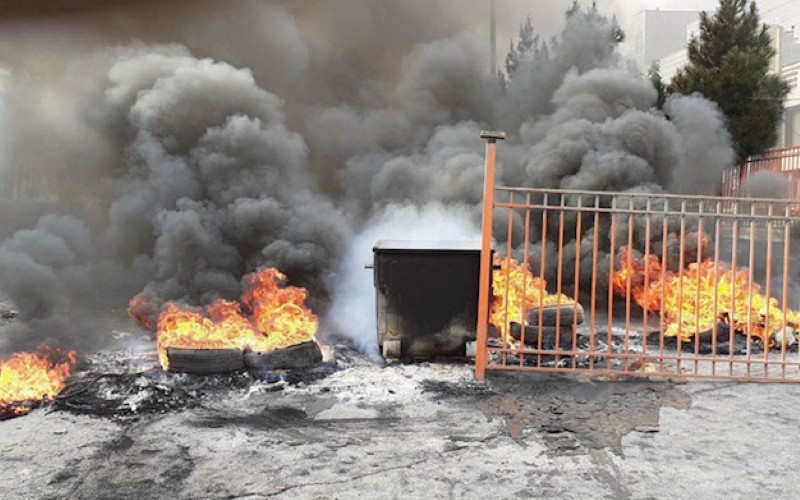

Six years later, the regime still withholds the truth about the scale of killings, arrests, and the nationwide shutdown of information.
Six years ago, the abrupt gasoline price hike of November 2019 ignited one of the deadliest protests in the history of the Iranian regime. Within less than a week, hundreds of protesters were killed, thousands arrested, and the regime imposed a near-total internet blackout. The events deepened the divide between the Iranian people and the ruling establishment and marked a decisive chapter in the trajectory of resistance against the dictatorship.
A Sudden Midnight Announcement
On the night of November 15, 2019 (24 Aban 1398), the National Iranian Oil Products Distribution Company suddenly announced that the price of rationed gasoline would rise from 10,000 to 15,000 rials, and the price of free-market gasoline would double to 30,000 rials.
The decision—approved by the Supreme Council for Economic Coordination and directly endorsed by the regime’s Supreme Leader—was made behind closed doors, without warning, consultation, or public debate.
Within hours, protests erupted across the country. Sirjan in Kerman Province became one of the first flashpoints. Crowds gathering at fuel stations clashed with security forces, and reports confirmed the first fatality that same night, rapidly circulating across social media and inspiring demonstrations in more cities.
Nationwide Eruption
By November 16 (25 Aban), protests had spread from southern to northern Iran. Major cities—including Tehran, Shiraz, Ahvaz, Mashhad, Karaj, Kermanshah, Tabriz, and Isfahan—saw large crowds filling the streets.
Initially sparked by economic grievances, chants quickly shifted toward explicit political demands and condemnation of the regime’s leadership.
In several cities, demonstrators blocked roads, surrounded government buildings, and set fire to banks and fuel stations. Security forces responded with unprecedented violence. Eyewitness testimonies and video evidence confirmed the use of live ammunition from the second day, with shootings reported in Ahvaz, Behbahan, Shahriar, and Sanandaj.
That same day, the regime moved to silence the nation: internet access was cut almost entirely. Telecommunications companies severed connections to the global network, and by nightfall, Iran’s connectivity dropped below 5 percent.
Netblocks later described the shutdown as one of the largest in internet history—an information blackout that enabled the regime to intensify its crackdown away from global scrutiny.
Khamenei’s Endorsement and Escalation of Violence
On November 17 (26 Aban), Ali Khamenei openly endorsed the price hike and framed the protests as the work of “troublemakers.” He ordered a decisive and uncompromising response.
Immediately after his remarks, the violence escalated dramatically.
Reinforcements from the Revolutionary Guard (IRGC), Basij militia, and special police units flooded major cities. Witnesses from areas such as Eslamshahr and Shahriar reported live gunfire against unarmed protesters.
Videos of bodies lying in the streets and gunshots echoing through neighborhoods surfaced once internet access slowly returned days later.
According to a later Reuters investigation, Khamenei told senior security officials to do “whatever it takes” to end the protests. Sources within the regime told Reuters that following this order, the crackdown intensified sharply, resulting in the killing of hundreds across multiple cities.
Mahshahr: The Symbol of Atrocity
Between November 18 and 20 (27–29 Aban), the industrial city of Mahshahr in Khuzestan Province became the center of one of the most brutal episodes of the entire crackdown.
Large crowds blocked the road linking Mahshahr to Bandar Imam. IRGC units were deployed to regain control. Witnesses reported that many protesters fled into surrounding marshlands for safety, where IRGC forces opened fire with machine guns.
Dozens were killed instantly, and others drowned in waterways while attempting to escape.
Although the regime never released official casualty figures, local testimonies and Amnesty International reports estimated that between 40 and 150 people were killed in Mahshahr alone.
In 2020, the United States sanctioned IRGC commander Hassan Shahvarpour for his direct role in the massacre.
A Nation Cut Off From the World
For seven days—from November 16 to November 23—Iran was almost entirely disconnected from the global internet.
Citizens could not access social media, online news platforms, or even banking systems. Many were cut off from basic communication, even via SMS.
During this blackout, security forces carried out mass arrests. In cities like Shiraz and Karaj, authorities used surveillance cameras to identify protesters, raiding homes and detaining individuals seen at demonstrations.
Thousands were arrested; weeks later, a confidential report to Parliament’s National Security Commission estimated over 7,000 detainees.
The Internet Returns—and the Truth Emerges
After November 23, connectivity gradually returned, reaching about 60 percent. The moment the internet came back, videos and eyewitness accounts poured out:
– shootings at close range
– bodies lying in streets
– burned vehicles
– grieving families collecting their dead from morgues
Human rights groups documented that most victims were shot in the head, neck, or chest—clear evidence of deliberate intent to kill.
Amnesty International confirmed at least 304 deaths, later revising the number to 321 identified victims.
Reuters, citing three officials from Iran’s Interior Ministry, reported the true death toll at around 1,500—among them at least 400 women and 17 minors.
Cover-ups, Midnight Burials, and Silencing Families
For months, the regime attempted to conceal the scale of the killings.
Bodies were buried at night; families were pressured not to hold funerals; in many cases, authorities demanded written pledges not to speak to the media in exchange for releasing bodies.
The then–Interior Minister Abdolreza Rahmani Fazli eventually admitted in a closed parliamentary session that security forces had fired at protesters.
When questioned why so many were shot in the head, he reportedly replied: “We also shot them in the legs.”
The remark became a symbol of the regime’s impunity.
International Condemnation
As evidence mounted, global reactions intensified.
The UN High Commissioner for Human Rights called for an independent investigation and referred to the regime’s actions as “shooting to kill.”
Amnesty International and Human Rights Watch demanded transparency on the death toll and the release of detainees.
The regime’s then-president Hassan Rouhani, meanwhile, dismissed responsibility. In a widely criticized statement, he joked that he had learned of the price hike “the same morning as everyone else,” fueling further public outrage.
A Lasting National Trauma
Years later, families of the victims continue to seek justice, while none of the commanders responsible for the killings have been held accountable. For many observers, November 2019 marks a major rupture between the Iranian people and the regime—a moment when public trust collapsed and the term “Aban Massacre” entered the collective memory of the nation.
The events of November 2019 remain a defining example of the regime’s readiness to use lethal force to suppress dissent and its determination to conceal the truth—no matter the cost in human lives.