
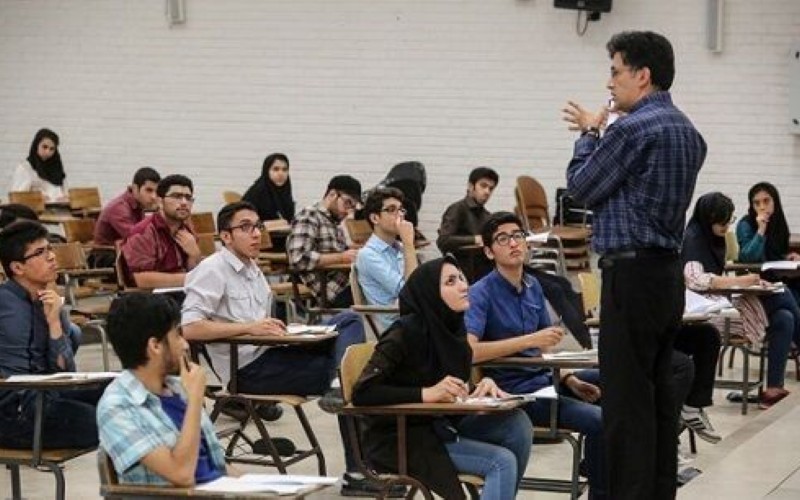

The mass departure of Iranian university professors—an unprecedented wave of academic flight—has become one of the most devastating national crises under the regime’s rule. What is unfolding is not a temporary fluctuation in the country’s academic workforce; it is a historic collapse of Iran’s scientific foundation.
Even regime-aligned media can no longer conceal the disaster. On November 14, the state-affiliated outlet Asr-e Iran quoted former regime’s deputy minister of science Gholamreza Zarifian admitting that the “ecosystem and governance of higher education have undergone fundamental changes” and that universities “can no longer be managed with the approaches of the past.” His statement, however, reflects more than a governance failure—it is an indictment of a political system that has suffocated knowledge, punished talent, and driven its brightest minds across the border.
Today, the academic exodus has become a full-blown national emergency. Zarifian himself acknowledged that 12,000 university professors have left Iran in the past decade, a figure so staggering that it exposes the depth of the regime’s hostility toward scientific independence. Even more alarming is his admission that 60 percent of these departures occurred in just the last four years, revealing an accelerating collapse. This is not the natural movement of labor seen in open societies; it is the direct product of authoritarianism, repression, and engineered intellectual decay.
The causes are painfully clear. Economic desperation, political persecution, and social instability have hollowed out Iran’s universities. Amid soaring inflation and a currency in freefall, professors cannot afford basic living expenses. Former minister of science Hossein Simaei-Sarraf publicly conceded that Iranian professors earn a fraction of their regional counterparts. While academics in Turkey or the UAE make four to seven thousand dollars per month, a professor in Iran struggles to reach five hundred. This disparity is not merely economic—it is the regime’s deliberate strategy of impoverishment to ensure obedience.
This strategy has profound consequences. Forced into second jobs to survive, young academics have no time for research or innovation. Universities, corrupted by political vetting and administrative patronage, have devolved into degree factories rather than engines of scientific advancement. Professors in engineering and technical fields—those most essential to rebuilding Iran’s decaying industries—are leaving at the fastest rate. Between 2016 and 2020 alone, 1,500 such experts departed. The regime has effectively starved the very backbone of national development.
The suffocation is not only financial but fiercely political. Under the regime, universities have become securitized zones policed by intelligence forces. Student protests are met with truncheons; faculty members who express dissent face interrogation, dismissal, or even prosecution. Hundreds of professors have been fired under fabricated charges, and those who support student rights are targeted for “disciplinary action.” It is no surprise that the Minister of Science admitted that one in four professors has emigrated in recent years. These figures reflect the cost of turning universities into ideological fortresses rather than free intellectual spaces.
Censorship and scientific isolation exacerbate the crisis. Research restrictions, bans on international collaboration, and systematic filtering of knowledge have severed Iran from the global academic community. By 2019, an estimated 180,000 Iranian specialists were leaving the country annually, placing Iran second in the world for brain drain. The economic cost of this hemorrhage has been estimated at fifty billion dollars per year—a figure that dwarfs the regime’s investment in repression yet still fails to compel it toward reform.
As professors leave, classrooms fall silent. Students, deprived of mentors and academic continuity, look abroad for opportunity. Stanford University’s estimates show that more than 100,000 Iranian students now choose foreign universities over domestic ones, a number projected to rise to 120,000 by the end of the decade. With each departure, the scientific infrastructure weakens, innovation slows, and Iran slips further down global rankings. The regime’s anti-intellectual policies have erased decades of academic progress and inflicted lasting damage on the country’s future.
The long-term implications for Iran’s economy are dire. Without scientists, engineers, and researchers, advanced industries cannot function. The resulting cycle—professor exits, student migration, institutional decline—becomes self-reinforcing. What remains is an empty shell of a university system incapable of contributing to national development.
The ruling establishment deepens the crisis by refusing to recognize basic academic freedoms and human rights. The clerical regime’s hostility to knowledge is ideological, not incidental. Every professor who leaves is a testament to a system that punishes thought and rewards conformity. Every empty chair in a lecture hall is an indictment of authoritarian governance.
The truth is unmistakable: the exodus of Iran’s professors is not a policy failure—it is the inevitable outcome of a regime that views independent intellect as a threat. This crisis cannot be reversed through minor adjustments or bureaucratic reforms. It requires a structural transformation of governance itself.
The only genuine solution lies in a transition toward democracy, secular governance, and academic autonomy. Iran’s scholars will not return to a country where free inquiry is criminalized and where survival depends on silence. Student movements, supported internationally, remain one of the few forces capable of resisting this decay. The future of Iran’s scientific community—and indeed the future of the nation—rests on their resilience and on the global recognition that the current system cannot be reformed.
The academic exodus is not a statistic; it is a human tragedy, a generational loss, and a national warning. Until the authoritarian, anti-science establishment is dismantled, the flight of Iran’s brightest minds will continue—and the regime that created this catastrophe must be held accountable.