
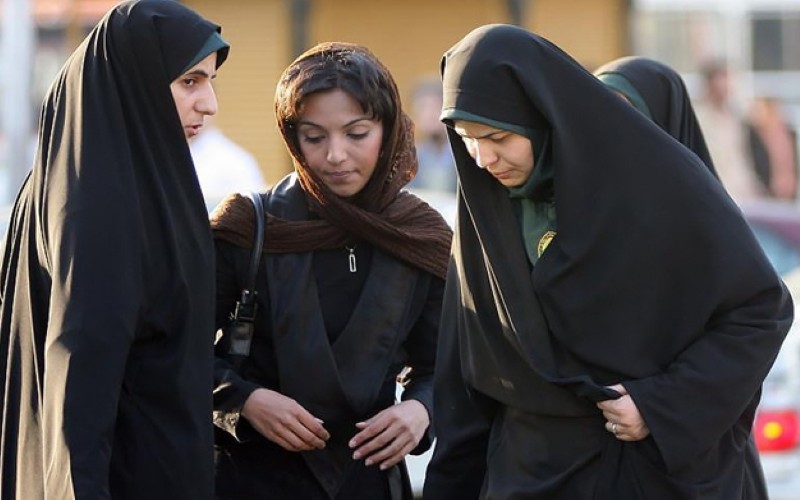

Regime media reveal deep internal rifts as its leaders push hijab enforcement despite economic crisis, public anger, and security warnings
Debate over the compulsory hijab has once again exposed deep fractures within the Iran regime—fractures that go far beyond a single law and strike at the heart of governance, legitimacy, and social stability. Regime-affiliated media outlets now openly acknowledge that the confrontation over enforcing the so-called “Chastity and Hijab Law” has turned into a high-stakes political and security struggle, unfolding against the backdrop of economic collapse and widespread public discontent.
According to Shargh, the current dispute is not merely about the implementation of a legal text. Instead, it has become a test of the regime’s capacity for rational governance, its understanding of public opinion. Escalating media attacks, formal letters, and public feuds on social media among regime insiders reveal the dominance of medieval thinking and an insistence on pushing an agenda, that has become largely one of the main major issues for the regime’s existence.
Contrary to claims by MPs in the regime’s parliament, the suspension of the hijab law’s notification and enforcement was not an arbitrary decision by the government nor a retreat from legalism. Regime media confirm that the move was taken by the Supreme National Security Council, with the approval of the heads of the three branches of power. Even the speaker of parliament has publicly defended the decision, fearing broader security and social crisis, something that ignited the nationwide protests in 2022.
Despite this, a group of parliamentarians has deliberately ignored this reality for weeks, insisting on the enforcement on the compulsory hijab. By attacking both the regime’s president and the parliamentary speaker, they have sought to construct a narrative of “refusal to enforce the law.”
A public exchange on social media between Mohammad Saeed Ahdian, an aide to the parliamentary speaker, and Masoud Barati, a political adviser to Saeed Jalili, laid bare the essence of the conflict.
Ahdian bluntly stated: “Your issue is not hijab; it is political objectives.” His argument highlighted a central contradiction—if suspending the law were truly illegal, there would have been an official and explicit objection within the Supreme National Security Council itself. Instead, the hardliners selectively invoke “law” as a political tool, not as a principled commitment.
On the opposite side, figures such as Fatemeh Mohammadi-Beigi, a member of parliament from Qazvin, continue to insist on enforcing what they claim are 16 separate laws related to hijab passed since 1981. This insistence underscores how disconnected sections of the regime remain from social realities, clinging to decades-old legislation while society moves in the opposite direction.
The economic context makes this confrontation even more explosive. As Jahan-e Sanat emphasizes, Iran is grappling with sweeping international sanctions, a collapsing national currency, and a dramatic erosion of purchasing power. Large segments of society are struggling to meet their most basic needs. In such conditions, adding social repression to economic hardship is a recipe for unrest. Regime analysts warn that public tolerance is finite and that piling ideological pressure onto an already impoverished population risks triggering protests.
Regime media also acknowledge that the Supreme National Security Council—whose members include senior security and intelligence officials—likely made its decision with the knowledge and coordination of the regime’s top leadership.
As the highest security decision-making body, its strategy reflects concerns about maintaining control amid mounting social tension. Ignoring or undermining this decision, commentators warn, raises serious questions about the authority of the regime’s own security institutions and risks accelerating social fragmentation.
Yet despite these warnings, some actors within the Iran regime appear determined to pursue what even regime media describe as adventurism. Such actions, they concede, not only inflame domestic tensions but also hand propaganda opportunities to the regime’s external adversaries. More critically, they deepen the gap between the state and a society already pushed to the brink by poverty and mismanagement.
Perhaps most revealing is the admission that while Iranian society is moving decisively in one direction, many Friday prayer leaders and ideological enforcers remain fixated on compulsory hijab as the country’s primary threat. Regime commentators counter that the true dangers facing Iran are not women’s clothing choices, but systemic incompetence, chronic mismanagement, and relentless economic pressure imposed on the population.
Taken together, these regime-media assessments expose a stark reality: the compulsory hijab has become a symbol of the Iran regime’s broader crisis. It reflects a ruling system trapped between ideological rigidity and the fear of social explosion—one that increasingly recognizes the risks of enforcement, yet remains incapable of resolving the deeper failures that have alienated society and eroded its own foundations.