


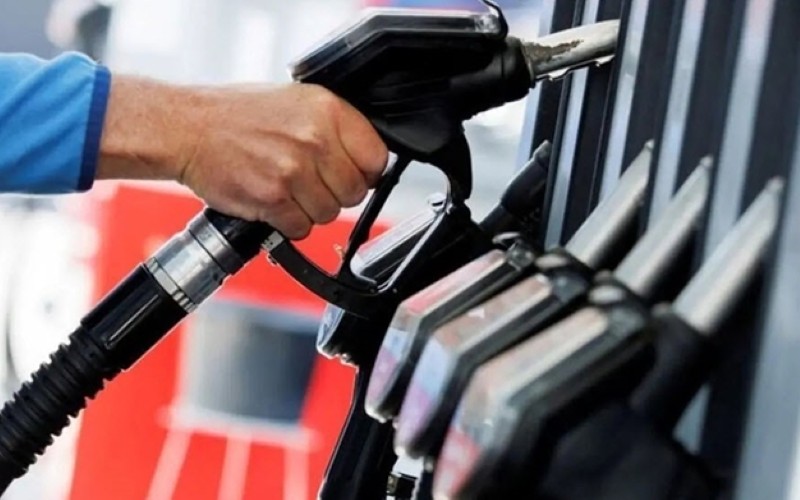

New plans for quarterly gasoline price increases emerge amid reports of nearly $1 billion in fresh financial support from Iran’s regime to Hezbollah.
As reports emerge of Iran’s regime agreeing to provide nearly $1 billion in new financial assistance to Hezbollah in Lebanon, fresh evidence suggests that the cost of chronic budget deficits and costly foreign interventions is once again being transferred directly onto the shoulders of the Iranian public.
At a time when Iran’s economy is grappling with runaway inflation, a historic collapse of the national currency, and the rapid expansion of poverty, Iran’s regime is moving forward with a mechanism described as a “seasonal gasoline price increase.” The policy would allow fuel prices to rise every three months, delivering repeated shocks to household livelihoods.
Images circulating from an official cabinet approval document indicate that the regime has issued an amendment to a previous resolution, effectively paving the way for regular, seasonal gasoline price hikes. Under the revised framework, gasoline prices—particularly the third-tier rate and fuel purchased using emergency station cards—are to be reviewed each quarter based on the “average purchase price of gasoline from refineries in the previous season.”
According to analysts, this represents not a temporary adjustment but the establishment of a permanent structure for continuous price increases.
Under the earlier resolution, the regime had set gasoline price increases at 10 percent of the refinery purchase price, assuming a benchmark price of 50,000 tomans. The new amendment removes that fixed assumption and introduces a floating, seasonal calculation. In practical terms, any rise in refinery prices will now automatically translate into higher costs for consumers. The inclusion of the word “minimum” in the revised text further grants the government latitude to raise prices by more than 10 percent per quarter.
Fuel as the engine of inflation
The significance of this decision extends far beyond gasoline itself. In Iran’s economy, fuel functions as a primary driver of price formation. Any increase in gasoline prices rapidly ripples through transportation costs, goods distribution, urban services, and inflationary expectations.
Recent weeks have already seen increases in ride-hailing fares, food prices, and everyday services, suggesting that markets are reacting even before new rates are formally implemented. In this context, quarterly gasoline hikes amount to the injection of regular, pre-planned shocks into an already fragile economy—leaving households with little opportunity to recover between waves of price increases.
Official justifications and growing criticism
The regime continues to justify the policy by citing “gasoline imbalance” and “sanctions-induced constraints.” Officials argue that domestic gasoline production does not meet consumption levels and that fuel imports impose a heavy burden on the state budget.
Critics, however, question why more structural and costly inefficiencies remain untouched. They point to an aging transportation fleet, fuel-inefficient vehicles, organized fuel smuggling networks, and the vast budgets allocated to military and ideological institutions. Instead of addressing these issues, the regime has opted for the simplest and fastest solution: raising prices for ordinary citizens.
Foreign spending versus domestic hardship
These questions become sharper in light of parallel reports about the continuation of Iran’s regime’s financial support for proxy groups in the region. Tehran has reportedly approved the transfer of nearly $1 billion in additional funding to Hezbollah in Lebanon.
Previously, the US Treasury Secretary stated that Iran’s regime had already spent at least another $1 billion on Hezbollah in 2025 alone. These funds are believed to be used primarily for rebuilding the group’s military capabilities and paying salaries to its fighters.
The contrast sends a clear message: the budget shortfalls repeatedly cited by the regime are not being addressed through cuts to foreign expenditures, but rather through intensified pressure on the daily lives of Iranians.
A gradual strategy shaped by past unrest
At the same time, Iran’s regime appears intent on advancing gasoline price hikes gradually rather than abruptly. This approach recalls the regime’s efforts to avoid a repeat of the November 2019 scenario, when a sudden fuel price increase sparked nationwide protests that were met with a brutal crackdown.
The move toward phased, seasonal increases is widely interpreted not as an act of concern for public welfare, but as a calculated strategy to normalize rising prices and reduce the risk of large-scale social backlash.
As Iran’s regime continues to finance its regional ambitions while systematically transferring economic costs to the population, the proposed quarterly gasoline hikes stand as another flashpoint in a society already strained by poverty, inflation, and deepening mistrust toward those in power.