


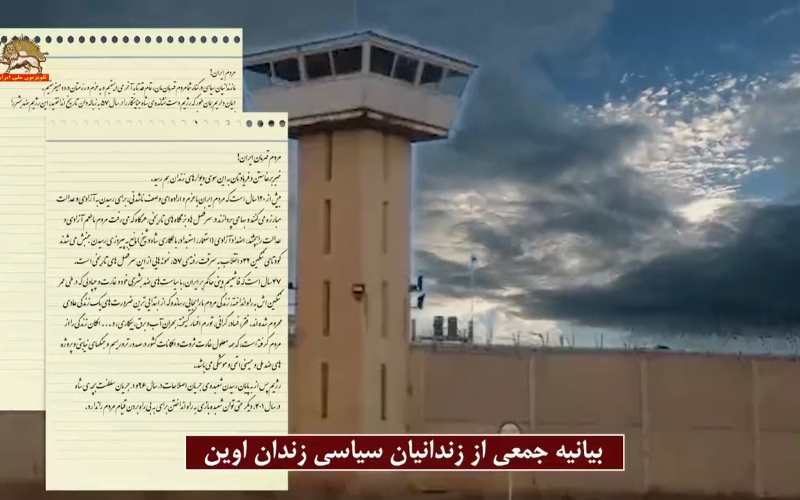

In a powerful declaration from behind prison walls, named political prisoners in Evin and three inmates under death sentences openly align themselves with Iran’s uprising and call on students to sustain the revolt.
As protests continue to spread across Iran, voices from behind the regime’s prison walls have broken through censorship and repression. In a collective statement, political prisoners held in Tehran’s Evin Prison declared their full solidarity with the uprising. In parallel, three political prisoners held under sentence of death in Qezel Hesar Prison issued a direct message to protesting university students.
Together, these messages represent a rare and defiant intervention from within the regime’s detention system—turning prisons into active fronts of resistance.
“Your Voice Has Reached Us Behind These Walls”
Addressing the Iranian people, the political prisoners of Evin Prison opened their statement by acknowledging the nationwide protests:
“The news of your uprising and your cries has reached us on this side of the prison walls.”
The statement—signed by Amir-Hassan Akbari Monfared, Reza Akbari Monfared, Mojtaba Taghavi, Pejman Tubreh-Rizi, Shahin Zoghi-Tabar, Ehsan Rostami, Ramin Rostami, Afshin Rangriz Heyrati, Behzad Zargan, Reza Ashourzadeh, Nasrollah Fallahi, Bijan Kazemi, and Pouria Vahidiyan—places the current uprising within a century-long struggle for freedom and justice in Iran.
The prisoners argue that for more than 120 years, Iranians have repeatedly approached the threshold of liberation, only to see their movements crushed or hijacked by forces of repression—whether through foreign-backed coups, monarchy, or clerical rule. They point to the 1953 coup and the stolen 1979 revolution as defining moments when popular will was thwarted.
Forty-Seven Years of Religious Fascism and Plunder
The Evin prisoners sharply condemn the ruling system as a form of religious fascism that has governed Iran for 47 years through repression, looting, and anti-human policies. They describe a society stripped of the most basic conditions of normal life, listing poverty, corruption, soaring prices, runaway inflation, water and electricity shortages, and mass unemployment.
According to the statement, these crises are not the result of mismanagement alone, but of the systematic diversion of national wealth into terrorism, proxy wars, and nuclear and missile projects described as anti-national and destructive to Iran’s future.
The prisoners stress that the regime’s survival strategy has always rested on two pillars: internal repression and the export of war and terror. Yet they assert that the authorities themselves know their end is near, because society has reached a point of irreversible confrontation.
The Collapse of Political Deception
The statement further argues that the regime has lost even its ability to deceive. Following the collapse of the so-called reformist project in 2017 and the nationwide uprising of 2022, the system no longer has the capacity to divert public anger through political illusions or controlled factions.
Declaring their position unequivocally, the Evin prisoners state that they stand “fully and to the end” alongside the people and salute their determination. The statement concludes with a tribute to those killed in the struggle for freedom and an oath of resistance:
“By the blood of our comrades, we stand to the end.”
Death-Row Prisoners: “We Stand with You, Even from the Gallows”
In a separate message, three political prisoners held under death sentences in Qezel Hesar Prison—Mohammad Taghavi, Babak Alipour, and Vahid Bani Amerian—addressed Iran’s university students directly.
They praised students as freedom-seekers who, at a decisive historical moment, have “ignited the fire of freedom.” Emphasizing that the signs of regime collapse are growing clearer, they urged students to join the broader population in the streets and help carry the uprising forward.
The prisoners declared that the time has come to bury both clerical and monarchical dictatorship and to usher in freedom and a democratic republic. Despite imprisonment and the threat of execution, they stressed that they remain fully present in the uprising:
“Though we are in chains, in prison, and under death sentences, we stand with you—in every moment of your rebellion and resistance.”
The message ends with a slogan that has become central to Iran’s protest movement:
“Death to the oppressor, whether Shah or Supreme Leader.”
Prisons as Extensions of the Uprising
These named declarations—issued under constant threat of retaliation—lay bare the regime’s fear of a society that no longer accepts silence or submission. When political prisoners, including those facing execution, publicly align themselves with protesters and students, it exposes the limits of repression.
Far from extinguishing dissent, Iran’s prisons have become extensions of the uprising itself—amplifying a message the regime is desperate to suppress: that the struggle for freedom now transcends walls, sentences, and even the gallows.