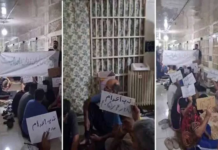
From judicial threats and campus shutdowns to economic retreats and security reshuffles, the Iranian regime’s recent moves reveal a власти gripped by fear of a society on the brink of revolt.
Recent statements and actions by Iran regime’s officials leave little doubt: the regime is no longer projecting authority—it is reacting in fear. Judicial threats, sudden university closures, economic backtracking, and high-level security reshuffles all point to a regime alarmed by the rapid spread of protests and the growing convergence of social groups in open defiance.
Judicial Threats as a Confession of Fear
The regime’s chief prosecutor, Mohammad Movahedi, issued a warning that reads less like law enforcement and more like an admission of panic. By accusing protesters of “organized misuse of legitimate demands” and alleging manipulation through “guided media networks” and “deceived individuals,” the regime once again resorted to its familiar narrative: deny the authenticity of public anger and blame shadowy external forces.
Such rhetoric is revealing. When a system feels secure, it does not need to criminalize grievances or preemptively threaten “decisive legal responses.” The prosecutor’s warning that economic protests will be met with harsh measures if they “turn into insecurity” underscores the regime’s deepest fear—that bread-and-butter grievances are rapidly transforming into a political uprising beyond its control.
Universities: Closed Not by Cold, but by Protest
That fear was immediately mirrored on university campuses. Following widespread student protests on Tuesday, the Ministry of Science under the Masoud Pezeshkian government abruptly announced that classes at two major universities—National University and Allameh Tabataba’i—would move online until the end of the term.
The official justification—cold weather and energy imbalance—was widely ridiculed. In reality, the closures were a transparent attempt to dismantle protests. Iranian universities have historically served as catalysts for nationwide uprisings, and the regime’s instinctive response was not dialogue, but lockdown.
Economic Retreats Masquerading as Policy
Simultaneously, protests in Tehran’s bazaars forced the regime into a humiliating economic retreat. President Pezeshkian, visibly cornered, resorted to temporary and cosmetic concessions aimed at calming enraged merchants.
According to state-affiliated media, the government and parliament agreed to suspend several tax and regulatory measures for one year, including enforcement of the taxpayer system, value-added tax obligations, tax penalties, and new licensing requirements. Even regime-aligned economic outlets openly described these measures as short-term sedatives—explicit acknowledgments that the government was retreating under pressure, not implementing reform.
These moves expose a regime governing through crisis management, not policy. When protests erupt, rules are suspended; when the streets quiet, repression resumes. This pattern itself signals weakness.
Campuses Purged, Not Reformed
As student protests intensified across Tehran, the regime turned once again to its preferred method of control: reshuffling enforcers. The heads of security (harasat) at several major universities—including Iran University of Science and Technology, Alzahra University, and Sharif University—were abruptly removed and replaced.
State media cynically framed these purges as part of a routine effort to enhance “protective governance” and improve “synergy” in safeguarding the academic environment. In reality, these changes were aimed at tightening surveillance and repression after previous security chiefs failed to contain student dissent.
When a government fires its campus enforcers during protests, it is not reforming—it is panicking.
Militarization at the Top
The regime’s anxiety is not confined to campuses and markets. At the highest levels of power, Supreme Leader Ali Khamenei appointed Ahmad Vahidi—a figure synonymous with repression and militarization—as deputy commander of the Islamic Revolutionary Guard Corps, replacing Ali Fadavi.
State media described the appointment as “strategic and surprising,” citing the need to improve coordination within the armed forces. The timing is telling. As unrest spreads across cities, the regime is reinforcing its security apparatus, prioritizing troop readiness and loyalty over any form of political outreach.
This is the reflex of a system that sees its survival threatened from below.
A Regime on the Defensive
Taken together, these developments form a coherent picture. Threats from the judiciary, shutdowns of universities, economic backpedaling, purges of campus security, and militarization at the top are not signs of control—they are symptoms of fear.
The regime understands that protests are no longer isolated. Students, merchants, and ordinary citizens are converging around shared grievances rooted in economic collapse and political repression. Each retreat, each threat, and each reshuffle only reinforces a central reality: the ruling system is reacting to events, not shaping them.
In its effort to suppress dissent, the regime has instead exposed its most vulnerable truth—it fears its own society.