


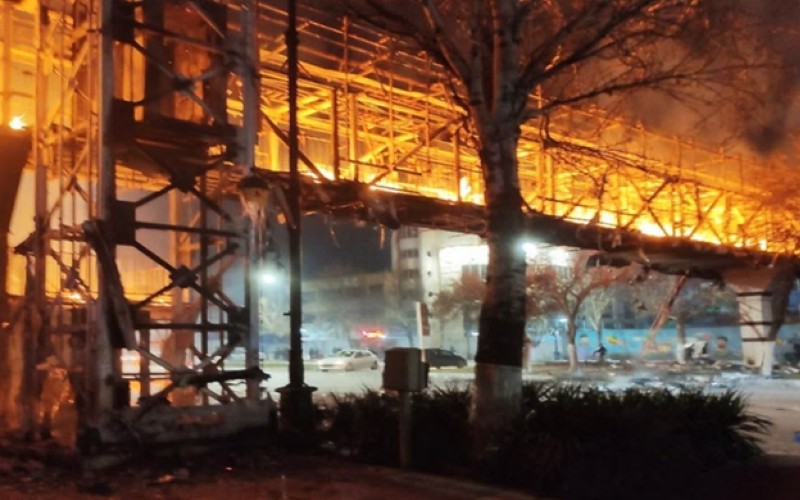

Why Iran’s latest uprising was not just about hardship, but a clear rejection of authoritarian rule.
From Economic Protest to a Political Turning Point
The uprising of January 2026 marked a decisive moment in modern Iranian history. What began as protests over economic hardship quickly evolved into something much larger: a direct challenge to the political legitimacy of the ruling system itself.
This was not simply an emotional outburst or a short-lived reaction to rising prices. It represented a critical stage in the long process of dismantling Iran’s religious dictatorship. For the first time in years, the protests openly targeted the foundations of power, not just its policies.
One of the most telling signs came from Tehran’s main bazaar. Traditionally, the bazaar has been closely linked to the religious establishment. When strikes and protests began there, it signaled a historic rupture between the regime and its former social allies. This was not symbolic alone—it showed that the regime’s social base was collapsing.
A Nationwide Movement, Not Isolated Anger
The protests spread rapidly—from central neighborhoods to outlying districts, from city to city, and across social classes. This speed and scale revealed something important: public anger had been building for years, and the usual methods of controlling dissatisfaction no longer worked.
From the very first days, it became clear that the uprising went far beyond economic demands. Protesters were calling for a fundamental change in how the country is governed. This was evident in the dominant slogans—especially those directly aimed at the highest authority in the system, such as “Death to Khamenei.”
These slogans showed a clear shift. People were no longer blaming individual officials or asking for reforms. They were rejecting the entire structure of power. In simple terms, the problem was no longer “bad management,” but the system itself.
The Collapse of the Politics of Fear
How threats of chaos stopped working
For years, the Iranian regime and its supporters relied on a familiar warning:
“If the system falls, the country will collapse.”
They constantly invoked fears of civil war, national breakup, or “becoming another Syria.” This narrative was designed to scare society into passivity. Protest was framed not as a civic right, but as a dangerous step toward chaos.
In reality, this was not a neutral warning—it was a tool of control. By turning the future into a permanent threat, the regime tried to present the current situation, no matter how unjust, as the only “reasonable” option.
The January uprising shattered this logic.
On the ground, the feared chaos did not happen. Instead of social breakdown, people showed solidarity across ethnic, religious, and social lines. Instead of disorder, a form of self-organization emerged—based on mutual care, trust, and practical cooperation.
Slogans such as “Neither Shah nor Mullahs” made this clear. Society was rejecting both forms of authoritarianism: monarchy and religious rule. Protesters were not looking backward; they were pointing toward a new idea—citizens governing themselves.
This proved something crucial: order does not require absolute authority. It can grow from shared responsibility and social trust.
Violence Comes from Power, Not Protest
The regime long claimed that protests would lead to violence. The uprising showed the opposite. Protesters acted with restraint and purpose, while violence largely came from the state’s monopoly on force.
This exposed a basic truth: systemic violence is a result of political exclusion and concentrated power, not public protest.
The fear narrative depended on portraying society as irrational and dangerous. The uprising showed a society that was aware, disciplined, and politically conscious.
From Symbolic Protest to Conscious Resistance
Another key change was how people protested.
After years of repression, demonstrators moved beyond purely symbolic actions. They adopted more flexible and strategic forms of resistance, including self-defense when necessary. This shift did not come from ideology or training—it came from lived experience.
Society learned from past crackdowns. It adapted.
Meanwhile, the behavior of security forces revealed something else: weakness at the top. Conflicting orders, chaotic responses, and visible confusion pointed to a crisis of authority. Political theory has long noted that when a regime relies more and more on brute force, it is a sign of declining legitimacy, not strength.
Citizenship, Responsibility, and Moral Choice
The January uprising also raised a deeper question: What does responsibility mean in a historic moment like this?
Participation crossed generations, classes, and identities. A broad consensus emerged against all forms of inherited or absolute power—religious or monarchism. Slogans like “Death to the oppressor, whether Shah or Supreme Leader” captured this shift clearly.
In such moments, neutrality is not neutral.
Political thinkers have long argued that silence in the face of injustice helps preserve injustice. Choosing not to act is still a form of action—one that favors the status quo.
This does not mean everyone must protest in the streets. But it does mean that a society cannot place the full cost of change on a small group and then expect to enjoy freedom without moral responsibility.
Rights do not survive without shared responsibility.
An Uprising as a Point of No Return
The January uprising marked a transition. Iranian society moved out of a long period of suspension and entered a phase of irreversible change.
This was not a response to a single crisis, but the release of long-standing tensions—economic, cultural, generational, and symbolic. People no longer saw themselves as passive observers waiting for reform from above or rescue by elites. They began to see themselves as political actors.
For the first time in decades, demands were framed not around survival, but around legitimacy and rights. Fear stopped being the main force shaping behavior.
While the regime still holds weapons, it has largely lost control over meaning and narrative. The old stories—reform from within, guaranteed stability, inevitable obedience—no longer convince.
What emerged is not yet a fully defined political program, but it has a clear foundation: a firm “No” to inherited power, religious rule, and authoritarianism in all its forms. This rejection is the condition for any future democratic “Yes.”
The importance of January lies not in immediate results, but in a permanent change in political behavior. Iran has entered a stage where returning to the past is no longer possible.
The transition has begun—costly, uncertain, and unfinished, but irreversible.