


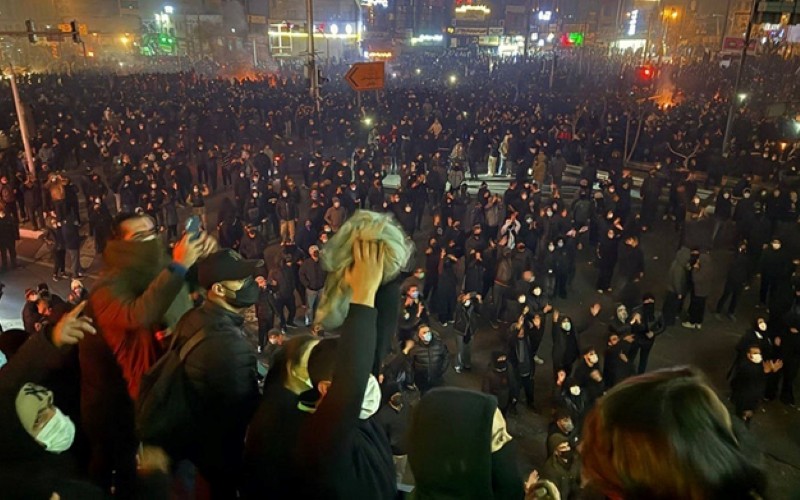

From monarchy to theocracy, and from foreign-engineered “solutions” to organized resistance—how a century of struggle has shaped Iran’s democratic alternative.
A Century Defined by Resistance, Not Chance
Iran’s modern political history, particularly over the last one hundred years, has been marked by continuous struggle for freedom. The situation Iran faces today—standing on the threshold of profound political change—is not the result of coincidence, sudden unrest, or a spontaneous social process. Rather, it is the outcome of organized resistance, built over decades and rooted in a long historical confrontation with authoritarianism.
This resistance is not merely a reaction to present conditions. It is the continuation of a historical trajectory in which Iranians have repeatedly confronted systems of absolute power—first under monarchy, then under a theocratic dictatorship.
June 20, 1981: A Defining Point of No Return
A critical turning point came on June 20, 1981 (30 Khordad 1360 in the Iranian calendar). On that day, Iranian society faced a decisive choice: submit to the newly consolidated clerical dictatorship led by Ruhollah Khomeini, or resist—at an extraordinary human cost.
Khomeini’s regime, which institutionalized the concept of Velayat-e Faqih (absolute rule of the supreme cleric), was not a break from Iran’s authoritarian past. It was its continuation, now wrapped in religious legitimacy. Khomeini himself openly admitted regret that mass executions had not begun earlier—an admission that revealed the regime’s fundamentally anti-human character.
From that moment onward, resistance did not pause—not for a single hour. What began was not simply a political or military confrontation, but an existential struggle over the very meaning of freedom, not only for Iran but for the wider Middle East.
The Myth of “No Alternative”
A recurring claim—often repeated by regime sympathizers or those with vested interests—is that “there is no alternative” to the Islamic Republic. This assertion is not an analytical conclusion; it is a deliberate erasure.
It ignores a resistance movement with a clear political program, a long record of sacrifice, and decades of sustained struggle. This democratic alternative did not emerge from foreign think tanks or external power centers—whose historical interventions in Iran have repeatedly replaced one dictatorship with another—but from within Iran’s own political and social battles.
Its defining principle has been clear and consistent: “Neither Shah nor Mullahs.” Neither monarchy nor theocracy.
Foreign Engineering and Manufactured Alternatives
Iran’s modern history is filled with externally engineered “solutions” that produced disaster:
- If, a century ago, British General Edmund Ironside had not engineered the rise of Reza Shah through the Cossack Brigade
- If, in 1941, the Allied powers had not imposed dynastic continuity instead of respecting Iran’s national sovereignty
- If the 1953 coup against Prime Minister Mohammad Mossadegh—a democratically elected leader—had not taken place
Then the political space that ultimately allowed clerical rule to emerge might never have existed.
Each imposed alternative suppressed democratic development and reproduced authoritarianism under a new label.
How Monarchy Paved the Way for Theocracy
A bitter historical reality must be acknowledged: Khomeini inherited a political vacuum created by the Shah.
By executing the founders of revolutionary democratic movements, imprisoning freedom fighters, and systematically destroying independent political cadres through the secret police (SAVAK), the monarchy eliminated the very forces capable of leading a democratic transition.
This destruction of authentic democratic leadership allowed reactionary religious networks—deeply embedded in traditional structures—to hijack the 1979 anti-monarchy revolution. In this sense, clerical rule was not an aberration but the logical extension of a long-standing system of political exclusion.
Change Is Not Managed Behind Closed Doors
Revolutions and genuine change are not products of secret negotiations among powerful states. They arise from historical necessity, shaped by the will of an oppressed people.
From the Constitutional Revolution of the early 20th century to today’s uprisings, the Iranian people have consistently demanded two fundamental principles:
- Freedom
- Free and fair elections
These demands have never changed—only the price paid for them has.
A Democratic Alternative Forged in Sacrifice
Today’s democratic alternative is not theoretical. It is the result of over sixty years of endurance, sacrifice, and continuous resistance. It was not sustained by foreign subsidies or geopolitical convenience, but by what its supporters describe as maximum sacrifice.
This is why the current moment matters. Iran stands before a transformation whose cost has already been paid—by generations who refused to abandon the struggle, even in the darkest chapters of repression.
History Will Judge Who Endured
History rarely rewards those who wait for compromise with tyranny. It remembers those who refused to suspend the fight for freedom—even for a single hour.
Iran’s future, as history will record, belongs not to opportunists or imposed alternatives, but to those who understood that freedom is never granted—it is won, defended, and sustained through unwavering resistance.