

Regime statements reveal mass detentions, overwhelmed prisons, and persistent resistance despite sweeping crackdowns
Senior officials of Iran’s regime have made rare public admissions revealing the scale of damage suffered by the regime during the ongoing nationwide uprising, even as street confrontations continue across multiple provinces.
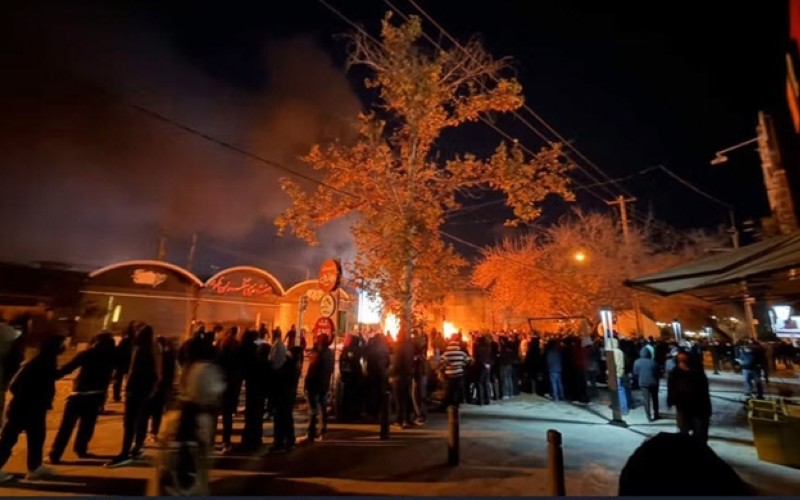
On Monday, Ebrahim Azizi, head of the regime parliament’s Security Commission, disclosed striking figures related to recent unrest. According to Azizi, protesters burned down 250 Basij bases, 90 religious seminaries used for the regime’s propaganda and repressive purposes, and more than 2,200 police motorcycles and vehicles. He also claimed that 3,709 members of the police, Basij, and Revolutionary Guards were severely injured during the clashes.
Despite clear inconsistencies and likely underreporting, these figures nonetheless point to an extraordinary level of public anger and organized resistance. The scale of destruction described by a senior regime official underscores the depth of social resentment accumulated over years of repression, economic hardship, and political exclusion.
Further confirmation of the regime’s strain came the same day from Gholamhossein Mohseni Ejei, the regime’s judiciary chief, who acknowledged that prisons are struggling to cope with the surge in arrests.
“A significant number of people have been added to the prisons, and keeping and managing them is not easy,” Ejei stated on Monday.
That admission was echoed indirectly by Ahmad-Reza Radan, the regime’s national police chief, who said that “many rioters have been identified” and that security forces would “go after them one by one” to arrest them. Taken together, these statements suggest two realities the regime authorities rarely concede openly: mass arrests have already stretched detention capacity to its limits, and despite widespread crackdowns, many key protest organizers remain at large.
While officials speak of control, events on the streets tell a different story.
On Monday, January 19, clashes and running battles continued between young protesters and riot police on Enghelab Street in Tehran, as well as in Tabriz and Izeh. Similar confrontations had already taken place on Saturday and Sunday (January 17–18) across Tehran and several provincial cities.
Neighborhoods including Valiasr Street, Saadat Abad, Salehiyeh, Tehranpars, and Ekbatan witnessed repeated clashes, with protesters chanting slogans such as “Death to the dictator” and “Death to Khamenei.”
In Eslamshahr, protesters reportedly attacked the Qaemiyeh police station after clashes with special forces and disarmed officers accused of firing on civilians. In Kermanshah Province, residents and young members of the Qelkhani tribe in the village of Aineh-Vand near Sarpol-e Zahab broke a security cordon and, during an armed confrontation, disarmed some government forces who had arrived to arrest wounded protesters.
Meanwhile, in the northwestern city of Khoy, intense street fighting was reported on Saturday night. Protesters set fire to the district governor’s office and a Basij base after security forces opened fire. The night before, two additional Basij centers in the city were reportedly torched during clashes.
Together, these developments shed light on the meaning behind the guarded statements of the regime’s top security and judicial officials. Despite mass arrests and aggressive repression, prisons are overcrowded, the state is under pressure, and the streets remain active and volatile.
As one pattern emerges clearly from both official admissions and field reports, it is this: the regime is increasingly besieged—administratively, socially, and on the streets—while the confrontation between the authorities and society shows no sign of abating.