


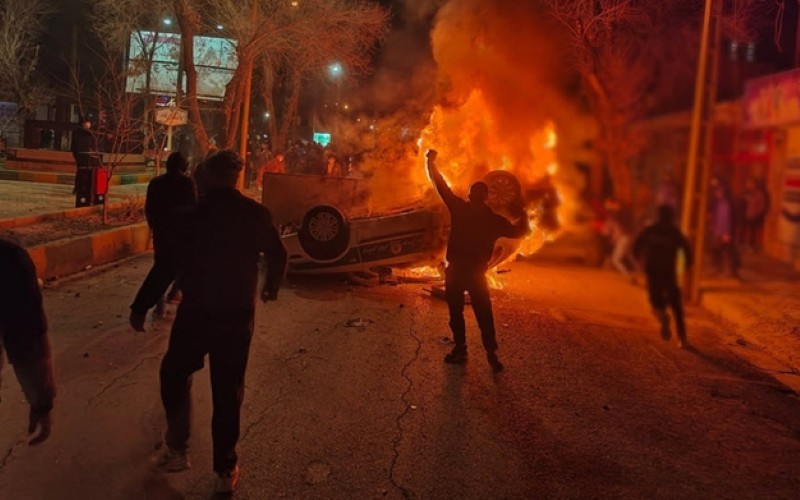

European Parliament resolution exposes regime vulnerability as officials warn of “war conditions” and fear continued uprising inside Iran
A Resolution That Struck a Nerve in Tehran
The Iranian regime’s leadership reacted with visible anger and anxiety after the European Parliament adopted a landmark resolution condemning the mass killing and repression of protesters in Iran and reiterating the call for the Islamic Revolutionary Guard Corps (IRGC) to be designated as a terrorist organization by the European Union.
The response—from the Foreign Ministry to senior IRGC commanders and regime-appointed Friday prayer leaders—revealed not confidence, but fear: fear of sustained public resistance, fear of international isolation, and fear that the IRGC, the backbone of the regime’s survival, is increasingly viewed as a criminal entity rather than a legitimate military force.
European Parliament: Repression, Executions, and the IRGC at the Center
In its resolution adopted on January 22, 2026, the European Parliament unequivocally condemned what it described as systematic, premeditated violence against protesters across Iran. Lawmakers cited mass killings, arbitrary arrests, accelerated death sentences following unfair trials, and one of the most extensive internet blackouts ever imposed by a state.
The Parliament stressed that the IRGC plays a central role in these abuses, both domestically and through regional destabilization. It called for:
- The full designation of the IRGC, including the Basij and Quds Force, as a terrorist organization
- Expanded EU sanctions, including asset freezes and travel bans against officials responsible for repression
- Immediate cessation of executions and the release of all political prisoners
- Accountability for crimes under international law
- Preparation for all possible scenarios, including political transition in Iran
The resolution also rejected regime claims that protests were foreign-driven, emphasizing that the uprising stems from deep economic, social, and political grievances shared across Iranian society.
Tehran’s Official Threats: “Interference Will Be Answered”
Iran regime’s Foreign Ministry responded by warning that any European decision concerning Iran’s armed forces or security institutions would be met with reciprocal action. While framed as a diplomatic warning, the statement underscored the regime’s sensitivity to the prospect of the IRGC being internationally branded as a terrorist entity.
Such language reflected less diplomatic confidence than concern over the legal, financial, and political consequences of further isolation.
IRGC Commanders Admit Unprecedented Resistance
More revealing were remarks by senior IRGC figures, who acknowledged that recent unrest went far beyond sporadic protests. One regional IRGC commander described the resistance as unusually organized and destructive, noting that numerous regime bases—used as ideological and military training centers—had been targeted.
He warned that delay in confronting what he described as an existential threat could make future action impossible, an implicit admission that the regime is losing control of the situation on the ground.
Friday Pulpits Echo Fear of Internal Collapse
Regime-appointed Friday prayer leaders across Iran echoed similar anxieties, repeatedly framing the protests as a near–civil war scenario.
In Tehran, the regime’s chief Friday prayer leader portrayed the uprising as a coordinated attempt to overthrow the system, warning that the country had been pushed to the brink of internal conflict. In other cities, representatives of the Supreme Leader described the situation as “fully war-like,” urging vigilance to prevent internal implosion.
Several explicitly acknowledged that the IRGC itself had become the primary target of public anger, conceding that the regime’s opponents view the Guard as the strategic pillar whose weakening could bring the entire system down.
A Regime on the Defensive
Taken together, these reactions form a coherent picture: a ruling structure under severe pressure, rattled by both internal resistance and growing international consensus against its methods of survival.
The European Parliament’s resolution did not merely condemn repression—it challenged the regime’s narrative, legitimacy, and coercive core. The increasingly agitated tone from Tehran suggests that European calls to blacklist the IRGC and hold perpetrators accountable are resonating far beyond diplomatic chambers.
As protests persist and international scrutiny intensifies, the Iranian regime appears less focused on projecting strength and more on containing a crisis it no longer fully controls.