



Satellite imagery reveals tunnel burial and reconstruction at a bombed facility, raising new concerns over the regime’s uranium enrichment ambitions
Renewed Activity Signals Strategic Concealment
Recent high-resolution satellite imagery reveals a sharp increase in activity at Iran regime’s Esfahan nuclear complex, pointing to deliberate efforts by the regime to conceal sensitive infrastructure and potentially reconstitute elements of its nuclear enrichment program.
According to a January 29, 2026 assessment by the Institute for Science and International Security, Iran’s regime has begun burying key tunnel entrances while simultaneously rebuilding part of a facility previously destroyed by Israeli air strikes.
The developments come amid heightened regional tensions and follow a pattern previously observed ahead of military strikes during the 12-day war, suggesting preparations against renewed attacks rather than routine maintenance.
Tunnel Entrances Buried as Northern Access Remains Active
Satellite images taken on January 24 and January 29 show Iran’s regime actively re-burying the middle and southern tunnel entrances at the Esfahan mountain complex using large volumes of fresh soil. Construction vehicles and convoys of dump trucks were observed transporting and depositing earth to fully block access points that had previously remained visible.
In contrast, the northernmost tunnel entrance—heavily reinforced over recent months with hardened structures and missile chicanes—remains open, with vehicles positioned nearby. Analysts assess that this asymmetry raises the possibility that Iran is relocating recovered or sensitive assets from exposed sites into the hardened northern tunnel, rather than removing equipment from the complex.
Rebuilding a Destroyed Facility Raises Red Flags
Even more concerning is renewed construction activity at an above-ground building inside the Esfahan complex that was destroyed during an Israeli strike on June 20, 2025. After months of debris clearance, Iran’s regime has repaired the surviving steel framework and installed a new roof, despite leaving wall panels absent as of late January 2026.
The addition of the roof began in early December 2025 and progressed in stages, indicating a deliberate reconstruction effort rather than simple cleanup. Experts note that a roof alone can serve to obscure internal activity from satellite observation while allowing work to proceed inside.
Links to Centrifuge Manufacturing
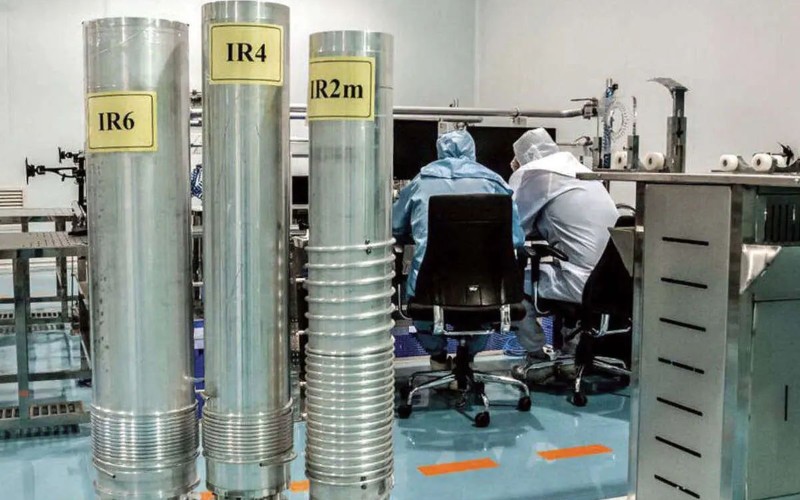
While analysts did not publicly identify the specific function of the destroyed building, multiple indicators suggest it was associated with gas centrifuge manufacturing. The building’s design—including a long annex added in late 2020—closely resembles structures at Iran’s centrifuge production facility near Karaj, which was attacked by drones in June 2021.
The annex configuration, roof-mounted ventilation-like structures, and expansion timeline align with known centrifuge component production sites. Moreover, analysis following the 2025 strike confirmed that the targeted area at Esfahan housed centrifuge manufacturing operations, involving at least two buildings.
Strategic Implications: Enrichment Takes Priority
Analysts assess that the combination of tunnel burial, selective hardening, and partial reconstruction indicates a strategic priority: preserving and recovering enrichment-related assets rather than uranium conversion infrastructure. If confirmed, this would signal the regime’s determination to maintain a latent—or rapidly restorable—uranium enrichment capability despite international scrutiny and prior military strikes.
Absent transparency or cooperation with international inspectors, these actions inevitably intensify concerns that Tehran is quietly rebuilding the backbone of its gas centrifuge program under layers of soil, concrete, and deception.
A Pattern of Defiance, Not Deterrence
Rather than signaling restraint, the latest activity at Esfahan underscores the regime’s longstanding pattern of concealment and escalation. By burying access points and shielding reconstruction from overhead surveillance, Tehran appears to be betting that opacity and physical fortification can outlast pressure—diplomatic or military.
For observers, the message is clear: the Esfahan nuclear site remains not only active, but central to Iran’s contested nuclear ambitions.