A defiant message from inside Qezel Hesar Prison honors the martyrs of Iran’s January 2026 uprising and reaffirms unwavering commitment to the struggle against the clerical regime.
A Voice From Behind Bars
In January 2026, political prisoner Akbar Bagheri issued a powerful statement from Qezel Hesar Prison, declaring solidarity with Iran’s nationwide uprising and honoring those who confronted the regime’s forces in the streets.
Opening his message with tribute and reverence, Bagheri saluted the people who stood unarmed against the machinery of repression:
“In respect and honor of the people who stood in the streets, fighting bravely in an unequal battle against the mercenaries of the Velayat-e Faqih, and who offered tens of thousands of martyrs and wounded, I stand and bow my head.”
He described the uprising as a sacred covenant—paid for with blood—whose purpose is nothing less than freedom:
“May the pure and sacred blood of these beloved pave the path to the freedom of Iran’s people, and may the trumpet of liberty and the sun of emancipation rise over Iran.”
From the Bazaar to the Streets
Bagheri recounts how the uprising ignited and spread rapidly, beginning with merchants and swelling into a mass revolt led by rebellious youth:
“The uprising of the people began with the bazaar and quickly became nationwide. The streets filled with revolutionary passion, overflowing with rebellious youth who finally cried out the suffocated rage that had been trapped in their throats for years.”
He warns that the regime’s familiar tactic of distortion is always a prelude to bloodshed:
“Whenever the regime resorts to distortion and inversion of reality, it has committed a crime. When the regime’s thugs label revolutionary youth as terrorists and foreign agents, their objective is perfectly clear.”
Drawing historical parallels, Bagheri adds:
“Under the Shah’s dictatorship as well, freedom fighters were branded terrorists and traitors. This is the unbroken tradition of dictators everywhere—and it is nothing new for us.”
Stars in the Darkness
From inside prison walls, Bagheri turns his gaze to the streets—where, amid gunfire, young Iranians make the ultimate sacrifice:
“In the streets, amid the clatter of the regime’s machine guns, there are young people who place their lives on the line, who give up everything for the liberation of their people.”
He memorializes them in poetic terms:
“They become stars so they may shine in the blackened darkness of their homeland. Bright stars departed from our sorrowful sky so they could illuminate the white dawn of freedom.”
Remembering Dr. Naim Abdollahi
Bagheri singles out one such figure: Dr. Naim Abdollahi, a 34-year-old scholar and university lecturer killed during the uprising.
“One of these shining stars was Dr. Naim Abdollahi, 34 years old, holding a PhD in law and political science, and a lecturer at Tehran University.”
Describing his background and commitment, Bagheri writes:
“Commander Naim, a courageous son of Kurdish Kermanshah, laid down his life for his ideals on January 8 in Nazi Abad, Tehran.”
Abdollahi’s vision, he explains, was rooted in lived solidarity with the marginalized:
“He wanted to give real meaning to prosperty—true prosperity—for oppressed people he understood with all his flesh and blood.”
Bagheri frames Abdollahi as a lasting model for Iran’s youth, quoting a defiant maxim:
“To live in humiliation is a disgrace; death is better than such a life.”
A Pledge Until Overthrow
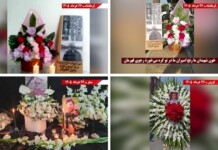
In the closing section, Bagheri honors the martyrs of January in Kermanshah, naming several fallen protesters and reaffirming an unbreakable vow:
“We pledge that until we dismantle Zahhak limb by limb, we will not rest.”
He concludes with a direct oath to his compatriots—especially Iran’s Kurdish population:
“I, a political prisoner, pledge to you—my sisters and brothers, my fellow citizens and Kurds—that I stand with you and will continue to stand until overthrow.”
His final words leave no ambiguity about the regime’s fate:
“Whenever a people are ready to give everything for freedom, they will certainly be victorious.”
A Message That Transcends Prison Walls
Akbar Bagheri’s statement from Qezel Hesar Prison is not merely a message of solidarity—it is an indictment of the clerical regime, a memorial to the fallen, and a declaration of unwavering resistance. From behind bars, his voice joins the chorus of a nation demanding liberation, echoing a single, unyielding resolve: until overthrow.