


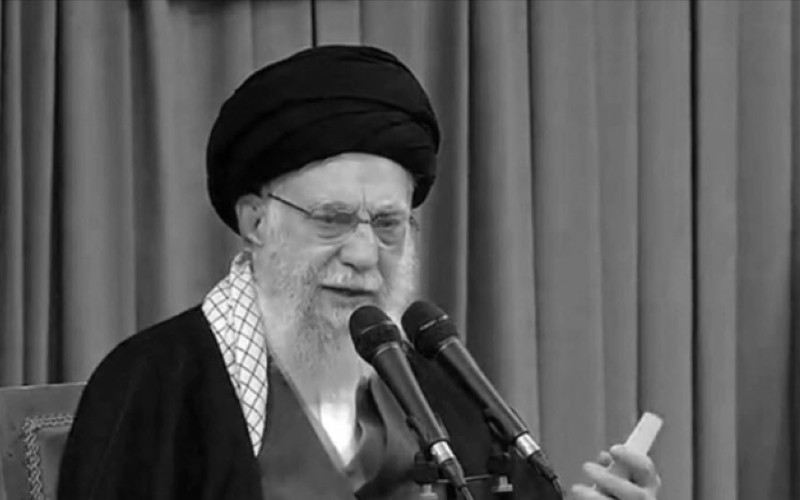

Tehran’s renewed push for negotiations is a strategy to buy time under revolutionary pressure—not a path to stability, reform, or national sovereignty.
Negotiation as Retreat, Not Confidence
After months of regional and international pressure—and particularly following the European Union’s designation of the IRGC as a terrorist organization—Iran regime’s supreme leader Ali Khamenei has been forced into an unmistakable retreat. The regime’s sudden willingness to consider “direct negotiations” is not a diplomatic breakthrough; it is the raising of a white flag by a system under siege.
The regime’s president, Masoud Pezeshkian, acting as the executor of the Supreme Leader’s line, attempted to reframe this retreat as prudence and dignity. In a carefully staged statement, he claimed that talks would proceed only if they were “fair,” “non-threatening,” and consistent with so-called “national interests.” This rhetoric is designed less to convince foreign interlocutors than to mask capitulation at home.
Only months earlier, Khamenei had repeatedly declared: “There will be neither war nor negotiations.” The reversal that followed the January 2026 nationwide uprising exposes the reality: this shift is not born of strength, but of profound structural weakness.
A Regime Buying Time Under Revolutionary Pressure
The clerical dictatorship now faces a convergence of crises: a revolutionary situation inside Iran, the mass killing of protesters, the total collapse of its social base, and sustained external pressure. Under these conditions, negotiations are not a solution—they are a time-buying mechanism.
From the regime’s perspective, reopening talks serves three immediate goals:
- Reducing the risk of regional escalation, not out of concern for peace, but to protect the IRGC from accountability.
- Diluting international pressure, particularly sanctions that are crippling the regime’s economy.
- Delaying decisive outcomes, especially until political cycles shift in Western capitals.
It is no coincidence that several regional states—Egypt, Qatar, Saudi Arabia, and the UAE—have expressed interest in facilitating talks. Their priority is de-escalation. However, de-escalation with a regime that thrives on crisis does not resolve the underlying threat.
The Nuclear File: Levels Are Negotiable, Capability Is Not
Tehran insists that any negotiations must be strictly limited to the nuclear issue—and even then, only on its own terms. Senior IRGC figures have openly stated that enriched uranium must remain inside Iran and that the regime’s technical infrastructure is non-negotiable.
In practical terms, the regime is demanding recognition of its nuclear breakout capability, including hundreds of kilograms of 60% enriched uranium, while offering only tactical reductions in enrichment levels. This means the speed of the program might slow—but its destination remains unchanged.
This is why the dispute is not technical but strategic. Temporary confidence-building measures do not eliminate the threat; they merely postpone it.
Missiles and Proxies: The Real Red Lines
Two additional pillars of the regime’s power are deliberately excluded from Tehran’s negotiating framework:
- Ballistic missiles, which function as the delivery mechanism connecting nuclear capability to real-world threat.
- Regional proxy forces, sustained through massive financial, logistical, and military support.
For Khamenei and the IRGC, these are absolute red lines. Yet they are precisely the elements that make the regime destabilizing at a regional level. Ignoring them renders any agreement fragile and reversible.
The regime’s insistence on keeping these tools intact reflects not confidence, but fear—particularly after the collapse of key regional strongholds and growing calls to dismantle armed militias in countries like Lebanon and Iraq.
No War, No Appeasement: The NCRI Perspective
It must be stated clearly: Iran’s crisis will not be resolved by foreign military intervention, nor by deals struck over the heads of the Iranian people. War strengthens the regime’s narrative of external threat, while appeasement prolongs its lifespan.
From the perspective of the National Council of Resistance of Iran (NCRI), the only viable solution is neither war nor clerical negotiation—but regime change by the Iranian people themselves. Any diplomatic process that sidelines human rights, repression, and the people’s right to sovereignty merely resets the clock for future crises.
Negotiations for Negotiations’ Sake
What Khamenei has launched today is not a peace initiative, but a familiar tactic: “no war, no peace.” A controlled stalemate that allows the regime to survive while continuing repression at home and destabilization abroad.
Yet the margins for maneuver are shrinking. Economic collapse, currency freefall, and chronic inflation are accelerating social unrest. Each delay deepens the regime’s vulnerability.
For this reason, the prospect of a genuine, comprehensive, and durable agreement is extremely weak. The contradictions are structural, the trust nonexistent, and the regime’s weakness irreversible.
In the end, negotiations cannot save a system already rejected by its own people. Iran’s future will not be decided in foreign capitals or closed-door talks—but in the continued resistance of a society that has already crossed the point of no return.