


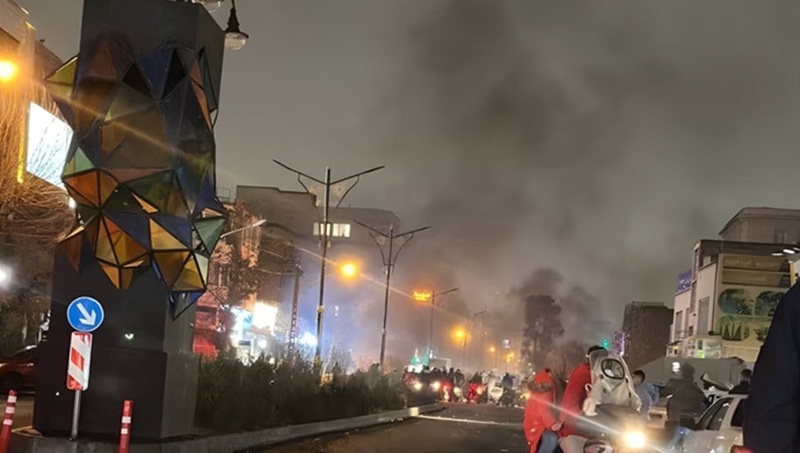

Even state-affiliated newspapers now expose a widening gap between society and a regime incapable of describing—let alone solving—Iran’s deepening crises
There comes a moment in the life cycle of authoritarian systems when repression is no longer sufficient—and rhetoric no longer credible. Iran’s exhausted doctrine of Velayat-e Faqih, sustained for decades through religious fundamentalism and systematic coercion, has now reached precisely that juncture.
What makes this moment particularly revealing is not opposition media or foreign analysis, but the language emerging from within the regime’s own tightly controlled press. Newspapers such as Tose’e Irani and Shargh, despite operating under structural censorship, have published assessments that inadvertently expose the historical deadlock confronting Iran’s rulers.
The regime is no longer merely facing protests. It is facing a crisis of narrative authority.
A System That Can No Longer Describe Reality
One of the clearest indicators of systemic decline is when a government loses not only the power to persuade, but the capacity to accurately describe the reality around it. Tose’e Irani directly pointed to what it described as a “deep gap between the language of the people and the rhetoric of officials.”
While authorities attempt to reduce widespread unrest to isolated incidents, lifestyle disputes, or foreign agitation, the newspaper warned against minimizing the scale of public anger. It noted that some political figures continue to portray the current upheaval as nothing more than fleeting excitement or external manipulation, yet the lived experience of society contradicts such reductionist narratives.
This observation is politically significant. It suggests that the regime’s response to mounting anger is not introspection but what can only be described as systemic deafness. When demands for bread, freedom, and dignity are reframed as superficial issues, the ruling establishment effectively signs its own declaration of estrangement from society.
A government that cannot articulate the grievances of its people has already lost one of the fundamental pillars of governance: legitimacy grounded in shared reality.
Economic Bankruptcy and the Radicalization of Normal Life
For years, the regime tied its survival to regional expansionism and ideological confrontation abroad. Today, however, it confronts a far more immediate and destabilizing reality: the emptying of household tables.
Tose’e Irani highlighted a stark admission by the regime’s president, who responded to criticism of the upcoming budget by stating bluntly that there is no money. The message conveyed to society was unmistakable—no structural change is forthcoming. In a country where the national currency has halved in value within a year and the middle class is steadily eroding, the public has grown immune to official justifications.
The implications are profound. When economic decline becomes normalized and the state offers no credible path forward, even the modest aspiration of living an ordinary life transforms into a radical demand. Under conditions of political blockage and economic misery, the simple “right to a normal life” evolves into a direct challenge to the system itself.
In this sense, the regime’s bankruptcy is not only fiscal—it is strategic.
A Society Under Trauma
Another dimension of the regime’s downward trajectory emerges in the social and psychological landscape described by Shargh. The newspaper examined the human consequences of sustained repression and insecurity, portraying a society caught between domestic coercion and external threats.
It wrote of a grieving population mourning those who lost their lives in recent unrest, while dissatisfaction, anger, and despair continue to rise. The paper also underscored a fundamental governance principle: a state unaware of the true conditions within society cannot define long-term objectives for it.
This is perhaps the most damning assessment of all. It portrays a ruling structure that has lost its organic connection with the population and survives primarily through fear and anxiety. Yet history demonstrates that when anger overtakes fear, repression ceases to guarantee stability.
Authoritarian systems depend on psychological dominance. Once that balance shifts—once citizens are more enraged than intimidated—the countdown to structural collapse begins.
Beyond Reform, Toward Resolution
What is emerging from these internal commentaries is not reformist optimism but systemic exhaustion. The regime appears trapped between denial and incapacity. It cannot meaningfully reform without undermining its ideological foundations, yet it cannot continue governing effectively under current conditions.
The widening chasm between official discourse and lived reality, the admission of economic insolvency, and the acknowledgment of collective trauma all point to a regime that has entered a terminal phase of political estrangement.
The critical variable is no longer whether discontent exists; it is whether the ruling establishment retains the institutional resilience to contain it. When language fails, when economic promises evaporate, and when social grief turns into organized anger, the architecture of authoritarian control begins to fracture from within.
Iran’s theocracy now stands exposed before a reality it can neither reinterpret nor repress indefinitely. And when a system loses the ability to define reality, it has already begun to lose power itself.