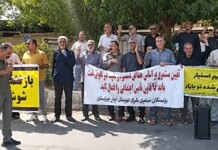
Senior regime figures openly reaffirm commitment to suppress protests and prosecute demonstrators
Senior figures within Iran’s regime have publicly reiterated their determination to intensify repression against protesters, signaling that the regime views the current unrest as an existential threat.
In recent statements broadcast on state-affiliated outlets on February 10, 2026, senior political and judicial authorities framed the protests not as domestic grievances but as part of an ongoing foreign-backed effort aimed at overthrowing the regime.
“The Enemy’s Objective Has Not Changed”
Mojtaba Zolnouri, a member of the Iranian Parliament, speaking in Rasht, asserted that the ultimate objective of what he described as the “enemy” remains regime change.
“The enemy’s objective, which is the overthrow of the system, has not changed.”
Referring to recent street clashes in Isfahan, he described incidents in which fuel was allegedly poured on road surfaces to cause motorcycles used by special forces to slip and crash. According to Zolnouri, two motorcycles fell and four riders were detained.
He also linked internal unrest to broader geopolitical tensions, questioning the meaning of simultaneous diplomatic engagement and military positioning by the United States. Referring to reported contacts between U.S. envoy Steve Witkoff and Iranian Foreign Minister Abbas Araghchi, alongside the presence of U.S. Central Command leadership, he stated:
“What does it mean that Mr. Witkoff sits at the table with Mr. Araghchi for negotiations, while at the same time Mr. Cooper, the U.S. regional commander and head of CENTCOM, is also brought to the table? It means on one side the carrot of negotiations and on the other side the stick—and if you do not yield, there will be a military attack.”
His remarks were aired by the state-run Baran TV network.
Judiciary Promises “Decisive” Action
Senior judiciary officials echoed similar themes, emphasizing that those accused of involvement in unrest would face firm legal consequences.
Ali Khalili, First Deputy of the Judiciary, addressed demands from pro-regime audiences calling for harsher punishment of what authorities label “rioters” and “terrorists.” When asked about the status of related cases, Khalili stated:
“Some of these cases have been investigated by the prosecutor’s office and have come to court with indictments. The courts have examined some of them and issued verdicts in accordance with legal standards. But as you have seen, in these circumstances where they rioted, caused disruption, and committed arson, decisive action will naturally be taken against them.”
His comments were published by the state-affiliated Student News Agency (ISNA).
Judiciary spokesperson Masoud Jahangir reinforced that message, warning that those accused of deliberately pouring gasoline during unrest would face legal repercussions.
“Those who deliberately and knowingly poured gasoline in these events should be assured that they will be dealt with according to the law.”
He added that the head of the judiciary had ordered firm and expedited handling of such cases and expressed dissatisfaction that judicial staff were not working with sufficient “jihadist” and round-the-clock effort. Jahangir concluded:
“We will distinguish crocodile tears from genuine tears.”
Escalation Rather Than De-escalation
Taken together, these statements indicate that Iran’s leadership is preparing for a sustained campaign of repression rather than accommodation. Officials consistently frame protests as organized subversion rather than expressions of domestic discontent, reinforcing the regime’s longstanding narrative that unrest is externally orchestrated.
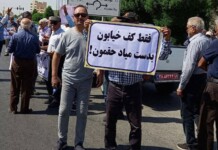
The emphasis on rapid indictments, decisive rulings, and intensified judicial procedures suggests a coordinated effort between security forces and the judiciary to deter further mobilization. As demonstrations and acts of civil resistance continue in various cities, the regime’s messaging leaves little doubt: it intends to respond with force, prosecution, and expanded security measures.
Whether this strategy will succeed in containing the unrest—or further deepen public anger—remains an open question. What is clear is that the regime perceives the current wave of protests not as an episodic disturbance, but as a direct challenge to its survival.