
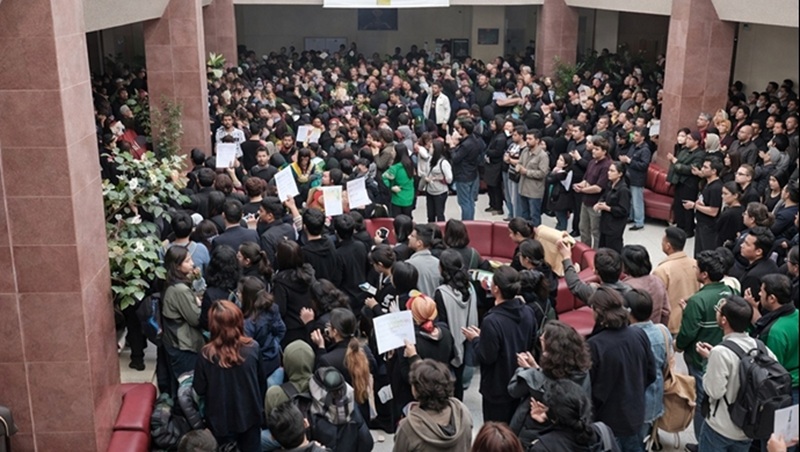

Student protests from February 21–25 reveal deepening anger, generational rupture, and a regime struggling to contain a restless post-January society
Universities as Aftershocks of January 2026
The renewed wave of protests across Iran’s universities between February 21 and February 25 confirms a central reality: the January 2026 uprising was not an isolated explosion of anger, but the beginning of a sustained phase of political and social confrontation.
State-run daily Jahan Sanat described the events of Dey 1404 (January 2026) as a “historic turning point” whose aftershocks are now clearly visible on campuses. What unfolded in early Esfand (late February) at major universities, the paper argues, must be understood as part of the same chapter—an extension of that “earthquake.”
This framing is significant. Even voices within the regime’s tolerated media sphere acknowledge that the unrest is systemic, long-term, and deeply embedded in society’s psychological fabric.
Accumulated Grievances, Not Isolated Incidents
The protests are repeatedly described as the product of “accumulated dissatisfaction.” This terminology suggests structural grievances—economic hardship, political exclusion, repression, and generational marginalization—rather than spontaneous unrest.
Warnings in state-affiliated commentary are unusually stark:
- If no meaningful change occurs, society should prepare for “more dangerous consequences.”
- The failure to create space for dialogue will not repair divides but deepen them.
- Widespread disappointment and despair may morph into broader instability.
Such language signals elite anxiety. The regime’s own commentators implicitly concede that suppression without reform risks escalating rather than containing unrest.
The Youth Factor: A Generational Deadlock
Perhaps the most revealing statistic comes from Etemad:
- 77% of those arrested during the January 2026 protests were under 30.
- Among them, 17% were high school students and 6% university students.
This demographic reality is politically explosive.
The current tension is described not as a “gap” between generations, but as a blockage—an “deadlock.” Young people reportedly feel that even when their voices are heard, nothing changes. Silence, under these conditions, becomes compressed frustration—ready to convert into anger.
This is not apathy. It is a transition from reform expectations to structural rejection.
Campuses Under Siege
According to the state-run daily Tose’e Irani, the reopening of universities was marked by confrontation, broken glass, physical altercations, and visible psychological strain. The symbolic meaning is clear:
- University lobbies once considered safe spaces were shattered.
- Campuses increasingly resemble securitized zones rather than academic institutions.
- Students confront not only security forces but also organized pro-regime groups.
The key unresolved question raised in coverage:
Under what legal authority are counter-protest groups empowered to physically confront students?
The presence of such groups reveals regime strategy: indirect confrontation, plausible deniability, and intimidation inside institutions traditionally associated with civil society.
The End of the “Command Era”
One of the most striking assessments describes the emergence of a new generation that:
- Does not understand the language of the regime’s “orders and command.”
- Views the university not as a credential factory, but as a fortress for reclaiming civic identity.
- Responds to threat lists and disciplinary intimidation not with retreat, but with intensified anger.
- This is a qualitative shift.
Control mechanisms effective in previous decades—disciplinary files, ideological screening, bureaucratic pressure of the regime—are now described as ineffective against a politically conscious, digitally connected, and psychologically mobilized generation.
Regime Fear and Strategic Dilemma
The tone of the commentaries reflects institutional concern:
- Continued securitization risks turning universities into permanent crisis centers.
- The cost of repression may become “irreparable.”
- The cycle of violence could destroy “all bridges of return.”
This is not revolutionary rhetoric—it is caution emerging from within the system’s own discourse.
The regime faces a structural dilemma:
- Concede political space and risk emboldening dissent.
- Escalate repression and risk radicalizing an entire generation.
Either path carries destabilizing implications.
The Continuity of January
The February university protests demonstrate three strategic realities:
- The anger of January 2026 has not dissipated. It has migrated into structured spaces—universities, schools, civic institutions.
- Youth participation is central, not peripheral. The demographic core of the uprising remains mobilized.
- The regime’s control narrative is weakening. Even regime-aligned media acknowledge systemic fractures and long-term consequences.
- The broken windows and empty professor chairs described in reports are not merely physical damage. They symbolize a legitimacy crisis unfolding inside the institutions that once reproduced state authority.
Conclusion: A Society Beyond Containment
The protests from February 21–25 are not an isolated campus disturbance. They are evidence that:
- The political shock of January 2026 continues to reverberate.
- Youth anger has hardened into determination.
- The regime’s instruments of fear are losing deterrent capacity.
- Structural reform remains absent.
Universities have once again become barometers of national unrest in Iran. What is unfolding is not simply student activism, but a generational confrontation with a governance model perceived as unresponsive and exclusionary.
If January was the earthquake, February may be proving that the fault line remains active.