


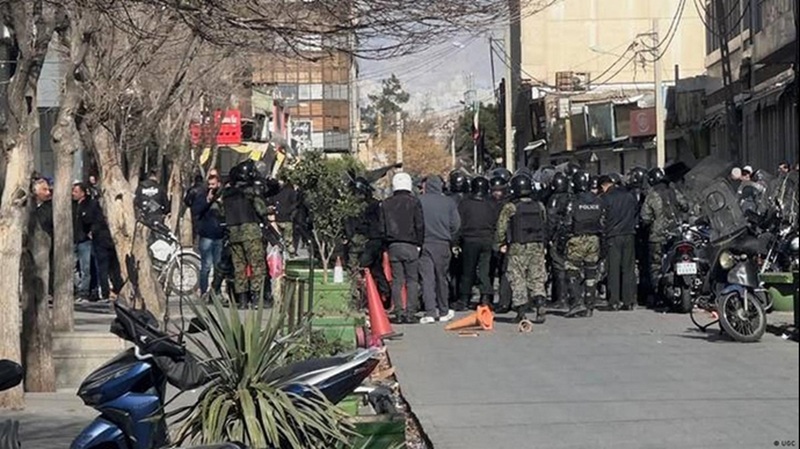

February 19 remarks outline a seven-phase strategy to criminalize protest, tighten internet control, and prepare security forces for intensified confrontation.
The February 19 statements by Majid Khademi, head of the Intelligence Organization of the Islamic Revolutionary Guard Corps (IRGC), should not be dismissed as a routine performance report. His remarks amount to an open admission of the regime’s roadmap for confronting future uprisings similar to those that erupted in January 2026.
By presenting what he described as a “seven-phase plan,” Khademi sought to attribute any form of domestic protest to foreign “think tanks” and hostile powers. He claimed that the “enemy” aims to spark unrest and transform it into strikes—describing strikes as an “invisible weapon.” In doing so, he effectively criminalized not only political dissent but also basic labor action and civil protest, framing them as components of an external security project.
This inversion—casting socioeconomic grievances as foreign conspiracies—is a familiar doctrine within the Iranian regime. It provides ideological cover for repression rooted in widening class divisions and economic hardship, rebranding crackdowns as counterterrorism.
Explicit Preparation for Confrontation
Khademi’s acknowledgment of “attacks on sites and headquarters aimed at dismantling the security ring,” alongside his reference to institutions such as the Islamic Revolutionary Guard Corps’s Tharallah Headquarters and the Basij militia, underscores the regime’s concern about the vulnerability of its coercive infrastructure. His remarks confirm that public anger has evolved beyond slogans and now directly targets the regime’s enforcement arms.
Most striking, however, was his citation of guidance from Supreme Leader Ali Khamenei. According to Khademi, Khamenei instructed security bodies to treat the current period as analogous to the early 1980s—a reference to the violent consolidation of power during the regime’s formative years.
He relayed three core directives attributed to Khamenei:
- Intensify intelligence monitoring, particularly regarding individual and factional “infiltration.”
- Separate “the people and protesters” from “rioters,” persuade the “uninformed youth,” and deal decisively with those labeled as instigators.
- Ensure “proper governance of the internet.”
The strategy of “separation” is not neutral crowd management. It is a mechanism for legitimizing selective but severe violence. By acknowledging that “people’s problems are real,” the regime attempts to project empathy. Yet the immediate call for decisive confrontation exposes the underlying priority: control through force.
Internet Control and Information Blockade
Repeated emphasis on “proper governance of cyberspace” signals the regime’s recognition that digital communication remains one of its greatest vulnerabilities. The reference to the 1980s is instructive. During that decade, the state relied on newspaper closures, media monopolization, mass arrests, torture, and executions to silence opposition.
Today, the same logic appears poised for digital replication—through expansion of the so-called “national internet,” cyber repression, and intensified surveillance. The objective is informational containment: prevent mobilization, restrict narrative formation, and disrupt coordination.
By invoking the year 1981 as a parallel, the message to security forces is unmistakable—prepare for uncompromising confrontation. The leadership appears intent on instilling a sense of existential threat among its ranks to prevent defections or hesitation within its enforcement apparatus.
Reframing Economic Protest as Treason
Khademi’s assertion that the “enemy seeks to exploit economic challenges to create unrest” reveals another pillar of the strategy: deny the domestic roots of protest. By redefining economic grievances as a foreign-engineered security operation, the regime lowers the political cost of repression.
This approach mirrors tactics employed during the Iran–Iraq War, when external conflict facilitated internal consolidation of absolute power. Today, references to economic pressure, the snapback sanctions debate, or the possibility of U.S. military action serve a similar function—framing dissent as national betrayal.
In the 1980s, dissenters were branded with ideological labels to justify elimination. The contemporary equivalent risks portraying every labor activist, student protester, or political critic as an infiltrator. Such framing is designed to normalize harsh measures in the public sphere.
A Regime in Defensive Posture
The cumulative effect of Khademi’s statements is a portrait of a government under siege—caught between a legitimacy crisis and fear of structural collapse. His warning that adversaries have concluded they must first create “crisis and rebellion” reflects less an intelligence breakthrough than an acknowledgment of widespread societal volatility.
The January uprising demonstrated that repression can suppress visible unrest but cannot eliminate the underlying drivers of dissent. Thousands were killed, injured, or detained, yet the demand for systemic change persisted.
The February 19 remarks suggest that the regime is preparing for a full-scale internal confrontation in the coming year. History indicates that such escalatory strategies may delay political reckoning but rarely resolve the structural conditions that produce unrest.
A society that has absorbed significant cost without abandoning its demands represents a fundamentally altered political landscape. The leadership may seek to recreate the coercive environment of the 1980s, but it now faces a far more interconnected, politically conscious, and economically strained population.
In that equation, the calculus of repression becomes increasingly uncertain—and potentially self-defeating.