


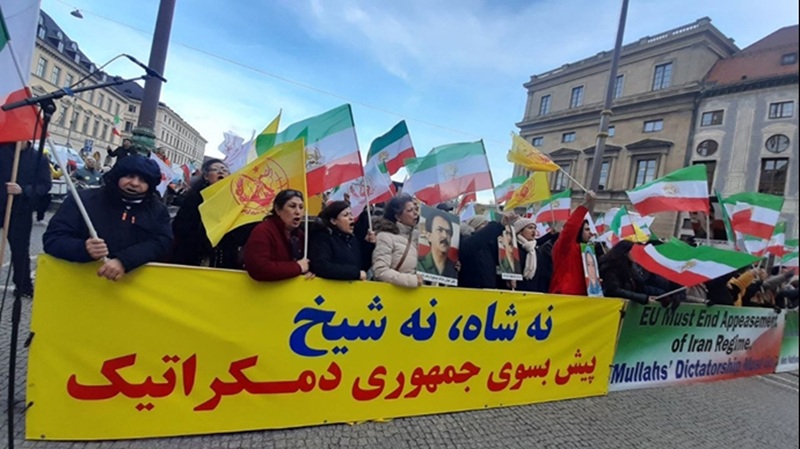

Why Iranians Reject Both Theocratic Rule and the Revival of Monarchical Absolutism
At this critical juncture in Iran’s modern history, the reemergence of monarchical claims—combined with their rhetorical and strategic overlap with narratives long promoted by the Islamic Revolutionary Guard Corps—reveals an unsettling reality: authoritarianism, regardless of its aesthetic or symbolism, speaks a common language. That language is the denial of popular sovereignty and the suppression of oppressed nationalities.
Once again, it becomes evident that the “crown” and the “turban” function not as opposites, but as complementary mechanisms of centralized domination.
While Iranian society grapples with suffocating economic crises and political repression, a curious spectacle unfolds. A self-proclaimed heir to monarchy issues medieval-style pronouncements calling for the suppression of Kurdish political forces, invoking the backing of a notional army. The irony is striking: the implicit audience for such pronouncements appears to be the very military and security apparatus whose hands are already stained with the blood of uprising youth.
The reliance of royalist remnants on supposed “defections” from the IRGC and praise for the regime’s security structures signals a dangerous project—continuity of despotism through cosmetic rebranding. When talk surfaces of tens of thousands of security personnel as a political backbone, the proposed “joint operations room” resembles less a platform for liberation and more a blueprint for resurrecting interrogation chambers reminiscent of figures such as Parviz Sabeti and Asadollah Lajevardi.
One must ask: what distinguishes an IRGC commander from a self-styled prince when both share a common adversary—the right of national self-determination?
For decades, authoritarian structures in Iran—whether draped in clerical robes or royal regalia—have weaponized the specter of “separatism” to suppress legitimate demands from marginalized communities. The synchronicity between royalist rhetoric and statements by hardline figures associated with the IRGC’s external operations branch, the Quds Force, underscores a deeper strategic alignment.
The truth is stark: what despotism fears is not the fragmentation of Iran, but the fragmentation of absolute, centralized power. The principle of self-determination is not a threat to national unity; it is a democratic guarantee of voluntary cohesion and equal citizenship. Invoking “territorial integrity” as a pretext to deny this right merely preserves a fascistic architecture in which a single center—be it monarch or supreme jurist—claims dominion over life and property.
The slogan “Neither Shah Nor Mullahs” is therefore not a mere negation. It is an affirmation of an alternative: a democratic republic. This clear demarcation separates revolution from reaction. Revolution transfers sovereignty to the people; reaction—whether cloaked in religion or hyper-nationalism—seeks to rewind history to eras of monopolized authority.
Those who confront the machinery of repression in Iran’s streets understand a fundamental lesson: freedom cannot be secured through appeasement of security elites or reliance on foreign patronage. It is forged through democratic radicalism incompatible with any form of monarchical fascism.
The vanguard responsibility today is to expose attempts to instrumentalize the blood of uprising martyrs as a ladder back to archaic despotism. Genuine liberation will materialize only when the people of Kurdistan, Baluchistan, and across Iran see themselves not as subjects of a “Shadow of God” nor disciples of a supreme jurist, but as equal citizens in a democratic, non-nuclear republic.
The era of royal decrees and clerical edicts has expired. Tomorrow’s Iran is being shaped in the streets by those who have paid for freedom with their own flesh and blood. Drawing a firm line against monarchical authoritarianism is not merely a political choice; it is a moral and national imperative.
The zero hour is the hour of rejecting all forms of guardianship and affirming the absolute sovereignty of the people. Iran has moved beyond the mullah—and it will not return to the shah. History’s trajectory does not bend backward toward restored absolutism; it advances toward accountable, popular rule.