


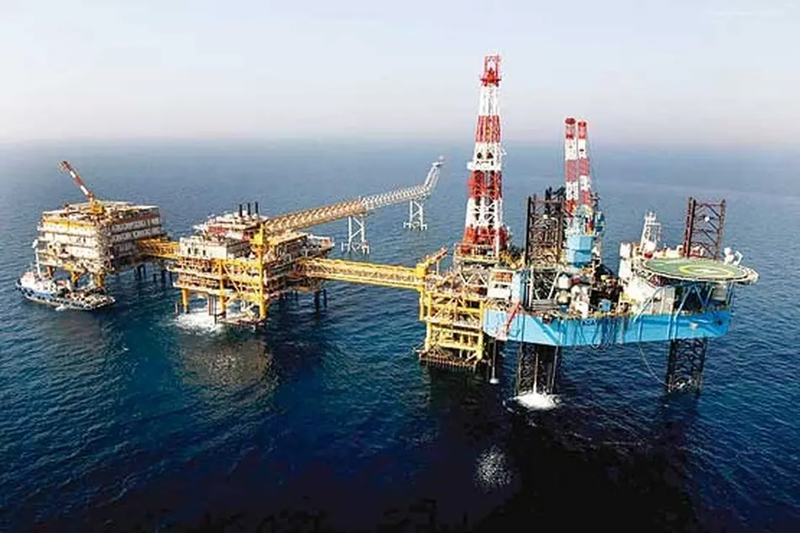

Despite holding some of the world’s largest energy reserves, Iran faces chronic shortages and declining production due to structural mismanagement, militarization of the sector, and lack of investment.
Iran possesses some of the largest oil and natural gas reserves in the world. More than seven decades have passed since the historic nationalization of the country’s oil industry. Yet today, these enormous natural resources have not translated into public prosperity. Instead, they have become part of a deep structural crisis within Iran’s energy economy.
The core of the problem extends beyond sanctions or poor management. At its root lies the political and economic structure of the system dominated by the Velayat-e Faqih, which has removed control over national resources from public oversight and concentrated it within powerful state and military networks.
From Production Powerhouse to Structural Decline
A review of the oil industry’s trajectory over the past four decades reveals a striking gap between potential capacity and sustainable production.
In 1979, the year of Iran’s revolution, the country produced roughly 5.7 million barrels of crude oil per day. During the 1980s—amid the Iran-Iraq War—production collapsed to below two million barrels per day.
While part of that decline was caused by wartime damage, the years following the war failed to produce a long-term industrial development strategy for the sector.
During Iran’s second and third national development plans in the late 1990s and early 2000s, production recovered to around 3.8 to 3.9 million barrels per day, appearing to restore balance in the industry. However, that stability rested heavily on intensive extraction from aging oil fields rather than structural modernization.
Investment in enhanced oil recovery technologies and infrastructure renewal lagged behind. By the mid-2000s, natural pressure decline began affecting Iran’s major fields, reducing potential output by 8–10 percent annually.
The Gap Between Nominal and Real Capacity
Official statistics frequently cite Iran’s nominal oil production capacity at more than four million barrels per day. In practice, however, actual production has fluctuated between three and 3.5 million barrels per day.
This discrepancy created a persistent production gap—at times reaching one to 1.5 million barrels per day. Analysts describe this not as a temporary disruption but as a structural problem reflecting the regime’s inability to mobilize the necessary investment and technical resources.
Maintaining output levels would require $20–25 billion in annual investment, yet such capital injections have consistently failed to materialize. As a result, infrastructure has aged, projects remain unfinished, and an estimated 30–40 percent of the sector’s nominal capacity is effectively unusable today.
Gas Production Growth Masking Structural Weakness
Iran’s natural gas sector presents a similar pattern. In 2024, the country’s gross gas production reached approximately 1,097 million cubic meters per day, representing about 13 percent growth compared to previous levels.
Despite this increase, production has achieved only 36 percent of the targets set in Iran’s Seventh Development Plan.
The Iranian economy relies heavily on natural gas, which supplies over 70 percent of the country’s total energy consumption. This dependence, combined with insufficient storage capacity, leaves the entire energy system vulnerable to seasonal shocks.
During peak winter demand in early 2025, only 25–26 million cubic meters per day were supplied from gas storage facilities—covering roughly three percent of national demand.
As household consumption surged, power plants were forced to switch to liquid fuels, raising electricity production costs and worsening air pollution in major cities.
These recurring cycles demonstrate that Iran’s energy crisis stems not from resource scarcity but from structural policy failures.
Militarization of the Energy Economy
Alongside declining investment and technical deterioration, another transformation has reshaped Iran’s energy sector: its increasing militarization.
The engineering conglomerate Khatam‑al Anbiya Construction Headquarters, originally formed during the Iran-Iraq War, has evolved into the country’s largest contractor in oil, gas, and infrastructure projects.
Operating under the authority of the Islamic Revolutionary Guard Corps, the organization now dominates many major national projects.
Legislative changes during the late 2000s and early 2010s—particularly under Iran’s eighth and ninth parliaments—facilitated the transfer of major contracts to entities affiliated with the IRGC. Non-transparent procurement processes and emergency contracting procedures expanded significantly.
As a result, private sector participation in the energy industry has been pushed to the margins.
Iranian economist Ali‑Mohammad Namazi described this process as effectively “humiliating the private sector,” arguing that monopolization of large-scale projects by military institutions eliminates competition and weakens oversight.
Oil Revenues Outside Transparent Channels
Financial arrangements between the government and military-linked contractors have further complicated transparency.
Large state debts owed to Khatam-al Anbiya have reportedly been settled through barter arrangements involving crude oil and state assets. In practice, this has allowed portions of Iran’s oil exports to occur outside the transparent mechanisms of the national treasury.
According to Article 53 of Iran’s constitution, all state revenues must be deposited into the national treasury. However, critics argue that the use of oil as a settlement tool for internal debts has turned national resources into instruments of political bargaining within the ruling establishment.
When the same institution both executes major projects and receives oil revenues as compensation, a significant conflict of interest emerges.
Social Consequences of Structural Energy Failure
The consequences of these structural issues are increasingly visible in everyday life.
During the winter of 2024–2025, industries across Iran faced gas shortages despite the country’s enormous reserves. Power plants were forced to burn liquid fuels, worsening air pollution and raising production costs.
Households experienced pressure drops in gas supply, while electricity shortages returned during the summer months.
This paradox is striking: a country with some of the world’s largest natural gas reserves struggles to provide reliable heating in winter and stable electricity in summer.
A Resource-Rich Country Facing Institutional Failure
Over the past four decades, Iran’s ruling system has relied heavily on oil and gas revenues to sustain political power networks rather than prioritize transparent economic development.
Productive investment in modernization has repeatedly taken a back seat to political considerations. The result is a widening gap between Iran’s immense resource potential and the daily realities faced by its population.
The nationalization of Iran’s oil industry in the early 1950s, led by Mohammad Mosaddegh, symbolized the idea that the country’s natural wealth should serve the people.
Today, critics argue that the increasing dominance of military-linked institutions over oil projects and exports has hollowed out the meaning of “national” ownership.
Iran’s energy crisis, therefore, is not the story of a country lacking resources. It is the story of a system that has transformed those resources into instruments of monopoly rather than engines of public prosperity.
In a nation where vast reserves remain beneath the ground but decision-making power rests in the hands of a narrow elite, the paradox persists: abundant wealth alongside persistent scarcity for ordinary citizens.