



Decades of warnings, a structured alternative, and a growing resistance point to an internal solution—free from appeasement or foreign intervention
For years, the Iranian resistance has warned the international community about the root of instability in the region—long before today’s crises and current war unfolded. From exposing the regime’s pursuit of nuclear capabilities to revealing its role in regional conflicts, terrorism, and human rights abuses, the pattern has been consistent: the root cause lies in Tehran.
These warnings extended beyond military and security concerns. The resistance repeatedly highlighted how the regime used its diplomatic network abroad as a cover for intelligence and operational activities, while also exposing the illusion of so-called internal reform and the danger of continued appeasement by Western governments. The central argument has remained unchanged: as long as the current regime remains in power, instability will persist both inside Iran and across the region.
More recently, Maryam Rajavi, the president-elect of the National Council of Resistance of Iran (NCRI) has called on the international community to recognize what she describes as the only viable solution to the Iranian crisis. In her view, resolving the situation requires acknowledging a path centered on the overthrow of the regime by the Iranian people and their organized resistance. This approach rejects both foreign military intervention and passive diplomacy, instead emphasizing a structured, domestic movement capable of leading political transformation.
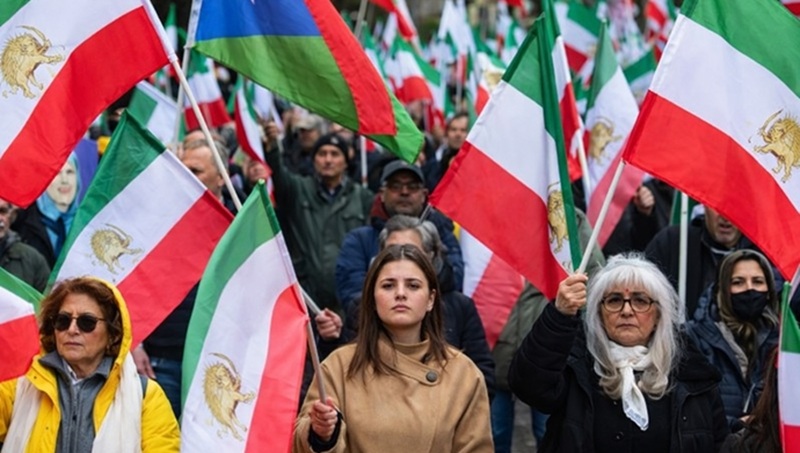
For decades, the regime has promoted a false narrative: that its fall would inevitably lead to chaos. This argument has been used to justify both internal repression and external aggression. At the same time, elements linked to the regime have quietly encouraged the idea of a return to monarchy, attempting to present it as a stabilizing alternative. Yet both scenarios—continued religious rule or a return to hereditary dictatorship—are rejected by a population that has experienced both and seeks neither.
At the center of the proposed alternative stands the NCRI, established in 1981 as a coalition aimed at transferring sovereignty to the Iranian people. The council presents itself as a parliament-in-exile, with a structured political platform and an extensive internal network. It has advanced a detailed roadmap for a democratic transition, including provisions for pluralism, equal rights, and the separation of religion and state.
A key component of this framework is a transitional government designed to oversee a limited transition of power. According to the plan, this interim authority would organize elections for a constituent assembly within six months of the regime’s fall, allowing representatives of the people to draft a new constitution and determine the country’s political future.
Central to the resistance’s strategy is the dismantling of the regime’s primary tool of repression, particularly the Islamic Revolutionary Guard Corps (IRGC), which it identifies as the backbone of authoritarian control and regional destabilization. The movement rejects both the notion that the regime will collapse on its own and the idea that foreign military intervention can produce sustainable change. Instead, it places responsibility squarely on the Iranian people and organized resistance units operating inside the country.
This strategy is grounded in decades of continuous struggle. The Iranian resistance points to its long record of political and social activism, both domestically and internationally, as evidence of its capacity to challenge the regime. It also emphasizes its financial independence and organizational resilience as key factors sustaining its efforts over time.
The political vision underpinning this movement is outlined in the ten-point plan first presented in Europe by Mrs. Rajavi. It calls for a democratic republic based on universal suffrage, gender equality, freedom of expression, the abolition of the death penalty, equal rights for ethnic and religious minorities, and a non-nuclear Iran committed to peaceful coexistence.
The broader message is clear: the future of Iran will not be shaped by external powers, nor by recycled forms of dictatorship. It will be determined by the will of its people and the strength of its organized resistance.
As the regime faces increasing internal and external pressure, the possibility of fundamental change appears closer than at any point in recent years. The situation is unlikely to revert to the status quo. Like the monarchy before it, the current system faces a trajectory that many believe will ultimately end in its fall—driven not by foreign intervention, but by the people it has long sought to suppress.
The resistance and its proposed transitional framework are built on a simple principle: peace and freedom. They reject reliance on foreign funding, weapons, or military presence, instead calling for international recognition of the Iranian people’s right to determine their own political future.
Today, the demands are explicit: an end to executions, the release of political prisoners, unrestricted access to information, and the closure of regime-linked diplomatic missions used for non-diplomatic purposes. For supporters of this vision, the time has come for the international community to move beyond rhetoric and recognize a democratic alternative rooted inside Iran itself.