


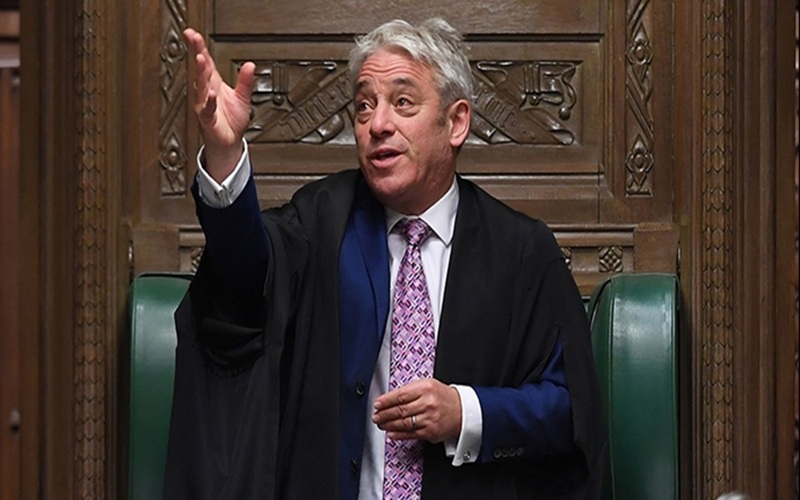

John Bercow warns against recycled alternatives and calls for recognition of organized democratic opposition
In the turbulent aftermath of Ali Khamenei’s death, Iran’s ruling system appears more fragile than at any point in its recent history. The clerical establishment is no longer projecting confidence—it is struggling for survival. At the same time, a parallel dynamic is unfolding: a surge of competing narratives and attempts to manufacture or appropriate alternatives to shape Iran’s political future.
Amid this noise, some international figures are drawing a critical distinction between political theater and structural reality. Among them is John Bercow, who, in an article published in the Express, offers a blunt assessment of the current moment. He argues that Khamenei’s death did not trigger the immediate collapse of the regime, but instead exposed a deeper truth—an entrenched system trapped in a strategic deadlock, incapable of meaningful reform or regeneration.
Bercow’s analysis goes further, challenging what he sees as a recurring mistake among certain Western observers: the tendency to gravitate toward familiar but fundamentally flawed figures. He points specifically to Reza Pahlavi, whose political appeal in some circles rests largely on lineage rather than demonstrated governance capacity. Bercow cautions that hereditary association should not be conflated with political legitimacy or competence, drawing parallels to past international miscalculations where externally favored figures failed to deliver stable outcomes.
His warning is grounded in both historical precedent and contemporary reality. Referencing figures such as Ahmed Chalabi, Bercow underscores how externally amplified alternatives can collapse under the weight of weak domestic legitimacy. More importantly, he points to a clear and repeated message from within Iran itself: the population has consistently rejected both theocratic authoritarianism and any return to monarchy. This sentiment, widely expressed in public protests, reflects a deeper societal demand for a fundamentally different political order.
Against this backdrop, Bercow shifts focus to what he considers credible alternatives—movements that combine organizational depth, political clarity, and a proven track record of resistance. He highlights the Ten-Point Plan proposed by Maryam Rajavi as a structured vision for a democratic republic grounded in universal suffrage.
According to Bercow’s assessment, serious consideration should be directed toward movements that have demonstrated resilience over time rather than those amplified by media attention alone. He points to the National Council of Resistance of Iran as an example of an organized opposition that has sustained itself for decades under intense repression. The scale of sacrifice associated with this movement—thousands of activists subjected to imprisonment, torture, and execution—underscores that it is not a product of convenience, but of sustained political commitment.
In strategic terms, Bercow draws a stark contrast between what he describes as “exhausted forces” and a forward-looking opposition. The former, he argues, lacks both the legitimacy and the capacity to stabilize a collapsing system. The latter offers a qualitatively different alternative—one rooted in structure, sacrifice, and a defined political program.
His conclusion carries clear policy implications. The persistence of status quo thinking in Western capitals, he suggests, is increasingly disconnected from realities on the ground. Rather than attempting to preserve a failing equilibrium or recycling outdated political models, he calls for alignment with emerging forces that reflect the aspirations of the Iranian people.
The post-Khamenei moment is not simply a leadership transition; it is a systemic inflection point. The central question is no longer whether change is inevitable, but which forces are equipped to shape it. As Bercow’s analysis makes clear, distinguishing between illusion and viable political architecture will be decisive—not only for Iran’s future, but for the broader stability of the region.