


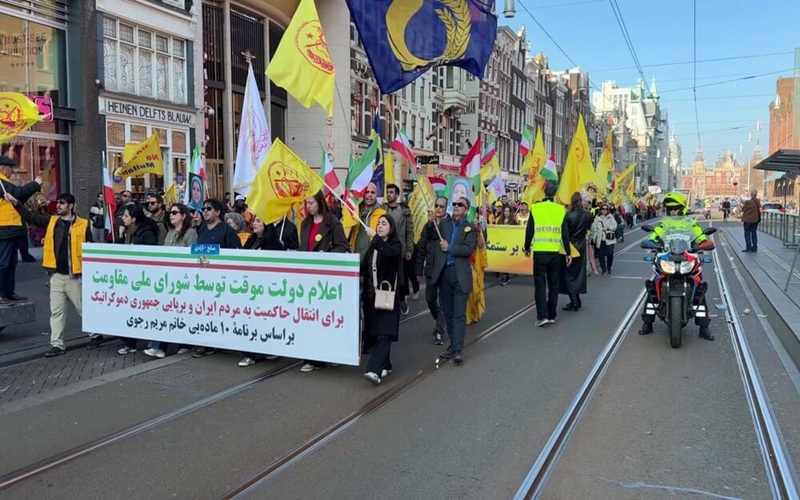

Maryam Rajavi’s strategy reframes the Iran question as a matter of empowering citizens—not external intervention
For nearly three decades, the international approach to Iran has oscillated between two flawed poles: accommodation of the ruling system and the looming threat of military confrontation. Neither has delivered stability, accountability, or meaningful change. Against this backdrop, the democratic alternative articulated by Maryam Rajavi stands out not as an abstract slogan, but as a grounded and actionable strategy.
This approach begins with a fundamental premise: the current ruling system lacks legitimacy. Its record—both domestically and beyond Iran’s borders—has been marked by systemic repression and actions widely condemned as violations of basic human rights. From this perspective, the question is no longer whether change is justified, but how it should be realized.
The answer proposed by the Iranian resistance reframes the debate entirely. Democratic change is not synonymous with a single tactic; it is a spectrum of legitimate pathways through which a population can reclaim sovereignty. At one end lies the possibility of a free and internationally supervised referendum. At the other lies the right to resistance should all peaceful avenues be blocked. The determining variable is not ideology, but the behavior of the ruling system itself.
This conditional framework is critical. If those in power were to allow genuine political participation and transfer authority to the people, the transition could unfold without violence. However, if—as has consistently been the case—every nonviolent avenue is systematically closed, then escalation becomes both predictable and, under international norms, justifiable. In this formulation, responsibility for the trajectory of change rests squarely with those who deny it.
Yet this internal dynamic does not unfold in isolation. External policy choices have played a decisive role in shaping the balance of power between state and society in Iran. The long-standing policy of appeasement by major powers has, in effect, tilted this balance in favor of the ruling system. By prioritizing short-term stability over structural change, these policies have extended the lifespan of a system that might otherwise have faced far greater internal pressure.
More consequentially, such policies have often constrained the very forces capable of driving democratic transformation. The National Council of Resistance of Iran—widely regarded as a principal organized opposition—has faced not only repression from within Iran but also political and legal restrictions abroad. Measures such as terrorist designations in previous years, later overturned, exemplify how international actions have at times aligned, intentionally or not, with the interests of the ruling establishment.
Rajavi has addressed this contradiction directly in international forums, including at the European Parliament. Her message to Western governments has been notably restrained in its demands: do not intervene militarily, but also do not side—actively or passively—with a system that denies its citizens fundamental rights. The call is not for external engineering of Iran’s future, but for the removal of obstacles that prevent Iranians from determining that future themselves.
This position also reframes the debate around war. Military confrontation is often presented as the inevitable alternative to a failing diplomatic track. However, this framing overlooks a crucial causal chain: prolonged appeasement can itself create the conditions under which war becomes more likely. By emboldening hardline elements and delaying internal change, it narrows the space for peaceful resolution until more extreme options dominate the agenda.
The democratic solution, therefore, is neither complex nor utopian. It is rooted in a principle widely accepted in international law and political theory: sovereignty resides with the people. Operationally, this translates into a clear set of policy implications for external actors—non-interference in Iran’s internal struggle in ways that benefit the ruling system, removal of constraints on legitimate opposition movements, and recognition of the Iranian people’s right to pursue change through means consistent with global norms.
What emerges is a strategic recalibration. The issue is not choosing between appeasement and war, but recognizing that both approaches have failed to address the underlying political reality. A sustainable resolution requires shifting agency back to where it belongs—with the Iranian people.
In that sense, the democratic change strategy is not merely an alternative; it is a corrective. It challenges external actors to abandon the illusion that stability can be engineered from above while a society is denied its most basic political rights. And it asserts that the path to a stable, democratic Iran does not run through foreign capitals or military interventions, but through the will and agency of its citizens.