
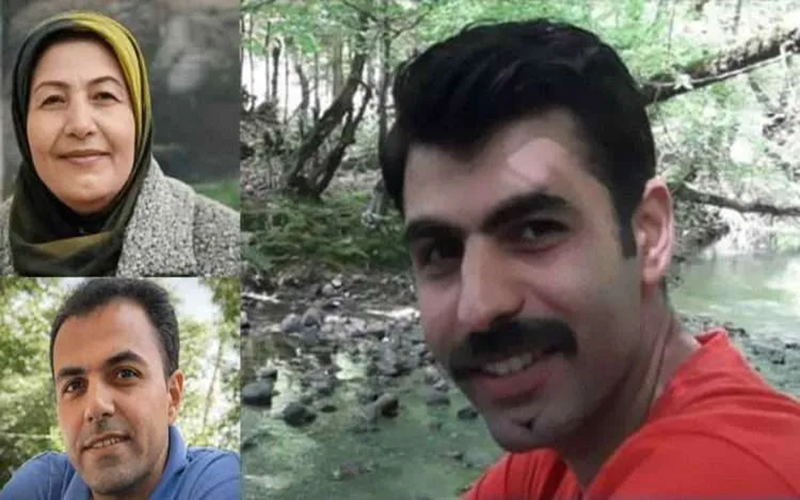

After Babak Alipour’s execution, regime authorities continue to detain his relatives and refuse to return his body, intensifying pressure on grieving families and raising serious human rights concerns.
The continued detention of family members and the refusal to release the body of executed political prisoner Babak Alipour have revealed a deeper pattern of coordinated pressure and enforced silence against his relatives.
Nearly one week after his execution, reports indicate that three close family members remain in custody. Babak Alipour was executed on March 31, yet his family was not only denied a final visit before his death, but has also been prevented from retrieving his body for burial—an act widely seen as an additional layer of psychological punishment.
According to available information, his mother, Ommolbanin Dehghan, his brother, Roozbeh Alipour, and his sister, Maryam Alipour, have been detained since late January. They were arrested in Tehran by the regime’s security forces while returning from a visit with him, in what appears to have been a deliberate effort to isolate the prisoner and silence his immediate support network.
Since their arrest, there has been almost no official communication regarding their condition. The only confirmed update came in the form of a brief message sent to Roozbeh Alipour, informing him that a case had been opened against him on charges of “collusion and conspiracy.” No clear legal status or formal charges have been disclosed for his mother and sister.
Reports suggest that Ommolbanin Dehghan and Maryam Alipour are being held in Qarchak Prison in Varamin, a facility long criticized by human rights organizations for its harsh and inadequate conditions. Roozbeh Alipour, meanwhile, is reportedly being interrogated in Ward 209 of Evin Prison, a section known for housing political detainees under the control of security agencies.
Ommolbanin Dehghan, 63, had been active in the “No to Execution Tuesdays” campaign, a grassroots movement opposing the death penalty that has drawn participation from families of prisoners and civil society activists. Her son Roozbeh had previously served a two-year sentence on charges of “insulting the Supreme Leader” and had only recently been released before being detained again.
The treatment of the Alipour family reflects a broader pattern. Not only were they denied a final meeting with Babak before his execution, but the regimes’ authorities have also withheld his body—an increasingly reported practice in political cases. This approach appears designed to intensify emotional distress and prevent public mourning or gatherings that could draw attention to such executions.
Babak Alipour had been sentenced to death alongside five other prisoners—Vahid Bani-Amerian, Mohammad Taghavi, Pouya Ghobadi, Abolhassan Montazer, and Akbar Daneshvar Kar. All were executed over a span of several days in recent week, following what critics describe as opaque and expedited judicial proceedings.
The rapid implementation of these sentences, combined with the lack of transparency around their timing, has raised serious concerns about due process. In multiple cases, families have reported that they were not informed in advance and only learned of the executions after they had already been carried out.
Taken together, the detention of family members, denial of final visits, and withholding of bodies point to a systematic strategy aimed not only at punishing individuals but also at extending repression to their families. These measures deepen the climate of fear while drawing increasing scrutiny over the judicial and human rights practices surrounding political prisoners in Iran.