



Politicians, civil society groups, and activists criticize perceived contradictions between his democratic claims and unresolved ties to Iran’s monarchical past
Reports from Italy indicate a growing wave of widespread protests and criticisms toward the recent visit of Reza Pahlavi, reflecting unease not only among political and civil groups but also within factions close to the Italian government.
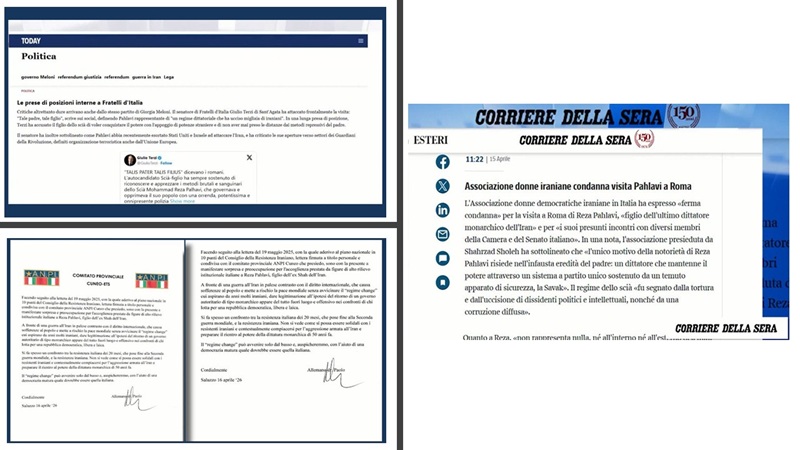
According to the Italian outlet Today Politica, the visit has drawn sharp criticism from members of the ruling party led by Giorgia Meloni. Among the most vocal critics is Giulio Terzi, a senator from the Brothers of Italy party, who openly denounced Pahlavi’s presence, describing him as a representative of a dictatorial regime.
Terzi invoked an Italian proverb—“like father, like son”—to underscore his point, referencing the record of Iran’s former monarchy under Mohammad Reza Shah. He emphasized that the former regime was responsible for the repression and killing of thousands, adding that Pahlavi has yet to clearly distance himself from that legacy. Terzi further accused him of seeking power through reliance on foreign backing while failing to explicitly reject past authoritarian practices.
Criticism Over Contradictions and Foreign Alignment
Terzi also pointed to Pahlavi’s recent positions on regional developments, noting his support of military actions against Iran. He argued that such positions stand in direct contradiction to claims of advocating freedom and democracy. Additionally, the senator criticized alleged links between Pahlavi and elements of the Islamic Revolutionary Guard Corps, an institution currently under European sanctions.
Parallel criticism came from Elisabetta Zamparutti, a member of the executive council of Italy’s Radical Party and a former parliamentarian. She questioned the timing and intent of Pahlavi’s visit, suggesting that unsuccessful attempts to gain a platform in the European Parliament may have led him to shift focus toward Italy.
Zamparutti stressed that while Pahlavi presents himself as a democratic alternative to Iran’s current regime, he has not meaningfully distanced himself from a past marked by repression, torture, and systemic human rights violations. “He has not only failed to break from that past,” she stated, “but in some cases has openly defended it,” referring to his recent remarks in Sweden that triggered public backlash.
She further argued that genuine democracy requires a clear rupture from all forms of authoritarianism, warning against ignoring the historical impact of the Shah’s regime on millions of Iranians. Addressing Pahlavi’s suggestions about managing a future Iran with the involvement of existing security structures, Zamparutti highlighted the inconsistency of such proposals, particularly regarding the IRGC, given its sanctioned status within the European Union.
“I remain convinced,” she added, “that the Iranian people will not achieve full freedom if a crown replaces the turban,” emphasizing that Iranians have already paid a heavy price for externally imposed systems of governance.
Civil Society and Historical Memory
Zamparutti also underscored that meaningful support for the Iranian people lies in backing forces that oppose both monarchy and the current theocratic regime. She pointed to grassroots movements such as the “No to Execution Tuesdays” campaign in Iranian prisons as examples of authentic resistance emerging from within society, rather than from formal political circles.
In a separate development, the Italian Association of Anti-Fascist Partisans in the city of Cuneo issued a statement condemning Pahlavi’s visit. The organization argued that granting legitimacy to the son of a former Shah undermines the ongoing struggles of Iranians seeking a democratic, secular republic.
Drawing parallels with Italy’s own anti-fascist resistance during World War II, the association stressed that genuine solidarity with the Iranian people cannot align with support for the restoration of a monarchical system. The statement further emphasized that any political transformation in Iran must originate from within the country, warning against externally imposed alternatives.
Women’s Groups and Broader Opposition
Criticism also came from the Iranian Democratic Women’s Association in Italy, whose statement—reported by Corriere della Sera—strongly condemned the visit. The group argued that Pahlavi’s prominence is rooted primarily in his father’s legacy, a system characterized by one-party rule, political repression, and reliance on the notorious SAVAK security apparatus.
The association cited historical accounts of torture, killing of opponents, and widespread corruption during that era, while also criticizing Pahlavi’s recent statements in Sweden. According to the group, he not only refrained from condemning the former regime but described aspects of it as a source of pride.
They further accused him of repeatedly calling for foreign intervention, including military action against Iran, and of referencing connections with figures inside the IRGC.
The statement concluded that the majority of Iranians, as demonstrated in recent nationwide protests, reject both forms of dictatorship—monarchical and religious. It warned that legitimizing the son of a former dictator risks reinforcing the Iranian regime’s narrative that popular protests are driven by foreign interference.
A Controversial Visit
Taken together, these reactions illustrate the depth of concern surrounding Reza Pahlavi’s visit to Italy. The criticism converges on three core issues: unresolved questions about his stance toward the Shah-era legacy, perceived inconsistencies in his current political positions, and a broader insistence that Iran’s future must be determined by its people—not external actors or inherited power/authority.
The episode underscores the sensitivity and complexity of representing democratic alternatives to the Iranian regime on the international stage, particularly when historical memory and contemporary politics intersect so sharply.