



As Tehran clings to threats abroad, its deepest vulnerability lies in the streets at home—where organized resistance is reshaping the balance of power
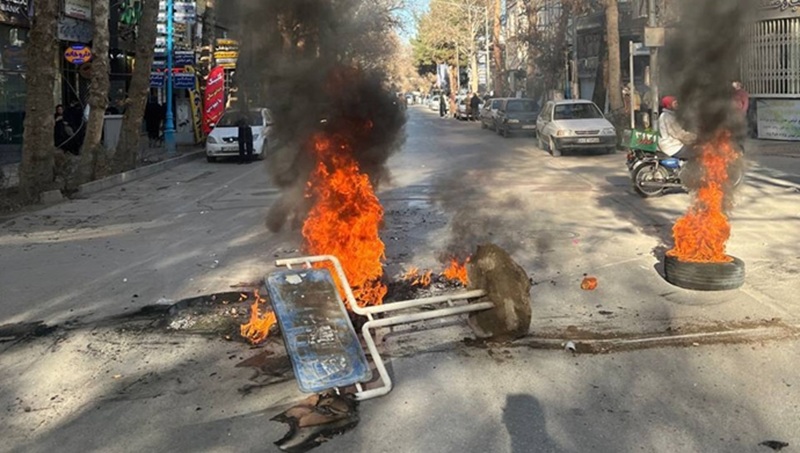
In the political lexicon of Iran’s ruling system, the closure of the Strait of Hormuz has long been invoked as a strategic deterrent—a pressure point against external adversaries. Today, however, the primary nightmare haunting the regime’s security apparatus is not in distant waters, but embedded in the very pavement of Iran’s cities. The system now faces a far more immediate and existential paradox: the “Street Strait”—a domestic chokepoint which, if lost, could unravel the entire architecture of power.
To justify its persistent use of violence, the regime increasingly treats public space as if it were occupied territory. Streets are no longer civic arenas; they are militarized zones requiring constant surveillance and force projection. This posture is not theoretical—it is openly articulated by senior officials.
Ahmad Alamolhoda, in a sermon delivered in Mashhad on December 5, 2025, warned explicitly: “The enemy is waiting to take the streets from us; if the Basij and Hezbollah forces do not maintain a strong and physical presence in public spaces, agitators will exploit these openings to strike at the very foundation of the system.”
Similarly, Ahmad-Reza Radan, commander of Iran’s Law Enforcement Forces, reinforced this doctrine during a gathering of special units in January 2026: “Presence in the field is not optional. Any leniency in controlling the streets is equivalent to giving hostile elements the opportunity to ignite an uprising.”
These statements are not mere rhetoric—they reflect an institutionalized fear. The ground beneath the regime is perceived as unstable, constantly at risk of rupture.
A System Turning Inward
Amid this political deadlock, Iran’s regime has taken a decisive step toward consolidation through succession. The appointment of Mojtaba Khamenei as Supreme Leader effectively transforms the system into what can only be described as a hereditary clerical monarchy.
For more than three decades, Mojtaba Khamenei has operated behind the scenes—linked to the orchestration of repression, economic exploitation, and regional proxy operations. Now elevated to the apex of power, he represents not renewal, but contraction: a narrower, more fragile version of an already strained authority.
Efforts to project strength—whether through threats to close the Strait of Hormuz or reliance on proxy groups—mask a deeper strategic deficit. Installing a weaker successor is less a demonstration of continuity than an implicit admission that the regime lacks viable pathways to long-term survival.
The Rise of Organized Resistance
Opposing this apparatus of repression is a structured and expanding force embedded across Iran’s provinces. Resistance Units and the so-called Liberation Army have evolved into operational networks capable of sustained, coordinated action.
Over the past year alone, these groups have reportedly carried out more than 3,000 anti-repression operations, targeting institutions and symbols of state control. During successive waves of protests, they have played a decisive role in directing momentum and focusing public anger toward key centers of authority.
The cost has been significant. In recent uprisings, more than 2,000 individuals associated with these networks have reportedly been killed or disappeared. Yet rather than extinguishing dissent, these losses have intensified it—transforming localized grievances into a broader, organized movement.
The Decisive Battleground
A regime that had already entered its terminal phase under Ali Khamenei is unlikely to secure its survival through dynastic succession. The central conflict in Iran today is no longer defined by external threats, but by a stark internal contradiction: the regime’s machinery of repression versus the organized will of resistance, converging in the “Street Strait.”
Authorities attempt to buy time through the militarization of cities and the expansion of executions. But these measures address symptoms, not causes. The decisive reality is unfolding at street level—where control is contested daily and legitimacy is continuously eroded.
The Resistance Units have demonstrated that organized defiance, when strategically directed, can bypass traditional barriers of repression. The trajectory suggests that the regime’s fate will not be determined in maritime chokepoints like the Strait of Hormuz, but in the streets it struggles to dominate.
Before it can leverage external crises for survival, the system may find itself overwhelmed internally—its authority dissolved by the very society it seeks to control.
In that contest, the outcome will belong to those who have proven willing to sacrifice everything for freedom.